Sack of Aleppo (1400)
The Sack of Aleppo in 1400 stands as one of the most devastating episodes of the conflict between the Timurid Empire and the Mamluk Sultanate. Led by the conqueror Timur, the Timurid forces unleashed a campaign of systematic destruction that reshaped the landscape of northern Syria and signaled a period of immense suffering for the region's inhabitants.
Key Facts
- Date: October–November 1400.
- Location: Aleppo, Mamluk Sultanate (modern-day Syria).
- Outcome: Decisive Timurid victory.
- Mamluk Strength: Estimated between 30,000 and 35,000 soldiers.
- Casualties: Small for the Timurids; catastrophic for Aleppo's civilian population.
- Notable Atrocities: Massacres of civilians and the construction of a tower made from 20,000 skulls.
The Road to Aleppo
Before descending upon Aleppo, Timur's Mongol forces conducted a sweeping invasion through Armenia and Georgia. Their momentum continued as they captured the cities of Sivas, Malatya, and Aintab. As they approached Aleppo, Timur employed a cautious strategy, ordering the construction of fortified camps every night to secure his position.
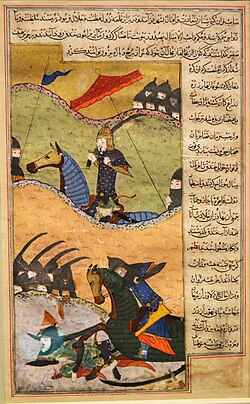
Historical accounts from the 15th-century Sufi historian Abd al-Rahman al-Bistami describe the arrival of Timur's army on October 24, 1400 (the fifth of Rabi' I of 803), characterizing the force as a destructive wave that brought pillaging and horror to the golden fields of Aleppo.
The Battle for the City
The Mamluk Sultanate attempted to defend the city by assembling a formidable force of 30,000 to 35,000 soldiers. For the first two days of the encounter, the two armies engaged in minor skirmishes. However, by the third day, the Syrian commanders decided to commit to a full-scale engagement.
Tactics and Combat
Timur utilized a sophisticated tactical approach, employing his cavalry to move in arc shapes to strike the Mamluk flanks. Meanwhile, his center remained steadfast, bolstered by the presence of war elephants brought from India. While some Mamluk leaders fought bravely—most notably Al-Mu'ayyad Shaykh, the regent of Tripoli, and Emir İzzeddin Özdemir and his son Emir Uzbek Yasbek—they were eventually overwhelmed. The fierce cavalry charges forced the Mamluk army, led by the governor of Aleppo, Tamardash, to break formation and retreat toward the city gates.
The Fall and Destruction of Aleppo
The city's defenses collapsed quickly. The destruction of Aleppo began on October 30, 1400, and concluded with the city's formal surrender on November 2. What followed was a period of extreme brutality. Timur ordered the massacre of a vast number of inhabitants and commanded the construction of a tower consisting of 20,000 human skulls outside the city walls.
Chroniclers such as Ibn Taghribirdi and Ibn Arabshah recorded horrific atrocities committed by the Timurid soldiers. These included the mass rape of women and the slaughter of children, often occurring within the sanctuary of the Great Mosque and other smaller mosques, while male relatives were tortured and forced to witness the violence.
Aftermath and Regional Collapse
The fall of Aleppo left the rest of Syria vulnerable. Following the victory, Timur's forces pushed south, capturing Hama, Homs, and Baalbek. The campaign culminated in the sack of Damascus in December 1400. Damascus capitulated without a major battle after the Mamluk Sultan, Nasir-ad-Din Faraj, engaged in only minor skirmishes before fleeing back to Cairo, claiming he needed to address internal political rivals.
Several high-ranking Mamluk officials were captured and put in chains, including the regents of Damascus (Sudun), Aleppo (Tamardash), Gaza (Omar bin Tahhani), and Baalbek (Altunboga Osmani), as well as Sheikh Ali El Haseki.
| Category | Timurid Empire | Mamluk Sultanate |
|---|---|---|
| Primary Leader | Timur | An-Nasir Faraj / Tamardash |
| Troop Strength | Unknown | 30,000–35,000 |
| Key Tactics | Flanking cavalry & Indian elephants | Defensive positioning |
| Outcome | Victory & Occupation | Defeat & Mass Casualties |
| Key Prisoners | N/A | Tamardash, Sudun, Al-Mu'ayyad Shaykh |
Frequently Asked Questions
When did the Sack of Aleppo take place?
The events occurred between October and November 1400, with the city's destruction beginning on October 30 and ending with its surrender on November 2.
What military tactics did Timur use to win the battle?
Timur used a combination of a firm center—which included war elephants from India—and swift cavalry movements that attacked the Mamluk flanks in arc shapes.
Who were the primary belligerents in this conflict?
The conflict was fought between the Timurid Empire, led by Timur, and the Mamluk Sultanate, led by Sultan An-Nasir Faraj.
What happened to the Mamluk leaders after the city fell?
Several key regents and leaders, including Tamardash of Aleppo and Sudun of Damascus, were captured by the Timurid forces and held in chains.
What was the fate of the civilian population in Aleppo?
The civilian population suffered immensely; many were massacred, and women and children were subjected to widespread violence and rape, particularly within the city's mosques.