Rusk County History: From Wilderness and Logging to Modern Industry
The landscape of Rusk County, Wisconsin, was once a vast forested wilderness, serving as a crossroads for various Native American nations who used its rivers for travel, camping, and burial grounds. The recorded European history of the region began in 1767 when English explorer Jonathan Carver ascended the Chippewa River during his journey from the Mississippi to Lake Superior. By 1790, the Ojibwe established control over the area after defeating Lakota warriors, maintaining their presence throughout the lucrative fur trade era.
The Era of Logging and Early Settlement
European-American settlement took root in 1847 when Adolph La Ronge and his wife arrived from Canada, settling near an existing Indian village. This area, near the current site of the St. Francis of Assisi Mission Church, became a gateway for further expansion. By the 1860s, the Daniel Shaw Lumber Company had established a farm to support its growing operations.
The early economy was driven by the harvest of white pine. Loggers spent winters cutting the finest timber, then used the spring and early summer floods to drive massive log rafts downriver to sawmills in Eau Claire and Chippewa Falls. To transport supplies, they initially used bateaux (flat-bottomed boats) before carving "tote roads" through the brush for oxen and horse teams.
Notable early routes included the Chippewa Trail and the 101 Tote Road. By 1880, the Chippewa Trail had evolved into a stage road featuring rough inns every five miles, providing essential resting points for lumberjacks traveling to and from remote camps.
The Arrival of the Railroads
The transportation landscape shifted dramatically in 1884 with the arrival of the railroads. The Mississippi River Logging Company introduced the first locomotive, while the Chippewa River and Menomonie Railroad (CR&M) laid tracks to haul logs from areas where streams were too small for floating. The CR&M was particularly known for constructing massive wooden trestles near Deer Lake and Star Lake.
Simultaneously, the Minneapolis, St. Paul and Sault Ste. Marie Railroad (the Soo Line) began building a route to connect the Twin Cities' grain with shipping ports at Sault Ste. Marie. The Soo Line and CR&M met at Apollonia, which briefly became the largest town in the region with 350 residents in the 1890s.
The Soo Line facilitated the growth of several towns, including Weyerhaeuser, Bruce, Ladysmith (then called Warner), Tony (then Deer Tail), Glen Flora (then Miller's Siding), Ingram, and Hawkins. This rail infrastructure was critical when the industry shifted from floating pine to transporting hardwoods, which did not float as effectively.
The Formation of Rusk County
Rusk County was officially created in 1901 when the Wisconsin legislature split the northern half of Chippewa County. Initially named Gates County after land speculator James L. Gates—who promised a $1,000 donation that never materialized—the state renamed it Rusk County in 1905. The name honors Jeremiah M. Rusk, a former Governor of Wisconsin and the first U.S. Secretary of Agriculture.
Ladysmith (originally Corbett) was designated as the county seat, a decision that was so contentious it was challenged in the state supreme court. The region's connectivity further improved in 1905 when the Wisconsin Central Railroad built a line from Chicago toward Superior, intersecting the Soo Line at Ladysmith and spawning hamlets such as Sheldon, Conrath, Crane, and Murry.
Economic Transition and the Great Depression
As the pine log drives ended around 1906, the economy transitioned toward hardwood lumbering, which peaked between 1905 and 1915. Following the decline of timber, the region saw various failed attempts at large-scale ranching and mining, though a paper mill in Ladysmith succeeded. Hydroelectric power also became a staple, with the Big Falls Dam built around 1920.
Cut-over land was sold to settler-farmers who cleared stumps using fire and dynamite to create 40- and 80-acre family farms. These farms shifted the role of sawmill towns toward providing creameries, feed mills, and general stores.
The Great Depression brought severe hardship, leading to the failure of banks in Tony, Ingram, Glen Flora, and Weyerhaeuser. However, this era also brought New Deal progress. The Rural Electric Administration helped bring power to farms via Jump River Electric, and the Civilian Conservation Corps (CCC) established a camp in 1933. CCC workers, many from Chicago, fought fires and planted trees until the camp disbanded during WWII.
Education and Modern Development
Education began with one-room rural schools, such as the Bear Lake school established by 1891. At its peak, the county had 125 rural schools. The Rusk County Normal School in Ladysmith operated from 1907 to 1948, training 719 teachers. By 1960, most rural schools were consolidated into larger town districts.
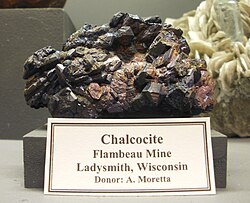
In the late 20th century, the region faced environmental and economic challenges. The Flambeau Mine, an open-pit operation that produced copper, gold, and silver from 1991 to 1999, was highly controversial due to its proximity to the Flambeau River. After closing, the pit was back-filled and reclaimed with native plants, and it now serves as a public walking trail.
Key Facts
- Established: Created in 1901 (originally as Gates County); renamed Rusk County in 1905.
- Primary Early Industry: White pine logging, transitioning to hardwoods around 1900.
- Key Infrastructure: The Soo Line and Wisconsin Central Railroads were pivotal for town development.
- Mining Output: The Flambeau Mine produced 181,000 tons of copper, 334,000 oz of gold, and 3.3 million oz of silver.
- Education: Once home to 125 rural schools and a Normal School that trained 719 teachers.
| Period/Year | Event/Development | Impact |
|---|---|---|
| 1767 | Jonathan Carver's visit | First recorded European visit |
| 1847 | Adolph La Ronge arrives | Start of European-American settlement |
| 1884 | Railroads arrive | Shift from river drives to rail transport |
| 1901-1905 | County Formation | Split from Chippewa County; named after Jeremiah M. Rusk |
| 1933 | CCC Camp established | Environmental conservation and employment during Depression |
| 1991-1999 | Flambeau Mine operation | Significant mineral extraction and subsequent reclamation |
Frequently Asked Questions
Why was the county originally called Gates County?
It was named after James L. Gates, a Milwaukee land speculator and major land-holder in the area, who promised to donate $1,000 to the new county if it bore his name. When he failed to provide the funds, the legislature renamed it Rusk County in 1905.
How did the railroad change the logging industry in Rusk County?
Railroads allowed loggers to transport hardwoods, which did not float as well as pine, to markets. This shifted the economy away from river-based log drives and led to the creation of several sawmill towns along the Soo Line.
What was the purpose of the Rusk County Normal School?
The Normal School, which operated in Ladysmith from 1907 to 1948, was dedicated to training qualified teachers for the region's extensive network of rural schools.
What happened to the Flambeau Mine after it closed?
Following its closure in 1999, the mine underwent a reclamation phase where the 2,600-foot long pit was back-filled and planted with native vegetation. It is now open to the public as a series of walking trails.
Who are the major employers in Rusk County today?
Current major employers include Weather Shield in Ladysmith, the Rusk County administration, local school districts, Wal-Mart, Artisans, the Ladysmith medical center, and Rand Trucking.