Royal Army Chaplains' Department
The Royal Army Chaplains' Department (RAChD) is an all-officer branch of the British Army dedicated to providing spiritual and pastoral care. Comprising both ordained clergy and non-religious chaplains, the department ensures that soldiers receive support regardless of their faith or belief system. Operating under the motto "In this Sign Conquer," the RAChD serves as a vital pillar of emotional and spiritual resilience within the armed forces.
Key Facts
- Established: 23 September 1796.
- Role: Providing multi-faith and non-religious pastoral care to British Army personnel.
- Unique Status: Chaplains are commissioned officers who do not carry arms and possess no executive authority.
- Leadership: Headed by the Chaplain General.
- Patron: Queen Camilla.
- Headquarters: Currently based at Beckett House, Shrivenham, Oxfordshire.
History and Evolution
The department was formally established by Royal Warrant on 23 September 1796. Prior to this, chaplains were attached to individual regiments rather than a centralized establishment. The department's inclusivity has grown steadily over two centuries: while only Anglican chaplains were initially recruited, Presbyterians were recognized in 1827 (and commissioned by 1858), followed by Roman Catholics in 1836, Methodists in 1881, and Jewish chaplains in 1892.
The two World Wars saw significant sacrifice from the department. During the First World War, approximately 4,400 chaplains were recruited, with 179 losing their lives. In recognition of their service, the department was granted the "Royal" prefix in February 1919. The Second World War claimed the lives of another 96 British and 38 Commonwealth chaplains.
The RAChD has moved its headquarters several times to meet evolving needs. From 1946 to 1996, it was located at Bagshot Park, Surrey. It then moved to Amport House near Andover in 1996, and since 2020, it has been based at Beckett House within the Defence Academy of the United Kingdom.
Role and Responsibilities
Army chaplains provide pastoral care to all soldiers, regardless of their denomination or lack of faith. While they wear the uniform of a commissioned officer, they occupy a unique position: they do not carry weapons and do not exercise command authority over other soldiers. Despite their non-combatant status, many have shown immense bravery; four chaplains have been awarded the Victoria Cross, the highest award for gallantry: James Adams, Noel Mellish, Theodore Hardy, and William Addison.
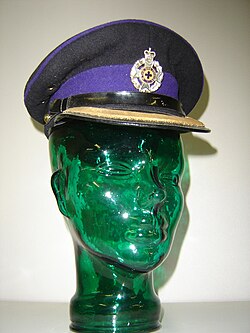
The department maintains distinct traditions, including the use of different cap badges for Christian and Jewish officers. For Jewish padres, the traditional Maltese Cross is replaced by the Star of David.
Faith and Belief Diversity
The Ministry of Defence recognizes a wide array of endorsing authorities to ensure representative care. These include various Christian denominations (Anglican, Baptist, Methodist, Roman Catholic, etc.), as well as Buddhist, Hindu, Jewish, Muslim, and Sikh faiths. Reflecting the changing demographics of the UK and HM Forces, the Ministry of Defence announced in November 2023 the intent to recruit Non-Religious Pastoral Support Officers to support humanists, agnostics, and atheists.
Selection, Training, and Rank
Candidates for the RAChD, whether regular or reserve, undergo a rigorous selection process. This begins with a familiarization visit to an Army camp, followed by physical and mental assessments at the Army Officer Selection Board at Leighton House, Westbury. Training is then completed at the Royal Military Academy Sandhurst and the Armed Forces Chaplaincy Centre at Beckett House.
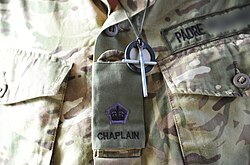
Unlike other officers, chaplains do not hold standard military ranks. Instead, they are designated as Chaplain to the Forces (CF) and are traditionally addressed as "Padre." However, they hold grades that equate to standard ranks for administrative and seniority purposes.
| RAChD Designation | Equivalent Army Rank |
|---|---|
| Chaplain-General (CG) | Major-General |
| Deputy Chaplain-General (DCG) | Brigadier |
| Chaplain to the Forces 1st Class (CF1) | Colonel |
| Chaplain to the Forces 2nd Class (CF2) | Lieutenant-Colonel |
| Chaplain to the Forces 3rd Class (CF3) | Major |
| Chaplain to the Forces 4th Class (CF4) | Captain |
The Royal Army Chaplains' Museum
The history of the department is preserved at the Royal Army Chaplains' Museum in Shrivenham. Opened on 17 May 2022 by the Countess of Wessex, the museum features a curated collection that was previously housed at the Museum of Army Chaplaincy in Amport House.
Frequently Asked Questions
Do Army chaplains carry weapons?
No. Army chaplains are unique within the British Army in that they do not carry arms, reflecting their role as non-combatant providers of spiritual and pastoral care.
What is the difference between a chaplain's grade and a rank?
Chaplains do not hold nominal military ranks (like Captain or Major). Instead, they use the title Chaplain to the Forces (CF) with a class designation (1st through 4th) that equates to a specific military rank for seniority and pay.
Can non-religious people become chaplains?
Yes. In November 2023, the Ministry of Defence announced the intent to recruit Non-Religious Pastoral Support Officers to better reflect the diverse beliefs of the UK population and military personnel.
How are chaplains addressed?
Regardless of their grade or equivalent rank, chaplains are usually addressed as "Padre."
What is the significance of the RAChD motto?
The motto "In this Sign Conquer" refers to the vision seen by the Roman Emperor Constantine before the Battle of the Milvian Bridge.