Royal Armoured Corps: The Steel Fist of the British Army
The Royal Armoured Corps (RAC) serves as the primary armoured arm of the British Army. Tasked with delivering heavy firepower and critical reconnaissance, the RAC provides the UK with its essential armour capability. Operating alongside the Household Cavalry, the RAC utilizes advanced machinery—including the Challenger 2 and Challenger 3 main battle tanks—to execute complex armoured warfare and reconnaissance missions.
Headquartered at the Bovington Garrison, the corps is a diverse organization comprising both regular and reserve regiments. While the Household Cavalry Regiment provides armoured capabilities, it remains a separate administrative formation and is not part of the RAC.
Key Facts
- Established: 4 April 1939.
- Primary Role: Armoured warfare, reconnaissance, and CBRN (Chemical, Biological, Radiological, and Nuclear) defense.
- Current Strength: 14 regiments (10 Regular, 4 Army Reserve) as of September 2024.
- Primary Vehicles: Challenger 2, Challenger 3, and Ajax.
- Headquarters: Bovington Garrison.
- Current Commander: Maj-Gen Nicholas C. L. Perry, DSO, MBE (Colonel Commandant).
History and Evolution
The RAC was formed on the eve of World War II in 1939. It was created by merging the Royal Tank Corps (which became the Royal Tank Regiment) with mechanised cavalry regiments of the line. As the conflict progressed, the corps expanded rapidly, absorbing more mechanised cavalry, Territorial Army Yeomanry units, and several infantry battalions that converted to armoured roles.
By 1944, the corps further broadened its scope by absorbing the regiments of the Reconnaissance Corps, cementing its role as the British Army's center for mobile, protected warfare.
Modern Structure and Regiments
The Royal Armoured Corps is categorized by the type of vehicle and role each regiment performs. These are divided into three primary specializations:
- Armour: Regiments operating main battle tanks.
- Armoured Cavalry: Regiments utilizing reconnaissance vehicles.
- Light Cavalry: Regiments employing Weapons Mount vehicles.
The corps maintains a strategic pairing system between Regular and Reserve units. This alignment ensures that operational and training cycles are synchronized, allowing for shared resources and increased strategic depth.
Regular Army Units
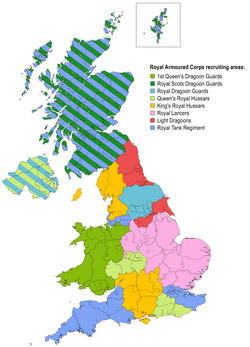
The regular force consists of three armoured, three armoured cavalry, and three light cavalry regiments. Notable units include the Royal Tank Regiment, the King's Royal Hussars, and the 1st The Queen's Dragoon Guards. Additionally, a specialized CBRN reconnaissance and survey squadron from the Royal Tank Regiment is integrated into the 28 Engineer Regiment (C-CBRN) of the Royal Engineers.
Army Reserve (Yeomanry)
The reserve component consists of four Yeomanry regiments: the Royal Yeomanry, Queen's Own Yeomanry, Scottish and North Irish Yeomanry, and the Royal Wessex Yeomanry. The Royal Wessex Yeomanry is unique in that it provides replacement soldiers for all three regular armoured regiments.
| Regular Army Unit | Paired Army Reserve Unit |
|---|---|
| 1st The Queen's Dragoon Guards | Royal Yeomanry |
| Royal Scots Dragoon Guards | Scottish & North Irish Yeomanry |
| Light Dragoons | Queen's Own Yeomanry |
| King's Royal Hussars | Royal Wessex Yeomanry |
| Queen's Royal Hussars | Royal Tank Regiment (Reserve Support) |
Strategic Reorganisations
The RAC has undergone several major transformations to adapt to changing global security needs:
- Delivering Security in a Changing World (2004): This shift saw armoured regiments move from Germany back to the UK and the introduction of Interim Medium Armour Squadrons.
- Army 2020 (2010/2012): This reform reduced the army's size and amalgamated several units, such as the 9th/12th Royal Lancers and the Queen's Royal Lancers into the Royal Lancers. It also established the "Reaction Force" (high readiness) and "Adaptable Force" (resource pool).
- Future Soldier (2021): The most recent reform reorganized the corps into the 1st (UK) Division (focused on operations outside Europe and NATO flanks) and the 3rd (UK) Division (the main reaction force for NATO).
Frequently Asked Questions
Is the Household Cavalry part of the Royal Armoured Corps?
No. While the Household Cavalry Regiment provides armoured capabilities to the British Army, it is a separate administrative formation and is not part of the RAC.
What are the primary vehicles used by the RAC?
The corps utilizes the Challenger 2 and Challenger 3 main battle tanks, as well as Ajax reconnaissance vehicles.
What is the role of the Yeomanry in the RAC?
The Yeomanry consists of Army Reserve regiments that are paired with regular units to provide reinforcements, strategic depth, and shared training resources.
Where is the Royal Armoured Corps headquartered?
The RAC is headquartered at the Bovington Garrison, which also houses the Armour Centre.
What is CBRN defense in the context of the RAC?
CBRN stands for Chemical, Biological, Radiological, and Nuclear defense. The RAC provides specialized reconnaissance and survey capabilities in these hazardous environments through a dedicated squadron within the Royal Tank Regiment.