Rotorcraft Classes: From Helicopters to Rotor Kites
Rotary-wing aviation encompasses a diverse range of aircraft that utilize rotating blades to generate lift. Unlike fixed-wing aircraft, which rely on forward velocity to move air over a stationary wing, rotorcraft use spinning rotors to achieve flight. These machines vary significantly in how they are powered, how they maintain stability, and how they transition between hovering and forward flight.
Key Facts
- Helicopters are the only class capable of fully powered vertical takeoff, landing, and hovering.
- Autogyros use unpowered rotors in a state of autorotation to create lift.
- Gyrodynes combine engine-driven rotors for takeoff with propellers for efficient cruise speeds.
- Rotor kites are entirely unpowered aircraft that must be towed or dropped to fly.
- Juan de la Cierva invented the autogyro in 1920.
Helicopters
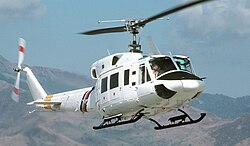
A helicopter is a powered rotorcraft where the engine drives the rotors throughout the entire flight. This capability allows the aircraft to take off and land vertically, hover in place, and move in any direction—forward, backward, or laterally. Depending on the design, helicopters may utilize one or more main rotors.
Because a spinning rotor creates torque (a rotational force that wants to spin the fuselage in the opposite direction), most single shaft-driven helicopters require an anti-torque device. Common examples include a tail rotor, a fantail, or NOTAR (No Tail Rotor) systems. Rare exceptions include helicopters using tip jet propulsion, which generates almost no torque.
Autogyros
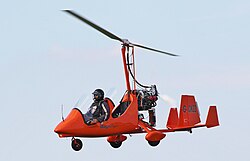
An autogyro—also known as a gyrocopter, gyroplane, or rotaplane—differs from a helicopter in that its rotor is unpowered. Instead, it relies on autorotation, a state where aerodynamic forces drive the rotor to develop lift as air flows upward through the rotor disk. To move forward, the autogyro uses an engine-powered propeller, similar to those found on fixed-wing aircraft.
Invented by Juan de la Cierva in 1920, early autogyros featured a tractor configuration with a front-mounted engine and wings. Modern versions typically use a pusher configuration, where the engine and propeller are mounted at the rear. The first pusher-propeller autogyro was tested by Etienne Dormoy using the Buhl A-1 Autogyro.
Gyrodynes
A gyrodyne is a hybrid rotorcraft designed to optimize both hovering and high-speed flight. During takeoff and landing, the engine drives the rotor, allowing it to hover like a helicopter. For forward propulsion and anti-torque, it utilizes one or more propellers mounted on stub wings.
As the aircraft increases speed, more power is shifted to the propellers and less to the rotor. This reduces rotor blade flapping and pitch angles. At cruise speeds, the rotor is powered only enough to maintain lift and overcome profile drag. This configuration is more efficient than the freewheeling rotor of an autogyro and helps minimize retreating blade stall—a phenomenon that limits the top speed of conventional helicopters.
![A Fairey Rotodyne prototype gyrodyne[3]](/images/0d/0c/0d0c4c4a1b1aea47ccb78afd86bd64bd26ed9bff41743e8abc322b0e93691b9a.jpg)
Rotor Kites
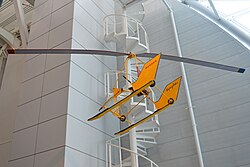
A rotor kite, or gyroglider, is an entirely unpowered rotary-wing aircraft. While it shares the use of rotors for lift with helicopters and autogyros, it lacks an engine entirely. Because it cannot generate its own thrust or power its rotors, a rotor kite must be carried aloft and dropped from another aircraft or towed into the air by a vehicle, such as a car or boat.
Rotorcraft Comparison Summary
| Type | Rotor Power | Thrust Source | Hover Capability | Engine Required |
|---|---|---|---|---|
| Helicopter | Engine-driven | Main Rotor | Yes | Yes |
| Autogyro | Autorotation | Propeller | No | Yes |
| Gyrodyne | Engine (Takeoff) | Propeller | Yes | Yes |
| Rotor Kite | Autorotation | External Tow/Drop | No | No |
Frequently Asked Questions
What is the difference between a helicopter and an autogyro?
The primary difference is how the rotor is powered. A helicopter's rotor is driven by an engine to provide both lift and thrust. An autogyro's rotor is unpowered and spins due to autorotation, while a separate propeller provides the forward thrust.
How does a gyrodyne improve upon a helicopter's speed?
Gyrodynes use propellers for forward thrust during cruise, which reduces the workload on the main rotor. This minimizes the adverse effects of retreating blade stall, allowing for more efficient high-speed flight than a standard helicopter.
What is autorotation?
Autorotation is a state where the rotor is turned by the flow of air moving upward through the rotor disk rather than by an engine, creating the necessary lift to keep the aircraft airborne.
Can a rotor kite take off on its own?
No, a rotor kite is unpowered. It requires an external force to get into the air, such as being towed by a boat or car, or being dropped from another aircraft.
Why do helicopters need tail rotors?
Tail rotors act as anti-torque devices. Because the main rotor creates a rotational force that would cause the helicopter's body to spin in the opposite direction, the tail rotor provides a counter-force to keep the aircraft stable.