Rotor-Powered Vehicles: Engineering Wind-Driven Speed
While traditional wind-powered transport relies on sails, a specialized class of engineering known as rotor-powered vehicles utilizes rotors to harness the wind. These vehicles employ either an unducted propeller or a ducted fan (a rotor enclosed in a shroud) that can adjust its orientation to face the apparent wind. Depending on the design, the rotor may be mechanically linked to the wheels via a drive train or connected to a generator that powers electric motors.
Beyond standard propellers, some designs utilize vertical axis wind turbines, where airfoils rotate around a central vertical axis. This concept is not entirely new; as early as 1904, a version was created using a repurposed rotor from a mass-produced windmill, with its gearing connected directly to the driving wheels.
Key Facts
- Dual Functionality: Rotors can act as turbines to drive wheels (upwind) or as propellers driven by wheels (downwind).
- Speed Potential: These vehicles can travel faster than the wind speed in both upwind and downwind directions.
- Blackbird Record: The Blackbird vehicle achieved speeds 2.8 times the wind speed downwind and 2.1 times the wind speed upwind.
- Efficiency Limits: Maximum speed is determined by blade efficiency, drive train losses, and aerodynamic drag.
- Competitive Racing: Events like Racing Aeolus in the Netherlands showcase university-led innovations in rotor propulsion.
The Physics of Rotor Propulsion
The ability of a bladed rotor to propel a vehicle faster than the wind relies on the velocity difference between the air mass and the ground. To the vehicle, both the air and the ground move backward, but the relative speeds differ based on direction.
Traveling Upwind
When moving against the wind, the air hits the vehicle faster than the ground passes beneath it. In this scenario, the rotor functions as a wind turbine, harvesting energy from the oncoming air to drive the wheels forward.
Traveling Downwind
When traveling downwind faster than the wind speed, the ground becomes the faster-moving medium relative to the vehicle. The wheels harvest energy from the ground and impart it to the rotor, which then acts as a propeller to push the vehicle forward.
This principle is not limited to land; it applies equally to watercraft using a wind turbine to drive a screw propeller upwind, or a water turbine to drive an aerial propeller downwind.
Fixed-Course Competitions and Innovations
The pursuit of efficiency has led to several high-profile competitions, most notably Racing Aeolus in the Netherlands. In this annual event, universities design rotor-powered vehicles to compete in drag races and speed trials heading into the wind. Rules permit temporary energy storage, provided the storage is empty at the start of the race.
The Ventomobile
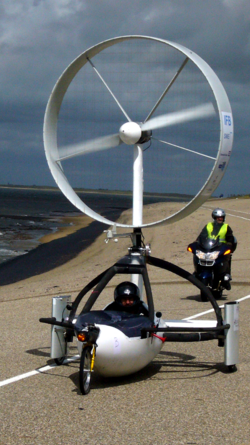
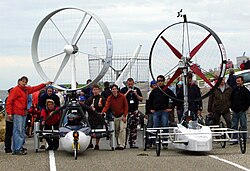
Developed by students at the University of Stuttgart, the Ventomobile is a lightweight three-wheeler. It features a carbon-fiber rotor support and variably pitched blades that adjust based on wind speed. Its power is transmitted to the wheels via a bicycle chain and two bicycle gearboxes. The Ventomobile secured first prize at the August 2008 Racing Aeolus event in Den Helder.
Spirit of Amsterdam
Created by the Hogeschool van Amsterdam, the Spirit of Amsterdam and Spirit of Amsterdam 2 were dominant forces in the 2009 and 2010 competitions in Denmark. The Spirit of Amsterdam 2 utilized an onboard computer to automatically shift gears for optimum performance, achieving a speed of 6.6 meters per second (15 mph) in a 10 meters per second (22 mph) wind.
Straight-Line Demonstrations and World Records
Some vehicles are built specifically to prove the theoretical possibility of traveling faster than the wind. This concept, often referred to as DDFTTW (Directly Downwind Faster Than The Wind), has been explored by various engineers over the last century.
Early demonstrations include George Phillips' 1904 upwind vehicle and Andrew Bauer's 1969 downwind vehicle. Later, in 2008, Rick Cavallaro demonstrated the principle using a treadmill-based toy model.
The Blackbird Project
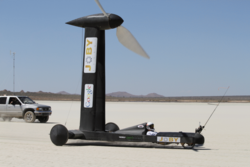
In 2010, Rick Cavallaro, in collaboration with San Jose State University and sponsored by Google, piloted the Blackbird. This vehicle provided the first certified proof of exceeding wind speed in both directions:
- Downwind: In 2010, it reached approximately 2.8 times the wind speed. By 2011, a streamlined version approached 3 times the wind speed.
- Upwind: In 2012, it set a record by traveling approximately 2.1 times the speed of the prevailing wind.
Summary of Notable Rotor Vehicles
| Vehicle | Developer | Key Feature | Notable Achievement |
|---|---|---|---|
| Ventomobile | University of Stuttgart | Variably pitched blades | 1st Prize, Racing Aeolus 2008 |
| Spirit of Amsterdam 2 | Hogeschool van Amsterdam | Automatic gear shifting | 1st Prize, Racing Aeolus 2009/2010 |
| Blackbird | Rick Cavallaro / SJSU | High-efficiency propulsion | Certified records for upwind and downwind speed |
Frequently Asked Questions
How can a vehicle go faster than the wind when traveling downwind?
When traveling faster than the wind, the vehicle's wheels move faster relative to the ground than the wind moves relative to the vehicle. The wheels harvest energy from the ground and drive the rotor, which then acts as a propeller to push the vehicle forward.
What is the difference between a rotor-powered vehicle and a sailing vehicle?
Sailing vehicles use sails to create lift or drag to move. Rotor-powered vehicles use rotating blades (turbines or propellers) mechanically linked to the wheels or an electric motor to generate propulsion.
What limits the maximum speed of these vehicles?
The top speed is limited by the aerodynamic drag of the vehicle body, the efficiency of the turbine blades, and mechanical energy losses within the drive train.
What was the Blackbird's most significant achievement?
The Blackbird was the first vehicle to achieve certified records for traveling both directly upwind and directly downwind faster than the speed of the prevailing wind using only wind power.