Rossland History: From Gold Rush Mining to Bedroom Community
The story of Rossland, British Columbia, is a classic tale of a frontier boomtown. Born from the discovery of rich ore on Red Mountain, the community evolved from a collection of tents and shacks into a bustling city of thousands, before eventually transitioning into the quiet residential hub it is today.
Before the arrival of prospectors, the area was known to the Sinixt First Nation as kEluwi'sst (suggested to mean "important temporary camp" or "up in the hills") or kmarkn ("smooth top"), the latter referring specifically to Red Mountain.
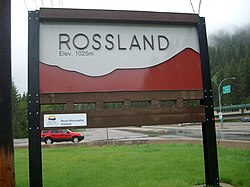
The Naming of Rossland
As mining claims were first staked, the settlement was known as Trail Creek camp, named after the Dewdney Trail. The town's final name honors Ross Thompson, who preempted 160 acres of land in 1892. In 1894, Thompson subdivided this land into lots to create the townsite of Thompson. However, within a few months, the name was changed to Rossland, likely at the request of postal authorities to avoid confusion with other similarly named locations.
The Mining Boom and the Le Roi Mine
The industrial spark occurred in July 1890 when partners Joe Bourjouis and Joe Morris staked claims on Red Mountain. While initial assays were disappointing, the pair registered several claims, including the Center Star, War Eagle, Idaho, and Virginia. They also sold a claim to "Colonel" Eugene Sayre Topping for $10, which Topping registered as the Le Roi.
The Le Roi claim quickly became a goldmine of opportunity. Topping sold a 53 per cent stake to a Spokane syndicate for $16,000 in November 1890. By the following spring, ore was being transported by mule along the Dewdney Trail to Trail Creek Landing, then by boat to Washington, and finally by rail to the Colorado Smelting and Mining Company Works in Butte, Montana.
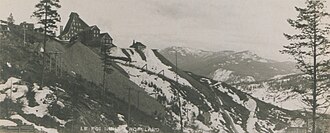
Expanding Infrastructure and Logistics
As operations grew, the logistics of moving ore evolved. In 1892, a new wagon road created by Oliver Durant connected Red Mountain to a ferry at Northport, Washington. A fleet of 40 wagons replaced the slower mule trains. By 1903, the Le Roi, Center Star, and War Eagle mines had produced 96 per cent of the mountain's total 1,500,000 tons of ore.
The arrival of the railway further accelerated growth. In June 1896, the Columbia and Western Railway (C&W) ran its first ore train to the Trail smelter. Shortly after, the Red Mountain Railway (RMR) and Columbia & Red Mountain Railway (C&RM) opened a route to Northport. This sparked intense competition between the Canadian Pacific Railway (CP), which bought the C&W and Trail smelter in 1897, and the Northern Pacific Railway (NP), which acquired the Northport route and smelter that same year.
The Rise of a Frontier City
Rossland's rapid growth saw it officially become a city in March 1897. At its peak around 1901, the population reached approximately 6,000 to 7,000 residents. The community was a bustling center of commerce and law, boasting 17 legal firms, eight doctors, and 42 saloons.
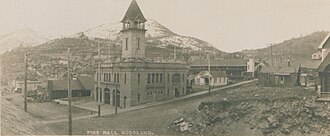
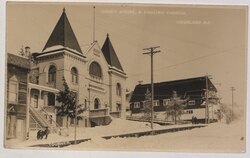
Early residents established a wide array of services. The 1895 Rossland Record listed essential tradespeople including a blacksmith, tinsmith, cobbler, baker, and several barbers and doctors. The town also built Presbyterian, Methodist, and Roman Catholic churches, as well as a school. Modernity arrived quickly; a small electricity generator began operation in 1896, and by 1898, West Kootenay Power supplied electricity from the Bonnington Falls dam.
Overcoming Disaster
The city's early years were marked by volatility and tragedy. A devastating fire in August 1902 destroyed most of upper Spokane Street, leaving only the International Hotel standing. Other disasters included a massive explosion in December 1905 and subsequent fires in 1927 and 1929 that leveled the wooden buildings of Columbia Street.
Industrial Decline and Transition
The mining era was not without conflict. Labor disputes, strikes, and lockouts were common. While militant unions successfully fought for an 8-hour workday in 1899, falling copper prices in 1907 forced workers to accept wage rollbacks to maintain job security.
Consolidation eventually took over. In 1906, the Consolidated Mining and Smelting Company of Canada (CM&S) was formed, with CP holding a 54 per cent stake. By 1911, CM&S acquired the Le Roi mine, creating a virtual monopoly. However, the industry began to fade; the Northport smelter closed in 1921, and the Le Roi mine finally shut down in 1929.
By the end of World War II, mining on the mountain had ceased. Rossland transitioned into a "bedroom community" for the nearby city of Trail. Rail passenger service ended in 1936, and the final freight lines were lifted in 1966. The town's accessibility improved significantly in 1964 with the opening of Highway 3A.
Key Facts
- Peak Population: Approximately 6,000 to 7,000 residents around 1901.
- Major Mine: The Le Roi mine was a primary driver of the local economy.
- Total Ore: 1,500,000 tons of ore were produced from the mountain up to 1903.
- Key Infrastructure: The town was served by the Columbia and Western Railway and later the Canadian Pacific Railway.
- Indigenous Roots: The area was originally called kEluwi'sst or kmarkn by the Sinixt First Nation.
| Period/Year | Key Development | Impact |
|---|---|---|
| 1890 | First claims staked on Red Mountain | Initiated the mining boom |
| 1894 | Townsite named Rossland | Established formal community identity |
| 1896-1897 | Arrival of C&W and RMR Railways | Efficient ore transport to smelters |
| 1901 | Population peak | Maximum urban growth and commercial activity |
| 1906-1911 | Formation of CM&S | Consolidation and monopoly of mountain ore |
| 1929-1945 | Closure of Le Roi and end of mining | Transition to a residential community |
Frequently Asked Questions
Who were the first people to name the Rossland area?
The Sinixt First Nation originally called the area kEluwi'sst or kmarkn, referring to the hills and the smooth top of Red Mountain.
How did the town get the name Rossland?
It was named after Ross Thompson, who preempted 160 acres in 1892. The name was changed from "Thompson" to "Rossland" in 1894 to avoid postal confusion with other locations.
What was the significance of the Le Roi mine?
The Le Roi mine, along with the Center Star and War Eagle mines, produced 96 per cent of the 1,500,000 tons of ore extracted from Red Mountain between 1890 and 1903.
What caused the decline of Rossland's population?
The population shrank due to the depletion of the mines, the impact of World War I, and the economic hardships of the Great Depression.
When did Rossland stop being a mining town?
While mining diminished gradually, the closure of the Le Roi mine in 1929 marked a major turning point, and mining on the mountain effectively ended by the conclusion of World War II.