Rosario Trolleybus System: A History of Electric Transit in Argentina
The city of Rosario, Argentina, has a long-standing relationship with electric mobility. Since its inception in 1959, the trolleybus system—electric buses that draw power from overhead wires—has served as a vital component of the city's urban transport network. From its early days replacing old tramways to modern efforts in local vehicle conversion, the system reflects the evolving technological and political landscape of the region.
Key Facts
- Opening Date: May 24, 1959.
- Current Primary Route: Line K (Ciudad Universitaria to Bulevar Wilde).
- Electrification: 600 V DC.
- Current Operator: Movi Rosario (since 2019).
- Route Length: 12.66 km (as of 2026).
- Notable Fleet: Includes Marcopolo/Volvo, Trolza Megapolis, and locally built REBUS units.
Early Development and Expansion (1959–1969)
The system was launched on May 24, 1959, to replace the electric tramway network that had operated since 1910. The initial fleet consisted of 10 German-made MAN trolleybuses serving Line G. Rapid growth followed, with the acquisition of 40 Fiat-Alfa Romeo-CGE units in 1959, leading to the creation of Line H in 1960 and Line J in 1961.
By December 1961, Line K began operations, and by 1962, Line L was introduced to meet high passenger demand. To optimize the network, the city merged several lines in 1967, resulting in three primary routes (M, H, and K) operated by a fleet of 45 vehicles.
Crisis, Decline, and Privatization
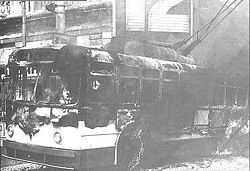
The system faced a severe setback on September 16, 1969, during the Rosariazo (a period of intense social protest). Eight Fiat vehicles were destroyed and many others damaged, forcing the suspension of Line H. To recover, the city acquired 23 used Mercedes-Benz trolleybuses from Buenos Aires and Mendoza, and later two more from a failed project in Bahía Blanca.
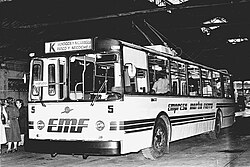
In 1979, the system was privatized under the operator Empresa Martín Fierro SRL (EMF). During this era, EMF attempted to modernize the fleet by importing five Soviet ZIU trolleybuses in 1980. While praised for their capacity and air suspension, these vehicles were poorly maintained and scrapped by 1984.
EMF also experimented with local construction, building 15 trolleybuses using new Mercedes-Benz chassis and recycled electrical equipment between 1980 and 1983. However, the system continued to shrink; Line M closed in 1984, and finally, Line K ceased operations on December 31, 1992, after the municipal authority revoked EMF's concession.
The Modern Revival and SEMTUR Era
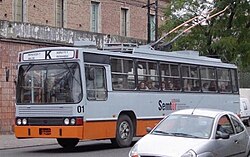
The system was reborn in 1994 under a new joint venture called Eco-Bus. The operator introduced 20 Marcopolo/Volvo trolleybuses. Although manufactured in 1987 for a cancelled project in Belo Horizonte, Brazil, these vehicles were effectively new upon arrival. The revived Line K was extended to reach Ciudad Universitaria and Calle Sánchez de Loria.
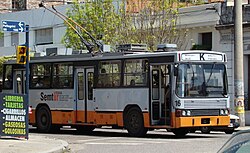
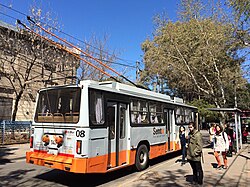
Following the economic crisis of 2002, Eco-Bus declared bankruptcy. In October 2004, the system returned to municipal control under the Sociedad del Estado Municipal para el Transporte Urbano de Rosario (SEMTUR). SEMTUR repainted the fleet in grey and orange and maintained service through the mid-2000s.
![EMF battery bus No. 1, an experimental vehicle, in 1982. This bus was converted into a trolleybus, No. 24, in 1983.[11]](/images/14/d1/14d1bc7d1b1dee19931071e48cfbd9112b7aa3362110855da7603d3d778a96e1.jpg)
Recent Innovations and Future Outlook
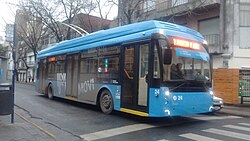
In 2017, Rosario attempted a major expansion with Line Q. This route utilized 12 Russian-made Trolza "Megapolis" trolleybuses equipped with traction batteries, allowing them to operate on sections of the route without overhead wires. However, due to battery overheating during hot summers, Line Q was permanently discontinued in December 2023.
Between 2019 and 2025, the city shifted toward local innovation. In collaboration with the National University of Rosario and the company Inventu, Movi Rosario introduced the REBUS model. These vehicles are converted from decommissioned diesel buses (Tatsa Puma and Metalpar Iguazu), blending existing chassis with new electric propulsion.
System Summary
| Period | Primary Operator | Key Fleet Types | Status |
|---|---|---|---|
| 1959–1979 | Municipality of Rosario | MAN, Fiat, Mercedes-Benz | Expansion |
| 1979–1992 | Empresa Martín Fierro (EMF) | ZIU, EMF-built Mercedes | Decline |
| 1994–2004 | Eco-Bus | Marcopolo/Volvo | Revival |
| 2004–2019 | SEMTUR | Marcopolo/Volvo, Trolza | Stabilization |
| 2019–Present | Movi Rosario | REBUS (Converted Diesel) | Modernization |
Frequently Asked Questions
Why was Line Q discontinued?
Line Q was permanently shut down in December 2023 because the traction batteries on the Trolza Megapolis vehicles suffered from overheating during the hot summer months.
What are REBUS trolleybuses?
REBUS trolleybuses are locally produced electric vehicles created by converting decommissioned diesel buses (specifically Tatsa Puma and Metalpar Iguazu models) into electric trolleybuses.
Is there any preserved equipment from the early years?
Yes, a 1961 Alfa Romeo/Fiat (No. 39) was fully restored to operating condition between 2010 and 2011 by the Asociación Rosarina Amigos del Riel and is used for special occasions.
How does the current system differ from the 1959 version?
While the original system had multiple lines (G, H, J, K, L, M), the current system is more streamlined, focusing primarily on Line K, and utilizes a mix of imported and locally converted electric vehicles.
What is the power source for the Rosario trolleybuses?
The system uses a 600 V DC electrification system provided via overhead wires, though some newer models have included batteries for short-distance off-wire travel.