Roman Britain: The Rise and Fall of a Frontier Province
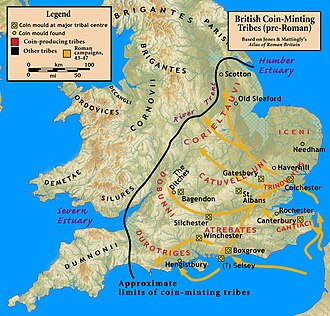
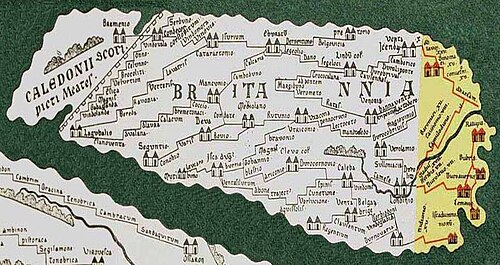
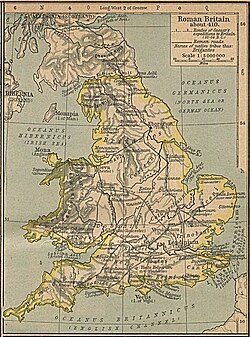
From the initial landings in 43 AD to the gradual withdrawal of imperial authority around 410 AD, Provincia Britannia served as a vital, if volatile, outpost of the Roman Empire. This period transformed the British Isles from a collection of Iron Age tribal territories into a structured province characterized by urban centers, sophisticated road networks, and a complex military presence.
The Roman presence was not merely a military occupation but a cultural shift known as Romanisation—the process by which indigenous populations adopted Roman customs, language, and administration. This era left an indelible mark on the geography and identity of what is now England, Wales, and southern Scotland.
Key Facts
- Duration: Roman rule lasted from 43 AD to approximately 410 AD.
- Capitals: The province was governed from Camulodunum (Colchester) and later Londinium (London).
- Population: Estimated at 3.6 million people by the end of the 4th century.
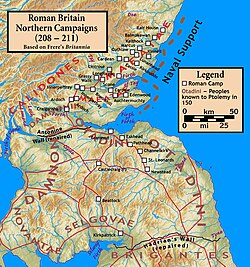
- Military Reach: Conquests extended as far north as Caledonia (Scotland) under Gnaeus Julius Agricola.
- Key Infrastructure: The province was linked by an extensive road system and defended by fortifications like Hadrian's Wall.
The Conquest and Establishment of Rule
The formal Roman invasion began in 43 AD under the command of Aulus Plautius. While the exact number of legions is debated, the Legio II Augusta, led by the future emperor Vespasian, is explicitly recorded as participating. Other units, including the Legio IX Hispana and XIV Gemina, were likely involved in the early campaigns and the subsequent suppression of the Boudican revolt in 60/61 AD.
The expansion continued under Gnaeus Julius Agricola between 77 and 84 AD. His campaigns pushed the imperial frontier deep into Caledonia. This period of expansion culminated in the Battle of Mons Graupius in 84 AD, where Roman forces faced the Caledonians led by Calgacus. Tacitus estimated Caledonian casualties at over 10,000, compared to roughly 360 Romans. This bloody conclusion to the forty-year conquest may have resulted in the deaths of 100,000 to 250,000 Britons.
Administration and Infrastructure
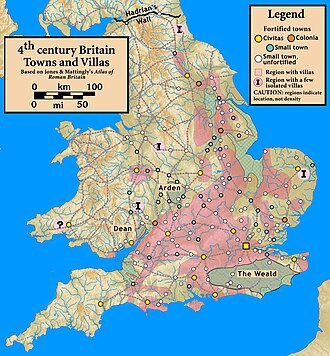
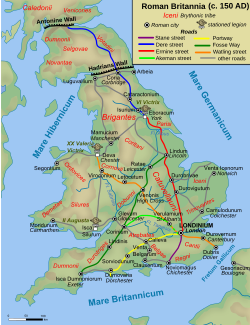
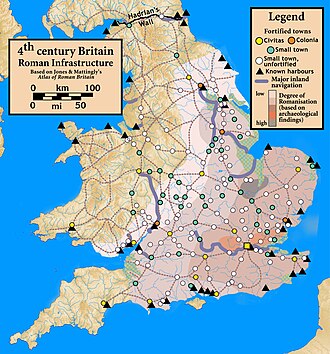
The Romans reorganized the landscape to facilitate trade and troop movements. They established a network of vici (small civilian settlements) and major urban centers. Londinium became the economic heart of the province, reaching an estimated population of 60,000 by the late 4th century.
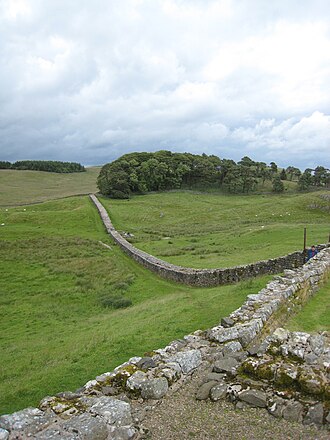
To maintain control over the northern frontier, the Romans constructed massive fortifications, most notably Hadrian's Wall. This served as both a defensive barrier and a means of regulating trade and migration between the province and the unconquered north.
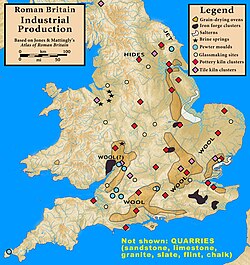
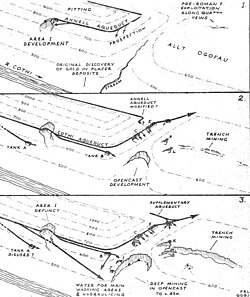
The province's economy was bolstered by industrial production and mining. The Dolaucothi Gold Mines in Wales represent one of the most significant industrial efforts of the era, extracting precious metals for the imperial treasury.
Transportation was revolutionized by the construction of paved roads, which allowed for the rapid deployment of legions and the efficient transport of goods across the province.
The Late Empire and the Great Conspiracy
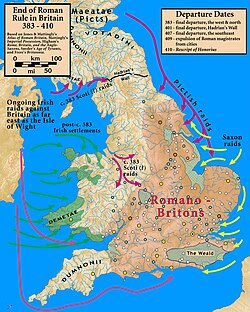
By the 4th century, the province faced increasing pressure from external threats. The Saxons attacked from the east, while the Scoti (Irish) raided the west. In 367 AD, a coordinated assault by Saxons, Picts, Scoti, and Attacotti—compounded by internal betrayal at Hadrian's Wall—led to a crisis known as the Barbarian Conspiracy.
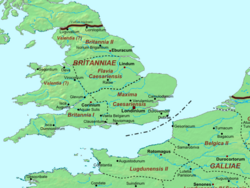
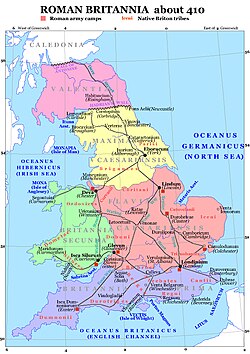
Order was restored by Theodosius the Elder, who arrived from Boulogne-sur-Mer. He implemented military reforms, regarrisoned abandoned forts, and created a new province called Valentia to better manage the far north.
However, stability was short-lived. In 383 AD, the usurper Magnus Maximus launched a revolt from Segontium (Caernarfon). His campaigns required the withdrawal of troops from Britain to the continent, leaving coastal forts like Chester abandoned and opening the door for Irish settlement in north Wales.
Religion and Culture
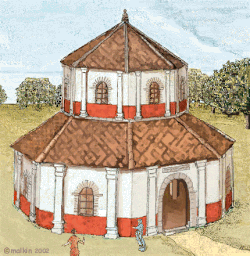
Spirituality in Roman Britain was a blend of indigenous paganism and imported Roman deities. Over time, Christianity gained a foothold. While early evidence is sparse, the 4th-century Chi-Rho fresco at Lullingstone Roman Villa provides a rare glimpse into early Christian art in Britain.
![The fourth-century Chi-Rho fresco from Lullingstone Roman Villa, Kent, contains the only known Christian paintings from the Roman era in Britain.[103]](/images/68/ed/68ed8aad7e113f1ad8a55c36b886c904716d5d6fe953b998f06fef584061dc39.jpg)
Christianity was legalized by Constantine I in 313 AD and became the state religion under Theodosius I in 391 AD. Notable figures included Saint Alban, the first British Christian martyr, and the monk Pelagius, whose teachings on human nature were later labeled as heresy by church authorities.
The End of Roman Rule and its Legacy
By 410 AD, the Roman Empire's resources were stretched thin across the Rhine and Danube. Troops were systematically withdrawn to defend Italy against Alaric I. The formal end of Roman rule left a power vacuum in what became Sub-Roman Britain.
Tradition suggests that the British leader Vortigern invited pagan Saxons as mercenaries to fight the Picts and Scoti. These mercenaries eventually rebelled, leading to a series of wars and the eventual Saxon occupation of Lowland Britain by 600 AD. Many Britons fled the chaos, migrating to Galicia and Brittany.
| Category | Details |
|---|---|
| Primary Capitals | Camulodunum, Londinium |
| Peak Population | c. 3.6 million (end of 4th century) |
| Major Military Works | Hadrian's Wall, Coastal Forts |
| Key Economic Drivers | Gold mining (Dolaucothi), Urban trade, Agriculture |
| Major Adversaries | Caledonians, Picts, Scoti, Saxons |
Frequently Asked Questions
When did the Romans first invade Britain?
The formal invasion took place in 43 AD under the leadership of Aulus Plautius, during the reign of Emperor Claudius.
What was the purpose of Hadrian's Wall?
Hadrian's Wall served as a defensive fortification to protect the province from northern tribes and to control the movement of people and trade across the frontier.
Who was the first Christian martyr in Britain?
Saint Alban is recognized as the first British Christian martyr, believed to have died in the 3rd or early 4th century.
What was the 'Barbarian Conspiracy'?
The Barbarian Conspiracy was a massive coordinated attack in 367 AD by Saxons, Picts, Scoti, and Attacotti that overwhelmed the northern and western regions of the province.
Why did the Romans leave Britain?
The Romans withdrew their legions to defend the heart of the Empire from other threats, such as the invasion of Italy by Alaric I, leaving Britain vulnerable to local instability and foreign raids.