Roller Speed Skating: The Thrill of Inline Racing
Roller speed skating, often referred to as inline racing, is a high-velocity sport where athletes compete on inline skates. While it evolved from traditional quad roller skating, its mechanics and demands are so similar to ice speed skating that many professional athletes transition between the two disciplines depending on the season.
The sport has seen a massive technological shift over the last few decades. Until 1991, World Championships were held exclusively on quad skates. However, by 1994, all events became "open," and inline skates quickly became the dominant choice due to their superior speed across all surfaces and tracks.
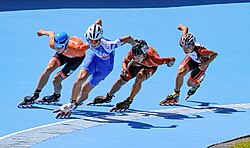
Key Facts
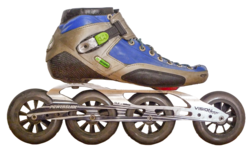
- Equipment: Modern racers primarily use inline skates with three or four polyurethane wheels.
- Wheel Size: Standard wheels range from 90mm to 110mm, with 125mm wheels permitted for specific senior and master categories.
- Surface Variety: Races occur on plastic-coated wood or cement (indoor) and various road surfaces (outdoor).
- Governing Body: The International Roller Sports Federation (FIRS) manages the technical standards and regulations.
- Olympic Status: While not yet an Olympic sport, it has been a staple of the World Games since 1981.
The Engineering of Speed: Skate Equipment
Frame and Mounting
The frame is the chassis that holds the wheels. Precise positioning of the frame relative to the boot is critical; even a minor misalignment can cause severe foot pain or "lock" the ankle and calf muscles, restricting movement. Because of this, skaters often spend days or weeks fine-tuning their setup. A key technical difference exists between disciplines: inline mounting is typically 195mm, whereas ice mounting is 165mm.
Wheel Composition and Durometer
Wheels are made of polyurethane. To maximize speed, skaters use the hardest possible wheels (measured by durometer) to minimize elastic hysteresis—the energy lost when the wheel deforms under the skater's weight.
- Indoor Wheels: Hardest (88–97 durometer), designed for smooth rinks.
- Outdoor Wheels: Softer (82–87 durometer) to handle surface roughness and provide grip, though they wear down faster.
Bearings and Friction
Most skates use the standardized 608 series bearings, with precision ratings ranging from ABEC-1 to ABEC-11. While steel is common, ceramic bearings (using black silicon nitride or white zirconium dioxide) are available. Ceramic options are lighter and more durable, though manufacturer data suggests that at skating speeds, friction is more heavily influenced by lubricants and seals than by the bearing material itself.
Race Venues and Competitive Formats
Inline speed skating is highly versatile, with events ranging from explosive sprints to grueling ultra-marathons.
Indoor Racing
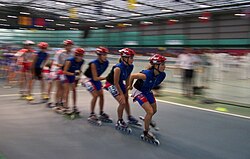
Common in the United States, indoor races take place on oval tracks (approximately 100m in circumference) with plastic-coated floors. These events often mirror short track speed skating, utilizing heats to qualify for finals.
Race Formats
- Time Trials: Known as "The Truth," these are individual tests against the clock without the benefit of drafting.
- Sprint Races: Short-distance knock-out tournaments (100m to 1000m).
- Criterium Races: Time-based races (15–45 minutes) that end after a final "bell lap."
- Distance and Marathons: Standard distance races are 5km or longer. Marathons cover the traditional 42.195km, with popular events like the North Shore Marathon in the USA and the Berlin Inline Marathon in Europe.
- Ultra Marathons: Extreme endurance events, such as the New York 100K or the Athens to Atlanta Road Skate (139.5km).
Performance Summary
| Feature | Indoor Specifications | Outdoor Specifications |
|---|---|---|
| Wheel Durometer | 88–97 (Hard) | 82–87 (Soft) |
| Common Wheel Size | 90mm – 110mm | Up to 125mm (Marathons/Masters) |
| Bearing Standard | 608 Series (Common) | 608 Series (Common) |
| Primary Material | Polyurethane | Polyurethane |
Frequently Asked Questions
Why are inline skates preferred over quad skates for racing?
By the mid-1990s, it became evident that inline skates were predominantly faster than quad skates on all surfaces and tracks, leading athletes to switch almost entirely to inline configurations.
What is the purpose of the durometer in skate wheels?
The durometer measures the hardness of the polyurethane. Harder wheels reduce energy loss from deformation (elastic hysteresis), which increases speed, provided the surface is smooth enough to prevent slipping.
Are inline speed skates used in the Olympics?
No, inline speed skating is not currently an Olympic sport, although it has been part of the World Games since 1981. Efforts to gain Olympic status have been made, but it has not yet been selected.
What is a "bell lap" in a criterium race?
In a criterium, skaters race for a set time (e.g., 30 minutes). When the time expires, a bell is rung, and the skaters complete one or two final laps to determine the winner.
How does frame positioning affect a skater?
Frame positioning is critical for ergonomics. Incorrect placement can lead to severe foot pain and the "locking" of ankle or calf muscles, which restricts the skater's range of motion and efficiency.