The Sinking of the ROKS Cheonan: An Investigation into the 2010 Baengnyeong Incident
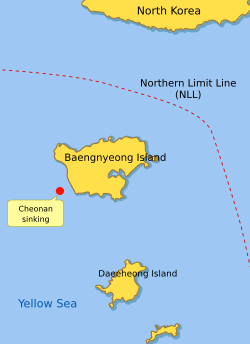
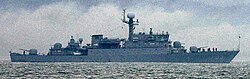
On the night of March 26, 2010, a sudden explosion in the Yellow Sea changed the landscape of inter-Korean relations forever. The ROKS Cheonan, a Pohang-class corvette belonging to the Republic of Korea Navy (ROKN), sank near Baengnyeong Island, resulting in a tragic loss of life and a major international diplomatic crisis.
What began as a maritime disaster quickly evolved into a complex forensic investigation involving multiple nations. The incident raised urgent questions about maritime security, the capabilities of North Korean naval technology, and the stability of the Northern Limit Line—the disputed maritime border between North and South Korea.
Key Facts
- Date: 26 March 2010, at 21:22 KST.
- Location: Near Baengnyeong Island, Yellow Sea.
- Casualties: 46 personnel killed; 58 personnel wounded.
- Primary Cause: A non-contact underwater explosion caused by a North Korean torpedo.
- Vessel Lost: One Pohang-class corvette (ROKS Cheonan).
The Incident and Immediate Aftermath
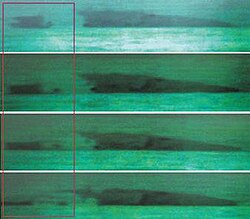
The ROKS Cheonan was performing routine operations when it was struck by an underwater force. The impact was so severe that the vessel split and sank. The immediate priority for the South Korean government was the rescue of survivors and the recovery of the wreckage from the seabed.
The rescue and recovery efforts were massive, involving both South Korean and international maritime expertise. Divers worked in challenging conditions to retrieve parts of the ship and search for missing personnel.
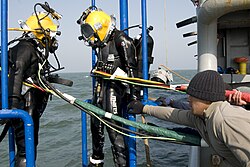
Recovery Operations
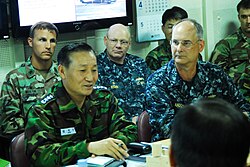
The salvage process was a highly coordinated effort. Significant milestones included the recovery of the ship's stern section, which provided critical evidence for investigators. This operation required high-level coordination between the Republic of Korea Navy and the United States Navy.
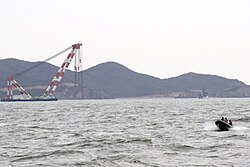
The Investigation: Finding the "Smoking Gun"
To determine the cause of the sinking, a Joint Civilian-Military Investigation Group (JIG) was convened. This international team included experts from Sweden, Australia, Britain, and the United States. Their goal was to analyze the wreckage and determine if the sinking was an accident or a deliberate attack.
The investigation focused on several key pieces of forensic evidence:
- Non-contact Explosion: Investigators concluded the ship was sunk by an explosion that occurred near the hull rather than a direct impact.
- Chemical Traces: Experts found traces of RDX, a high explosive more powerful than TNT, which is commonly used in torpedoes.
- Physical Fragments: A metal fragment was discovered containing a serial number that matched a North Korean torpedo previously captured by South Korea in 2003.
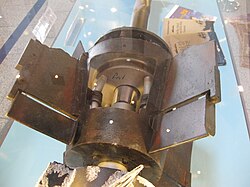
![Rear of the torpedo, with a clamshell fragment inside one of screw hub holes[75]](/images/05/6f/056f6266440cd8567fb3ce6402abf7aa7bd2a17d8ce686b32eaea204111ee64d.jpg)
The Conclusion
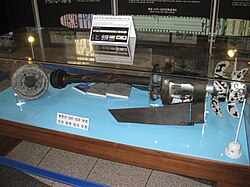
The JIG report concluded that a North Korean Yono-class submarine had deployed a torpedo that struck the Cheonan. The torpedo's propulsion section and specific markings provided the "smoking gun" needed to link the attack to the Korean People's Navy (DPRK).
International Reactions and Diplomatic Fallout
The findings sparked a wide range of international responses. While the United States and several Western nations supported the South Korean investigation, the diplomatic landscape remained divided.
The United Nations Security Council issued a Presidential Statement condemning the attack, though it stopped short of explicitly naming North Korea as the perpetrator. China, meanwhile, resisted calls for more stringent measures against Pyongyang. North Korea has consistently denied any involvement in the incident, labeling the investigation a fabrication.
Summary of Incident Details
| Category | South Korea (ROK) | North Korea (DPRK) |
|---|---|---|
| Units Involved | Pohang-class corvette (Cheonan) | Yono-class submarine (Alleged) |
| Casualties | 46 killed, 58 wounded | None reported |
| Official Stance | Confirmed torpedo attack | Denies involvement |
Frequently Asked Questions
What caused the ROKS Cheonan to sink?
The investigation concluded that the ship was sunk by a non-contact underwater explosion caused by a North Korean torpedo.
What was the role of RDX in the investigation?
RDX is a powerful high explosive used in torpedoes. The discovery of RDX traces on the sunken vessel provided critical evidence of an explosive attack.
How did the international community respond to the sinking?
The response was varied. The U.S. and other investigators supported the South Korean findings, while the UN Security Council issued a statement of condemnation. China resisted tougher sanctions, and North Korea denied all allegations.
Was the investigation conducted solely by South Korea?
No. While led by South Korea, the investigation included a multinational team of experts from the United States, Australia, Britain, and Sweden to ensure an international standard of forensic analysis.
What happened to the wreckage of the ship?
Sections of the wreckage, including the stern, were recovered from the seabed to assist in the investigation. Some evidence, such as the torpedo fragments, has been displayed at the War Memorial of Korea.