Robert Stone: The Visionary Documentary Filmmaker
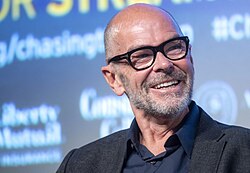
Robert Stone is a distinguished British-American documentary filmmaker renowned for his ability to blend historical rigor with cinematic storytelling. With a career spanning several decades, Stone has become a staple of high-quality non-fiction cinema, with numerous films appearing on PBS's American Experience series and multiple premieres at the prestigious Sundance Film Festival.
His work is characterized by an innovative use of archival material to explore complex political, social, and environmental themes. From the early days of nuclear testing to the heights of the space race, Stone transforms historical records into engaging narratives that challenge conventional wisdom.
Key Facts
- Accolades: Oscar nominee for Best Feature Documentary and three-time Emmy nominee for Exceptional Merit in Documentary Filmmaking.
- Notable Works: Director of Chasing the Moon, Pandora's Promise, and Radio Bikini.
- Education: Studied at the University of Wisconsin at Madison, Sorbonne University, and the Lee Strasberg Theatre and Film Institute.
- Advocacy: Co-founder of Energy for Humanity and co-author of the Ecomodernist Manifesto.
- PBS Presence: Seven of his films have been featured on the American Experience series.
Early Life and Educational Foundations
Born in England and raised in the United States, Stone's passion for history was an inherited trait. His father, Lawrence Stone, was a prominent historian and the chair of the History Department at Princeton University. Growing up in Princeton, New Jersey, Robert graduated from Princeton High School in 1976, noting that the combination of history, politics, and film felt natural given his upbringing.
Stone's filmmaking journey began remarkably early; at age 11, he produced an anti-pollution film using street interviews in Princeton. He further honed his craft through a diverse educational path, attending the University of Wisconsin at Madison, spending time at Sorbonne University in Paris, and studying at the Lee Strasberg Theatre and Film Institute in New York.
Career Evolution and Cinematic Style
After moving to New York in 1984, Stone connected with director Kevin Rafferty and the team behind The Atomic Cafe. This period helped shape his signature style: the sophisticated use of archival footage to reconstruct historical events. While primarily a documentary filmmaker, he briefly explored fiction in 1998 with World War Three, a counter-factual fake historical documentary created for German television.
Stone's filmography covers a vast array of subjects. He has explored the dark side of American history in American Babylon (2000) and the political intricacies of the Patty Hearst kidnapping in Guerrilla: The Taking of Patty Hearst (2004). More recently, he tackled the U.S. involvement in Iran in the thriller-style Taken Hostage (2022) and the life of NASA engineer Gentry Lee in Starman (2025), which premiered at the SXSW Film Festival.
Major Works and Accolades
Stone's debut film, Radio Bikini (1988), which examined 1946 nuclear tests at Bikini Atoll, earned him an Academy Award nomination. His later work, Chasing the Moon (2019), a comprehensive six-hour history of the space race, received a duPont-Columbia Award and his third Emmy nomination.
Critics have praised his insight; Variety's Owen Gleiberman described Stone as perhaps the most "under-celebrated great documentary filmmaker in America," specifically highlighting Guerrilla and Oswald's Ghost as explosively insightful works.
Environmental Advocacy and Ecomodernism
Beyond the screen, Stone has used his platform to address the climate crisis. His film Pandora's Promise (2013) argued for the role of nuclear energy as a viable solution to climate change. This work led him to co-found Energy for Humanity, a non-profit clean energy advocacy group, alongside philanthropist Daniel Aegerter and campaigner Kirsty Gogan.
Stone is also a proponent of Ecomodernism—a philosophy that suggests technology and human ingenuity can stabilize the climate while protecting nature. He is one of 18 co-authors of the Ecomodernist Manifesto and co-authored a companion book published by Ballantine Books.
Filmography Summary
| Year | Title | Subject/Genre |
|---|---|---|
| 1988 | Radio Bikini | Nuclear testing at Bikini Atoll |
| 2000 | American Babylon | Historical Documentary |
| 2004 | Guerrilla: The Taking of Patty Hearst | Political/Crime Documentary |
| 2013 | Pandora's Promise | Nuclear Energy and Climate Change |
| 2019 | Chasing the Moon | The U.S. Space Race |
| 2022 | Taken Hostage | U.S. involvement in Iran |
| 2025 | Starman | Biography of Gentry Lee |
Frequently Asked Questions
What is Robert Stone's primary filmmaking style?
Robert Stone is best known for his innovative use of archival material to create historical documentaries that blend political analysis with cinematic storytelling.
Which of Robert Stone's films were nominated for major awards?
His debut film Radio Bikini was nominated for an Academy Award. He has also received three Emmy nominations for Exceptional Merit in Documentary Filmmaking for works including Guerrilla: The Taking of Patty Hearst, Oswald's Ghost, and Chasing the Moon.
What is the Ecomodernist Manifesto?
The Ecomodernist Manifesto is a document co-authored by Stone and a group of scholars that challenges traditional views on sustainable development, arguing that technology and knowledge can allow humans to improve life while protecting the natural world.
Has Robert Stone ever made a fictional movie?
Yes, his only foray into fiction was a 1998 project for German television titled World War Three, which was presented as a counter-factual fake historical documentary.
What is the focus of the film Pandora's Promise?
Pandora's Promise makes the environmental case for nuclear energy, presenting it as a necessary solution to combat climate change.