Robert Lusser: The Engineer of Aviation, Rocketry, and Reliability
Robert Lusser was a polymath of 20th-century engineering whose career spanned the heights of aviation design, the dawn of rocket weaponry, and the mathematical study of system failure. From winning international flight contests in the 1920s to pioneering safety equipment for skiers, Lusser's life was defined by a relentless pursuit of technical precision and a critical eye for reliability.
Key Facts
- Aviation Pioneer: Contributed to the design of the Messerschmitt Bf 108 and the foundational architecture of the Bf 109 fighter.
- Rocketry Influence: Played a key role in the development of the V1 flying bomb (Vergeltungswaffe 1).
- Scientific Contribution: Formulated Lusser's Law, a theoretical framework for calculating the reliability of complex systems.
- Sporting Innovation: Invented modern ski bindings featuring teflon anti-friction pads and toe-grip mechanisms.
- Post-War Career: Worked with the US Navy and the Jet Propulsion Laboratory before returning to Germany.
Early Aviation Success and Messerschmitt
Born in Ulm, Lusser first gained prominence as a skilled aviator. In 1928, he won the International Light Aircraft Contest in France. He further established his reputation in the FAI International Tourist Plane Contests, achieving high rankings in 1929 (4th), 1930 (13th), and 1932 (10th), while also placing 3rd in the 1930 Giro Aereo d'Italia handicapped race.
Lusser transitioned from the cockpit to the drawing board, working for Klemm and Heinkel before joining the Bayerische Flugzeugwerke (Bavarian Aircraft Works) in 1933. Collaborating with Willy Messerschmitt, he assisted in the design of the M37 touring aircraft. This design evolved into the Messerschmitt Bf 108 and served as the critical basis for the Bf 109, one of the most famous fighter aircraft in history. By 1934, Lusser led the design bureau and managed the Bf 110 heavy fighter project.
The Heinkel Era and the V1 Flying Bomb
In 1938, Lusser returned to Heinkel, where he led the development of two sophisticated aircraft: the He 280 and the He 219. The He 280 was the first jet fighter to move from design to reality, though the Reich Aviation Ministry (RLM) ultimately chose the Messerschmitt Me 262. Similarly, the He 219 night-fighter was deemed too complex for mass production by the RLM in 1941, leading to Lusser's dismissal after Heinkel submitted a simplified version of the design.
Lusser subsequently joined Fieseler, where he collaborated with Argus engineer Fritz Gosslau to develop a pilotless aircraft powered by a pulsejet (a simple type of jet engine). This project, which gained high priority in 1942 under Erhard Milch, became the V1 flying bomb. During the production ramp-up near Wolfsburg, Lusser identified and corrected a critical flaw: an underdimensioned main wing spar.
This work placed Lusser in direct competition with Wernher von Braun, whose V2 vertical takeoff rocket was developed simultaneously. The rivalry between the two engineers persisted long after the war.
Post-War Contributions and Lusser's Law
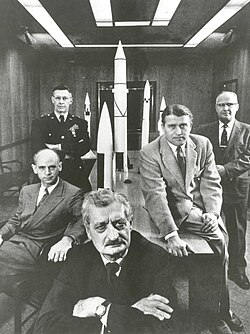
Following World War II, Lusser was brought to the United States as part of the effort to capture German technical expertise. He held positions with the US Navy and the Jet Propulsion Laboratory. In 1953, he joined Wernher von Braun's team in Huntsville, Alabama.
During his tenure in Alabama, Lusser formalized his theories on system reliability. He proposed that the overall reliability of a complex system is the product of the reliability of its individual components. This principle, known as Lusser's Law, led him to conclude that the extreme complexity of spacecraft required for missions to the Moon and Mars would likely lead to failure—a prediction that put him at odds with von Braun's ambitions.
Upon returning to Germany to work for Messerschmitt-Bölkow, Lusser applied his reliability studies to the F-104 Starfighter. His warnings regarding the aircraft's adaptations proved tragically accurate.
Innovation in Skiing
In 1961, a personal injury—a ruptured Achilles tendon caused by cable bindings—prompted Lusser to redesign ski equipment. He developed a new binding system that gripped the toe of the boot rather than the sole flange, allowing the binding to release in any direction to prevent injury. He also introduced teflon anti-friction pads to improve the release mechanism.
In 1963, he left the aerospace industry to found the Lusser Binding Company, which remained a prominent brand until his death on January 19, 1969, in Munich.
| Period | Field | Key Achievement/Project |
|---|---|---|
| 1928–1932 | Aviation | International flight contest winner (France, Italy) |
| 1933–1938 | Aircraft Design | Bf 108 and Bf 109 foundational design |
| 1938–1941 | Jet Aviation | He 280 (first jet fighter) and He 219 |
| 1942–1945 | Rocketry | V1 Flying Bomb development |
| 1953–1959 | Systems Engineering | Formulation of Lusser's Law |
| 1963–1969 | Sporting Goods | Founded Lusser Binding Company |
Frequently Asked Questions
What is Lusser's Law?
Lusser's Law is a theoretical study of reliability focusing on how the reliability of each individual part contributes to the overall reliability of a complex system. It suggests that as complexity increases, the probability of total system failure increases.
Which famous aircraft did Robert Lusser help design?
Lusser was instrumental in the design of the Messerschmitt Bf 108, which served as the basis for the legendary Bf 109 fighter. He also led the design of the He 280 jet fighter and the He 219 night-fighter.
What was the V1 flying bomb?
The V1 (Vergeltungswaffe 1) was a pilotless aircraft powered by a pulsejet engine. Developed by Fieseler and Argus, it was used as a "revenge weapon" during World War II.
How did Robert Lusser change the skiing industry?
Lusser revolutionized ski safety by creating bindings that gripped the toe of the boot and utilized teflon anti-friction pads, allowing for a multi-directional release to prevent leg injuries.
What was the relationship between Robert Lusser and Wernher von Braun?
Lusser and von Braun were professional rivals. While they worked together in Huntsville, Alabama, they disagreed fundamentally on the feasibility of lunar and Martian missions due to Lusser's calculations on system reliability.