Riverboats: Design, History, and Modern Applications
A riverboat is a specialized watercraft engineered for inland navigation on rivers, lakes, and artificial waterways. Unlike ocean-going vessels, riverboats are tailored for the specific constraints of inland environments, serving a diverse array of purposes from industrial freight and law enforcement to luxury tourism and public transit.
These vessels are essential components of regional infrastructure, providing a cost-effective means of transporting bulk cargo and passengers, particularly in areas where road and rail networks are underdeveloped or inefficient.
Key Facts
- Specialized Design: Built with shallow drafts to navigate waters often less than two meters deep.
- Cost Efficiency: Offers the lowest cost per ton-mile for transporting low-value bulk cargo.
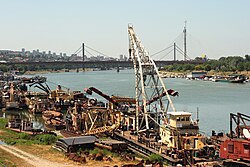
- Versatility: Used for dredging, fisheries management, fire fighting, and law enforcement.
- Evolution: Transitioned from ancient rafts and dugouts to steam-powered paddle wheelers and modern diesel-screw propulsion.
Design and Engineering
Riverboats differ significantly from sea-going ships in their construction. Because they do not face the extreme winds or massive waves of the open ocean, they are generally less sturdy and can be constructed from light composite materials. Their dimensions are strictly limited by the width and depth of the river channel and the vertical clearance of spanning bridges.
A critical feature of many riverboats is the shallow draft (the vertical distance between the waterline and the bottom of the hull). This allows vessels to operate in very shallow waters, a characteristic famously utilized by the paddle wheel steamers of the Mississippi River.
While ferries are primarily used for crossing a river, riverboats are designed to travel along the course of the waterway to move cargo or passengers for revenue.
The History of Inland Navigation
Humanity has utilized rivers for transport since at least 20,000 BC, beginning with simple rafts and dugouts. By 50 BC, Roman records indicate extensive transport of goods and people on the Rhine. For centuries, upstream travel relied on sails, oars, or towpaths where animals and people pulled boats from the shore.
The Era of the Steamboat
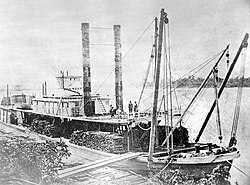
The 19th century saw the rise of the steamboat, which revolutionized transport in the United States along the Mississippi, Ohio, Missouri, Colorado, Columbia, and Sacramento rivers. These boats were so efficient at navigating shallow waters that it was often said they could "navigate on a heavy dew."
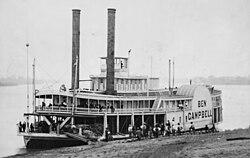
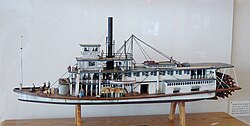
Early steamboats typically featured iron boilers, tall smokestacks, and a stern wheel (a paddlewheel at the rear). This design protected the propulsion system from underwater snags and made repairs easier. To facilitate loading in undeveloped areas, these boats featured a "brow"—a short bridge at the bow for transferring passengers and cargo to the shore.
Global Developments
In Australia, the Murray River served as a hub for large riverboats, with Echuca acting as a major inland port. In Canada, the Skeena River was vital during the steamboat age; the Union entered the river in 1864, and by 1891, the Caledonia successfully navigated the Kitselas Canyon to reach Hazelton.
Modern Riverboat Applications
Today, most riverboats have replaced paddle wheels with screw propellers powered by high-horsepower diesel engines.
Tourism and Luxury Travel
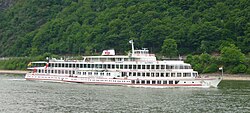
Modern luxury riverboats often mirror oceanic cruise ships, offering high-end dining and entertainment. In Europe, smaller luxury craft operate on canals and rivers, often integrating with land-based activities like cycling. On the Yangtze River, some vessels employ staff who serve as both waitstaff and performers.
Public and High-Speed Transport
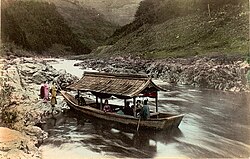
In urban centers, riverboats function as public transit. These are known by various names: water taxis in English-speaking regions, vaporetto in Venice, and river tramways in Poland and the former Soviet Union.
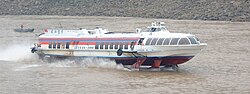
High-speed planing and hydrofoil boats provide a distinct advantage in narrow or congested waterways. On the Yangtze's Three Gorges, these agile craft can bypass slower, deeper-draft vessels by navigating the shallows.
Freight and Multimodal Logistics
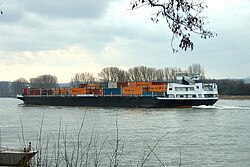
Riverboats remain the most economical choice for bulk cargo due to low capital costs and low cost per ton-mile. In China, riverboats play a unique multimodal role; because road networks along rivers can be dangerous or inadequate, drive-on/drive-off ramp barges are used to transport trucks across the region.
| Type | Primary Purpose | Key Feature |
|---|---|---|
| Luxury Cruiser | Tourism & Entertainment | Hotel-grade amenities |
| Barge/Cargo Boat | Bulk Freight | High capacity, low cost |
| Water Taxi/Tram | Urban Transit | Frequent stops, high agility |
| Service Craft | Maintenance/Law Enforcement | Specialized tools (e.g., dredges) |
| Hydrofoil | Rapid Transit | High speed, shallow operation |
Frequently Asked Questions
How do riverboats differ from ocean ships?
Riverboats are designed for inland waters, meaning they have shallower drafts, are generally less sturdy to save weight, and lack the heavy-duty navigational and rescue equipment required to withstand open-ocean waves and winds.
What is a "snagboat"?
A snagboat, such as the museum ship WT Preston, is a specialized river dredge used to remove underwater obstructions (snags) to keep the waterway navigable.
Why was the stern wheel preferred for early American riverboats?
The rear paddlewheel was less likely to be damaged by underwater debris (snags), was easier to repair, and was less prone to damage if the boat ran aground.
What is multimodal transport in the context of riverboats?
Multimodal transport involves using multiple modes of transport for a single journey. An example is the use of ramp barges in China to carry trucks across rivers where road infrastructure is insufficient.
Can riverboats operate in very shallow water?
Yes, many are specifically designed with shallow drafts. Historically, some Mississippi steamers could operate in water less than two meters deep.