Rhombic Dodecahedron: Topologically Equivalent Forms and Higher-Dimensional Projections
The rhombic dodecahedron is a fascinating geometric figure known for its ability to fill space. Beyond its standard form, it exists within a family of topologically equivalent shapes—figures that share the same connectivity of vertices, edges, and faces, even if their specific angles and lengths differ. By examining these variations and the figure's relationship to higher-dimensional polytopes, we can uncover the deep mathematical symmetry governing these structures.
Topologically Equivalent Forms
Several constructions share the same topology as the rhombic dodecahedron. Some of these are parallelotopes (polyhedra that can fill space by translation) and are similar to variations of space-filling truncated octahedra. One such variation features four square faces and 60-degree rhombic faces with D 4h dihedral symmetry of order 16; this form can be visualized as a cuboctahedron with square pyramids attached to its top and bottom.
In 1960, Stanko Bilinski identified the Bilinski dodecahedron. While it shares the same topology as the standard rhombic dodecahedron and consists of 12 congruent rhombus faces, its geometry is distinct because its rhombic faces are based on the golden ratio.
Another equivalent form is the deltoidal dodecahedron. This isohedral figure possesses tetrahedral symmetry of order 24. In this version, the rhombic faces are distorted into kites, also known as deltoids. This is achieved by adjusting eight vertices in alternating sets of four. The geometry of these forms can be parametrized by (a, b), where the relationship is defined by the equation 1/a + 1/b = 2 (with a, b > 1/2). When a = 1 and b = 1, the result is the standard rhombic solution.
Stellations of the Rhombic Dodecahedron
Stellation is the process of extending the faces or edges of a convex polyhedron until they meet to form a new figure. Dorman Luke described several such stellations for the rhombic dodecahedron. The first stellation, the stellated rhombic dodecahedron, is created by attaching a rhombic-based pyramid to each face. The height of these pyramids is calibrated so that their sides lie within the planes of the neighboring faces.
Luke further detailed four additional stellations: the second and third (which expand outward), a fourth formed by removing the second from the third, and a fifth created by adding the original rhombic dodecahedron back to that result.
Higher-Dimensional Polytope Relationships
The rhombic dodecahedron serves as the hull for the vertex-first projection of a tesseract (a four-dimensional hypercube) into three dimensions. A rhombic dodecahedron can be decomposed into four congruent rhombohedra in exactly two ways, which provides eight possible rhombohedra as projections of the tesseract's eight cubic cells.
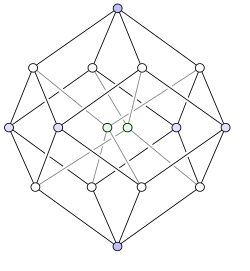
Furthermore, the rhombic dodecahedron is the maximal cross-section of a 24-cell and the hull of its vertex-first parallel projection. In this context, the rhombic dodecahedron can be decomposed into six congruent, non-regular square dipyramids that meet at a central vertex. These dipyramids represent six pairs of the 24-cell's octahedral cells, while the remaining 12 octahedral cells project onto the faces of the rhombic dodecahedron. The non-regularity of these shapes is a result of projective distortion, as the original facets of the 24-cell are regular octahedra in 4-space.
This relationship offers a practical construction method: a cube can be cut into six congruent square pyramids, which are then attached to the faces of a second cube. Because the triangular faces of adjacent pyramids lie on the same plane, they merge to form the rhombi of the rhombic dodecahedron.
Key Facts
- Space-Filling: The rhombic dodecahedron and its symmetry constructions are capable of filling 3D space.
- Bilinski Dodecahedron: A topological equivalent where the rhombic faces follow the golden ratio.
- Deltoidal Variation: The deltoidal dodecahedron transforms rhombic faces into kites (deltoids).
- Tesseract Connection: It forms the hull of a tesseract's vertex-first projection into 3D space.
- 24-Cell Connection: It is the maximal cross-section and vertex-first projection hull of a 24-cell.
| Form | Face Shape | Key Characteristic |
|---|---|---|
| Standard Rhombic Dodecahedron | Rhombus | Space-filling parallelotope |
| Bilinski Dodecahedron | Rhombus | Faces based on the golden ratio |
| Deltoidal Dodecahedron | Kite (Deltoid) | Tetrahedral symmetry order 24 |
| Stellated Rhombic Dodecahedron | Pyramidal faces | Faces extended to form new vertices |
Frequently Asked Questions
What is a topologically equivalent form in geometry?
A topologically equivalent form is a shape that maintains the same basic structure—the same number of vertices, edges, and faces connected in the same way—even if the lengths of the edges or the angles between faces are changed.
How does the Bilinski dodecahedron differ from the standard rhombic dodecahedron?
While both have 12 congruent rhombus faces and the same topology, the Bilinski dodecahedron's geometry is different because its faces are defined by the golden ratio.
What is stellation?
Stellation is the process of extending the faces or edges of a convex polyhedron outward until they intersect, creating a new, typically more complex, star-like polyhedron.
How is the rhombic dodecahedron related to the tesseract?
The rhombic dodecahedron forms the outer boundary (hull) when a tesseract is projected from four dimensions into three dimensions using a vertex-first projection.
How can you construct a rhombic dodecahedron using cubes?
You can create one by dividing a cube into six congruent square pyramids and attaching those pyramids to the six faces of another cube of the same size.