Republic of the Seven United Netherlands
The Republic of the Seven United Netherlands, commonly known as the Dutch Republic, was a formidable confederation and global superpower that existed from 1588 to 1795. Emerging from a revolt against Spanish rule, it became the first independent Dutch nation-state and a pioneer of early modern global trade.
The republic was born from the Union of Utrecht (1579), a mutual alliance formed by northern provinces to defend against the Army of Flanders. This led to the Act of Abjuration in 1581, a formal declaration of independence from King Philip II of Spain. After several failed attempts to find a new monarch, the provinces officially confederated as a republic on April 12, 1588.
Key Facts
- Duration: 1588–1795.
- Government: A confederal parliamentary republic.
- Core Provinces: Groningen, Frisia, Overijssel, Guelders, Utrecht, Holland, and Zeeland.
- Economic Engine: Dominated world trade via the Dutch East India Company (VOC) and Dutch West India Company (GWC).
- State Religion: Dutch Reformed.
- End of State: Dissolved during the Batavian Revolution of 1795.
Political Structure and Internal Tensions
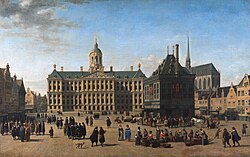
The Dutch Republic operated as a confederation where individual provinces maintained a high degree of autonomy from the federal assembly, known as the States General. Following the Peace of Westphalia in 1648, the republic expanded its territory by approximately 20% through the acquisition of Generality Lands, which were ruled directly by the States General.
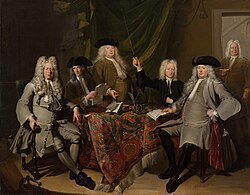
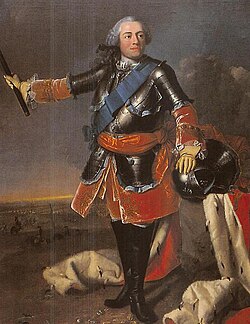
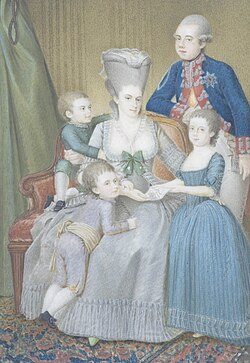
Governance was characterized by a persistent tension between two political factions: the Orangists and the Republicans. The Orangists supported the Stadtholder (literally a "steward"), a position usually held by the House of Orange, who acted as the effective head of state. Conversely, Republicans advocated for a stronger States General and less centralized power.

This ideological struggle resulted in two "Stadtholderless Periods" (1650–1672 and 1702–1747), during which the office was left vacant in key provinces. While the first period coincided with great prosperity, the second led to national instability and the eventual loss of the republic's great power status.
The Dutch Golden Age and Global Trade
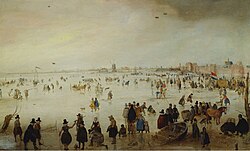
Despite a small population of roughly 1.5 million, the republic controlled a vast network of seafaring trade routes. The Dutch Golden Age saw the nation dominate world commerce, exporting Polish grain and establishing a colonial empire in the Asia-Pacific region.
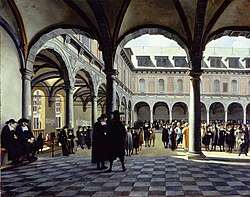
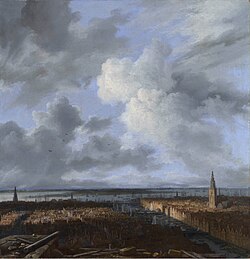
The County of Holland became the wealthiest and most urbanized region globally. By 1650, 31.7% of the republic's total population lived in cities; in Holland specifically, urban density reached 61% by 1675. This economic success was underpinned by innovative financial institutions and the sheer scale of the merchant fleet.
The Role of Trade Companies
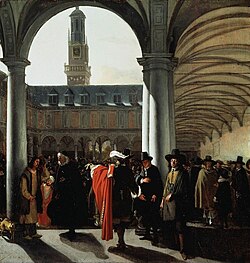
The Dutch East India Company (VOC) and the Dutch West India Company (GWC) were the primary vehicles for colonial expansion. The wealth generated from these enterprises allowed the small republic to fund a military capable of competing with the largest empires of the era.
Military Conflicts and Decline
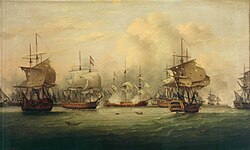
The republic's rise was marked by constant warfare. It fought the Eighty Years' War against Spain until 1648 and engaged in the Dutch–Portuguese War (1598–1663). Its naval supremacy led to four separate Anglo-Dutch Wars between 1652 and 1784, sparked largely by trade restrictions like England's Navigation Act of 1651.
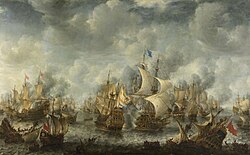
The decline began after 1730. Massive debts incurred from wars to contain French expansion under the "Sun King" forced the republic to prioritize its land army over its navy. This shift weakened the maritime economy. By the end of the War of the Austrian Succession in 1748, the Dutch Republic had ceased to be a major military power.

The Final Years
The late 18th century was marked by the Patriottentijd (1780–1787), a period of political instability and rebellion against the stadtholder. Although temporarily suppressed by a Prussian invasion, the unrest resurfaced during the French Revolution. Following a military defeat by France, the stadtholder was expelled in the Batavian Revolution of 1795, leading to the creation of the Batavian Republic.

Summary of the Dutch Republic
| Category | Details |
|---|---|
| Timeline | 1588–1795 |
| Key Figures | William of Orange, Johan van Oldenbarnevelt, William III |
| Major Wars | Eighty Years' War, Anglo-Dutch Wars, Franco-Dutch War |
| Economic Pillars | VOC, GWC, Global Merchant Fleet |
| Successor State | Batavian Republic |
Frequently Asked Questions
What was the Act of Abjuration?
The Act of Abjuration, signed in 1581, was the formal declaration of independence by the northern provinces of the Low Countries, effectively deposing Philip II of Spain as their ruler.
Who were the Stadtholders?
The Stadtholder was originally a provincial steward. Over time, the position became dominated by the House of Orange, evolving into a hereditary role that functioned as the de facto head of state.
Why did the Dutch Republic decline?
The decline was caused by a combination of economic stagnation after 1730 and the immense financial burden of maintaining a land army to defend against French expansion, which drained resources from the navy.
How did the Dutch Republic influence the United States?
The U.S. Declaration of Independence (1776) shares similarities with the Act of Abjuration (1581). Additionally, James Madison noted the Dutch confederacy's structure when discussing the strengths and weaknesses of government in Federalist No. 20.
What were the Stadtholderless Periods?
These were intervals (1650–1672 and 1702–1747) when the Republican faction successfully prevented the appointment of a Stadtholder in key provinces to limit the power of the House of Orange.