Redfin Pickerel
The redfin pickerel (Esox americanus americanus) is a specialized freshwater fish and a member of the pike family (Esocidae). While it shares a close relationship with the grass pickerel and chain pickerel, it is easily distinguished by its striking, brightly colored red fins. As a classic ambush predator—a hunter that hides and waits for prey to come within striking distance—the redfin pickerel is a master of stealth in the aquatic undergrowth.
Key Facts
- Scientific Name: Esox americanus americanus
- Distinctive Feature: Bright red fins.
- Habitat: Freshwater lakes, streams, and swamps along the Atlantic slope.
- Diet: Smaller fish, crayfish, and insect larvae.
- Max Length: Approximately 12 inches.
- Conservation Status: Secure / Least Concern.
Distribution and Habitat
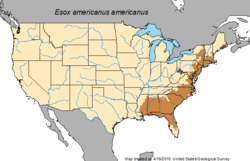
The redfin pickerel is primarily found along the Atlantic slope of North America. Its stable populations stretch from Massachusetts in the north down to Lake Okeechobee in Florida, extending westward into Gulf drainages as far as the Pascagoula River in Mississippi. In the western reaches of its range, it often overlaps with its sister species, the grass pickerel (Esox americanus vermiculatus).
To succeed as an ambush predator, this fish requires specific environmental conditions. It prefers freshwater habitats characterized by high visibility and dense vegetation or decaying organic matter, which provide the necessary cover to remain unseen by prey.
Physiology and Adaptations
The anatomy of the redfin pickerel is precision-engineered for sprint predation—short, explosive bursts of speed to capture prey. Its body is hydrodynamic and tube-shaped, featuring a flat nose and an unadorned head to reduce drag. The pectoral fins are shrunken to streamline the body, while the large caudal (tail) fin provides the massive thrust needed for a sudden strike.
The positioning of its fins is also unique; the dorsal fin aligns with the anal fin, and the ventral fins are positioned further rearward than in most other fish species. To locate prey, the redfin pickerel relies on its large eyes and a preference for clear, shallow waters.
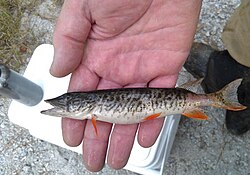
Camouflage is critical for its survival. The fish's lateral scales range from green to brown with vertical dark green streaks, while the ventral (bottom) side is white to pale amber. This allows the pickerel to blend seamlessly into aquatic vegetation. Its terminal mouth is equipped with long, conical teeth designed to grip fast-moving prey.
Life Cycle and Reproduction
Spawning occurs in the spring, typically between late February and early May. The timing varies by climate, with fish in warmer waters breeding earlier. Although generally solitary, these fish migrate from their primary lakes and rivers into small streams with temperatures ranging from 4°C (39°F) to 18.3°C (64.9°F) to mate.
The redfin pickerel practices polyandry, a mating system where one female mates with multiple males. The female scatters her eggs among the vegetation, and several males release their milt into the surrounding water. Once spawning is complete, the parents abandon the eggs.
The life cycle progresses as follows:
- Hatching: Occurs roughly 12 to 14 days after spawning.
- Larval Stage: Young pickerel school together for protection and feed on water fleas, amphipods, and insects.
- Maturity: Fish reach sexual maturity after two years and transition to a solitary lifestyle.
- Lifespan: Typically five years, though some individuals live up to eight years.
Diet and Ecological Role
As the apex predator of its small, shallow environment, the adult redfin pickerel feeds on crayfish, smaller fish, and insect larvae. By occupying the top of the food chain in these micro-habitats, it plays a vital role in regulating the populations of smaller aquatic organisms.
| Feature | Detail |
|---|---|
| Average Length | ~12 inches |
| Primary Diet | Small fish, crayfish, insect larvae |
| Mating System | Polyandrous |
| Lifespan | 5 to 8 years |
| Key Habitat | Vegetated freshwater lakes and swamps |
Ecological Concerns
While the IUCN lists the redfin pickerel as a species of least concern, it faces significant environmental threats. Habitat loss continues due to the drainage of wetlands and the construction of dams, which dry up the small streams essential for spawning.
A more insidious threat is biomagnification—the process where toxins increase in concentration as they move up the food chain. Because the redfin pickerel is a top predator, it accumulates high levels of environmental mercury from the smaller animals it consumes. This buildup in the fish's tissues poses a risk of mercury poisoning to the birds and humans that eat them.
Frequently Asked Questions
How is the redfin pickerel different from the grass pickerel?
The most striking difference is the redfin pickerel's brightly colored red fins, whereas the grass pickerel does not possess this coloration.
What is the typical size of a redfin pickerel?
Unlike some of its larger northern relatives in the pike family, the redfin pickerel generally grows to around twelve inches in length.
Where can the redfin pickerel be found?
They are found in freshwater lakes, streams, and swamps along the Atlantic slope, ranging from Massachusetts to Florida and west to the Pascagoula River in Mississippi.
Why is mercury a specific concern for this species?
As an apex predator, the redfin pickerel experiences biomagnification, meaning it absorbs and concentrates mercury from all the smaller prey it eats throughout its life.
How do redfin pickerels hunt?
They are ambush predators that use their green and brown camouflage to hide in dense vegetation, using a sudden burst of speed to strike prey with their conical teeth.