Red: The Science, Symbolism, and Variations of a Primary Color
Red is one of the most evocative colors in the human experience. From the deep crimson of a rose to the bright scarlet of a fire engine, it is a hue that commands attention and triggers immediate emotional responses. Beyond its visual impact, red is defined by precise scientific measurements and a vast array of standardized variations used in art, design, and digital media.
The Science of Red
In the visible light spectrum, red is characterized by the longest wavelengths. It is defined by spectral coordinates, which are the specific measurements of light that the human eye perceives as red. Specifically, red light has a wavelength ranging from approximately 630 to 740 nanometers (nm) and a frequency between 405 and 480 terahertz (THz).
In digital environments, red is often represented using the sRGB (standard Red Green Blue) model, an additive color system where red is a primary color. In its purest digital form, red is represented by the hex triplet #FF0000, meaning the red channel is at maximum intensity while green and blue are absent.
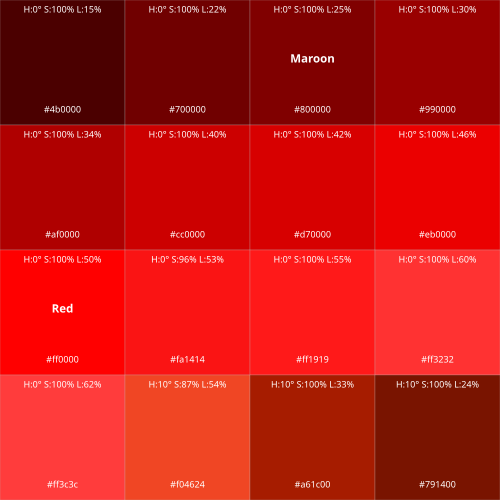
Key Facts
- Wavelength: Approximately 630–740 nm.
- Frequency: Approximately 405–480 THz.
- Digital Hex: #FF0000 (Pure sRGB Red).
- Common Associations: Heat, anger, passion, love, danger, and socialism.
- Primary Use: A primary color in additive (RGB) and a key component in subtractive (CMYK) printing.
Standardized Red Color Systems
Because "red" can vary significantly depending on the medium, several professional systems have been developed to standardize the hue.
Digital and Print Standards
- RGB: The standard for screens, where pure red is (255, 0, 0).
- CMYK: Used in printing, where red is created using subtractive primary colors (cyan, magenta, and yellow). A common pigment red in this system is #ED1B24.
- Pantone: A globally recognized proprietary system; Pantone Red is represented as #ED2839.
Artistic and Psychological Standards
- Crayola: The popular crayon standard defines red as #ED0A3F.
- Munsell: A system based on hue, value, and chroma, defining red as #FF0042.
- NCS (Natural Color System): Focuses on psychological perception, defining primary red as #C40234.
Variations and Shades of Red
The red family extends from pale pinks to deep, brownish maroons. These variations are often named after nature, minerals, or cultural objects.
| Color Name | Hex Triplet | ISCC-NBS Descriptor | Common Source/Inspiration |
|---|---|---|---|
| Crimson | #DC143C | Vivid red | Crimson rosella |
| Maroon | #800000 | Deep reddish brown | HTML/CSS Standard |
| Scarlet | #FF2400 | Vivid reddish orange | Scarlet tanager |
| Vermilion | #E34234 | Vivid reddish orange | Cinnabar lacquerware |
| Barn Red | #7C0902 | Deep reddish brown | Traditional barns |
| Salmon | #FA8072 | Strong reddish orange | Sockeye salmon |
Deep and Dark Reds
Darker reds often incorporate brown or black tones. Examples include Blood Red (#660000), Dark Red (#8B0000), and Rosewood (#65000B), which are often described as deep reddish browns.
Bright and Warm Reds
Warm reds lean toward orange. Tomato (#FF6347), Orange Red (#FF4500), and Cinnabar (#E44D2E) are characterized as vivid reddish oranges.
Soft and Pale Reds
When red is mixed with white, it creates pinks and corals. Misty Rose (#FFE4E1) is a pale yellowish pink, while Light Coral (#F08080) is categorized as a deep pink.
Frequently Asked Questions
What is the wavelength of red light?
Red light typically falls within the wavelength range of 630 to 740 nanometers.
How is red represented in HTML and CSS?
In HTML/CSS, pure red is most commonly represented by the hex triplet #FF0000 or the sRGB value (255, 0, 0).
What is the difference between Scarlet and Crimson?
While both are vivid reds, Scarlet (#FF2400) is a vivid reddish orange, whereas Crimson (#DC143C) is a vivid red with slightly different spectral properties.
What does the ISCC-NBS descriptor do?
The ISCC-NBS descriptor provides a standardized linguistic description of a color, such as "Vivid red" or "Deep reddish brown," to ensure consistent communication across different color systems.
Is red a primary color?
Yes, red is a primary color in the additive RGB color model used for digital screens. In the subtractive CMYK model used for printing, it is created by mixing magenta and yellow.