Red Lion Square Disturbances of 15 June 1974
On 15 June 1974, London became the site of intense political friction as two opposing marches converged on Red Lion Square. What began as a planned series of demonstrations ended in violent clashes, police intervention, and a historic tragedy. The events of that day highlighted the volatility of political tensions in the 1970s and the controversial tactics used by the Metropolitan Police to maintain order.
Police Deployment and Strategy
The policing operation was led by Deputy Assistant Commissioner John Gerrard. To manage the two opposing groups, Gerrard deployed a total of 923 officers, including 711 foot-police, 25 mounted police, and additional support from the Criminal Investigation Department (CID) and traffic officers.
A critical component of the deployment was the Special Patrol Group (SPG), a specialist squad within the Metropolitan Police. The SPG served as a mobile, centrally controlled reserve of uniformed officers trained to handle serious crime and civil disturbances. Each SPG unit was composed of an inspector, three sergeants, and twenty-four officers. For this operation, four SPG units (112 officers) were held in reserve near Holborn police station.
The Converging Marches
Two distinct groups marched toward the center of the action: the National Front and the Liberation march.
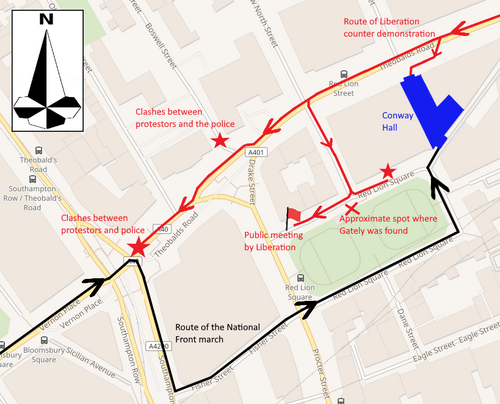
- The National Front: Approximately 900 strong, this group departed Tothill Street at 14:59. They marched through Parliament Square and the West End, arriving at the junction of Vernon Place and Southampton Row at 15:53. Using "defence parties" to protect their column, they reached the front entrance of Conway Hall by 16:20 without incident.
- The Liberation March: Comprising 1,000 to 1,500 people—many of whom were students in their late teens and early twenties—this group left the Embankment at 14:48. They arrived at the rear of Conway Hall at 15:33, with most continuing to Red Lion Square by 15:36.
The First Disturbance: Red Lion Square
Violence erupted when the Liberation march encountered a police cordon blocking access to the front of Conway Hall. While the lead 500 marchers moved toward their designated meeting area, a contingent from the International Marxist Group (IMG) launched what an official inquiry described as a "deliberate, determined and sustained attack" on the police line.
Demonstrators used smoke bombs, missiles, and placard staves as weapons. In response, Commissioner Gerrard deployed two SPG squads. The SPG utilized a V-shaped wedge formation to drive the crowd back and re-establish the cordon. By 15:50, the square was cleared of rioters.
The Death of Kevin Gately
During the SPG's surge to clear the square, peaceful demonstrators were caught in the movement. Among them was Kevin Gately, a student from Warwick. Photographic evidence shows Gately retreating unscathed before the second IMG surge; however, he was later found unconscious on the ground. He was treated at a St John Ambulance post and transported to University College Hospital, where he died four hours later. Gately's death marked the first fatality during a British demonstration in 55 years.
Subsequent Clashes
Southampton Row
Following the clearance of Red Lion Square, the IMG contingent moved to the junction of Theobalds Road and Southampton Row, where they were separated from the arriving National Front by a cordon of 120–140 officers. Just before 16:00, mounted police drove the Liberation marchers back down Theobalds Road without prior warning. Because the path was blocked by other police units, the demonstrators became trapped, leading to further violence and the widespread use of police truncheons.
Boswell Street
A final clash occurred in Boswell Street, where Chief Superintendent Adams ordered an SPG unit to clear approximately 70 IMG members. Despite challenges from journalists and some police sergeants regarding the necessity of the action, the SPG advanced, resulting in a violent confrontation and several arrests. Lord Scarman later noted that these arrests involved a "considerable degree of force."
Summary of the Day's Events
| Category | Details |
|---|---|
| Total Police Deployed | 923 (including 711 foot, 25 mounted, and 112 SPG) |
| National Front Strength | Approx. 900 |
| Liberation March Strength | 1,000 – 1,500 |
| Total Arrests | 51 (all from hard-left contingents) |
| Reported Injuries | 54 (46 police officers, 8 civilians) |
| Fatalities | 1 (Kevin Gately) |
Key Facts
- Historic Fatality: Kevin Gately was the first person to die during a demonstration in Britain in 55 years.
- Police Force: The Special Patrol Group (SPG) was used as a tactical wedge to break up crowds.
- Cordon Tactics: Violence was triggered by a police cordon blocking the front entrance of Conway Hall.
- Casualties: While only 54 injuries were officially reported, Lord Scarman suggested many more went unreported.
Frequently Asked Questions
Who was Kevin Gately?
Kevin Gately was a student from Warwick who participated in the Liberation march. He was found unconscious during the police clearance of Red Lion Square and died four hours later at University College Hospital.
What was the role of the Special Patrol Group (SPG)?
The SPG was a specialist mobile reserve of the Metropolitan Police designed to handle civil disturbances and serious crime. On 15 June 1974, they were used to drive demonstrators back using V-shaped wedge formations.
Did the National Front and the Liberation marchers clash directly?
No. Despite the proximity of the two groups, police cordons and the timing of their arrivals prevented direct contact between the main bodies of the two marches.
How many people were arrested during the disturbances?
A total of 51 people were arrested, all of whom were from the hard-left contingents.
What was the outcome of the Boswell Street incident?
The incident involved a clash between an SPG unit and about 70 IMG members. It resulted in several arrests that Lord Scarman later described as involving a "considerable degree of force."