Rangiaowhia: The Rise and Fall of a Waikato Agricultural Hub
In the mid-19th century, Rangiaowhia stood as a beacon of industry and prosperity in the Waikato region of New Zealand. Once described as a place that reminded observers of English farms, it was a thriving center of Māori agriculture, characterized by vast cornfields, orchards, and a sophisticated infrastructure of mills and bridges. This settlement was not merely a village but a vital economic engine that served as a granary for Auckland.
By 1852, the village spanned two miles with a population of approximately 700 people. The land was managed by 14 hapū (sub-tribes), who transformed the wilderness into productive farmland. The Waikato people cleared ancient forests and drained impassable swamps to create a network of roads and cultivated patches, ensuring that even seemingly barren fern lands were utilized for livestock such as horses, cattle, and pigs.
Key Facts
- Economic Power: Rangiaowhia was a major agricultural hub, producing wheat on 450 acres and exporting flour as far as San Francisco and Melbourne.
- Infrastructure: The village featured advanced milling operations, including the Pekapekarau mill and a later facility on the Te Rua-o-Tawhiwhi stream.
- Spiritual Centers: It hosted both Anglican (St Paul's Church) and Catholic (Holy Angels) missions.
- Tragic Turning Point: The village was attacked by Imperial forces on February 21, 1864, resulting in significant civilian casualties.
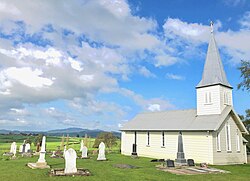
- Legacy: St Paul's Church remains one of the oldest surviving buildings in the Waikato.
Agricultural Prosperity and Industry
The agricultural success of Rangiaowhia began shortly after 1841. Wheat became a primary crop, eventually covering 450 acres. The diversity of produce was extensive, including barley, oats, potatoes, and a wide array of fruits such as peaches, apples, pears, plums, quinces, gooseberries, and almonds. To support this industry, a local blacksmith maintained the necessary ploughs and tools.
The Milling Economy
Milling was central to the village's wealth. In 1846, a mill was established at Pekapekarau using a scoria millstone sourced from Mt Eden. The commercial success of this venture was evident in the revenue; flour sales in Auckland grew from approximately £70 in 1848 to about £330 in later years. A second, more expensive mill was constructed between 1851 and 1855 on the Te Rua-o-Tawhiwhi stream.
The quality of Rangiaowhia's produce gained international reach during the gold rushes of 1849–52, with flour being shipped to Melbourne and San Francisco. The village's importance was further recognized by Governor Grey, who visited in 1849 and 1857, even sending bags of local flour to Queen Victoria.
Religious and Educational Foundations
Rangiaowhia was a center for both faith and learning, hosting two major mission stations.
St Paul's Church
Built between 1852 and 1856 in the Gothic Revival style, St Paul's Church replaced an earlier raupo chapel. It is one of the oldest surviving buildings in the Waikato. Notable features include stained glass windows depicting St Paul's encounter with a magician, believed to have been donated by Lady Burdett Coutts and brought from Britain by Bishop Selwyn in 1855. A steeple was added around 1857 by missionary teacher Taati Te Waru.
The Catholic Mission and Education
The Catholic Holy Angels mission station, established by Father Jean Pezant in 1844, was located north of St Paul's. While the church was demolished in 1931, the cemetery remains today with a memorial pou erected in 2015. Education was a priority for both missions; Rev. John Morgan's Anglican school taught English, singing, and religion to over 40 pupils, while Father Garaval's school hosted 24 boys before the outbreak of war in 1860.
The Invasion of 1864
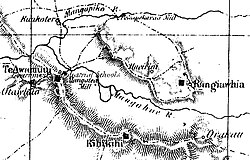
The political landscape shifted in 1858 when Pōtatau was installed as King at Rangiaowhia, making the village a target for government control. Despite the construction of defensive pā (fortified villages) at Paterangi and Rangiatea, General Cameron's forces bypassed these defenses by moving 1,230 troops overnight.
On February 21, 1864, Imperial cavalry and foot troops attacked the unfortified village. The population at the time consisted of about 200 Ngāti Apakura and Ngāti Hinetu people, primarily women, children, and the elderly. The attack resulted in the burning of houses and the deaths of civilians. While official British records cite 12 Māori deaths, unofficial estimates suggest the toll exceeded 100. Because the victims were largely non-combatants, the event is widely regarded as murder rather than a military engagement.
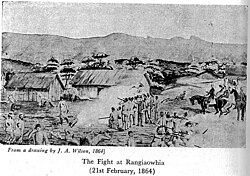
Following the attack, survivors attempted a defense at Hairini on February 22, which resulted in further casualties and the subsequent looting of the village. The aftermath saw the construction of a 200-man redoubt and a blockhouse in the 1870s to maintain military control.
Summary of Rangiaowhia's History
| Category | Details |
|---|---|
| Peak Population | Approx. 700 (c. 1852) |
| Primary Crops | Wheat (450 acres), barley, oats, potatoes, and various fruits |
| Key Infrastructure | Pekapekarau mill, Te Rua-o-Tawhiwhi mill, St Paul's Church |
| Major Conflict | Invasion of the Waikato (February 21, 1864) |
| Tribal Affiliations | Waikato tribe, including Ngāti Apakura and Ngāti Hinetu |
Frequently Asked Questions
What was the economic significance of Rangiaowhia?
Rangiaowhia was a powerhouse of Māori agriculture, acting as a primary food source for Auckland and exporting flour internationally to San Francisco and Melbourne during the gold rushes.
What is the significance of St Paul's Church today?
It is one of the oldest surviving buildings in the Waikato and serves as a historical witness to the village's growth and the 1864 attack, continuing to be used for services today.
Who were the primary victims of the 1864 attack?
The victims were primarily women, children, and the elderly from the Ngāti Apakura and Ngāti Hinetu people, who were sheltering in the unfortified village.
How did General Cameron capture the village?
He avoided the defensive pā at Paterangi and Rangiatea by moving 1,230 troops overnight via Waiari, allowing his forces to arrive at Te Awamutu by dawn.
When was the attack on Rangiaowhia officially commemorated?
A plaque was unveiled in 2014 to mark the 150th anniversary of the attack, as no memorials had existed for the victims until that time.