Rafic Hariri: The Life, Leadership, and Legacy of a Lebanese Prime Minister
Rafic Hariri (1944–2005) was a towering figure in Lebanese history, transitioning from a successful international businessman to a two-time Prime Minister. His tenure was marked by ambitious efforts to rebuild Lebanon's infrastructure and economy following years of conflict, as well as a complex political struggle against foreign influence in his home country.
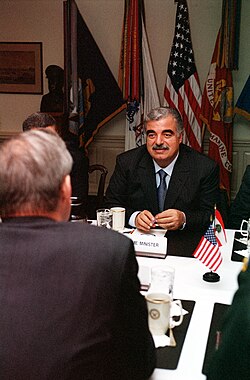
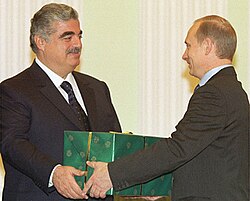
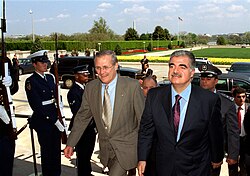
Hariri's influence extended far beyond the borders of Lebanon, maintaining high-level diplomatic ties with global powers, including the United States and Russia, to secure investment and political support for his vision of a modernized Lebanon.
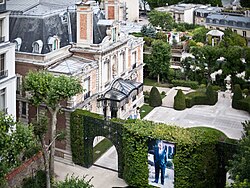
Key Facts
- Roles: Served as the 41st and 43rd Prime Minister of Lebanon.
- Terms in Office: 1992–1998 and 2000–2004.
- Economic Impact: Oversaw significant early growth in national income and the banking sector.
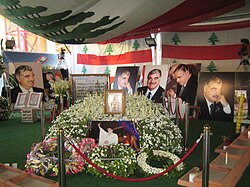
- Death: Assassinated on February 14, 2005, in a massive truck bombing in Beirut.
- Political Legacy: His death sparked the Cedar Revolution, leading to the withdrawal of Syrian forces from Lebanon.
Political Career and Premierships
Rafic Hariri entered the political arena as a businessman with a vision for reconstruction. He served as the Minister of Finance from 1992 to 1998 and was a member of the Parliament of Lebanon representing Beirut until his death.
First Premiership (1992–1998)
During his first term, Hariri implemented aggressive economic policies that yielded immediate results. Between 1992 and 1993, Lebanon saw a 6% increase in real national income, and the capital base of commercial banks effectively doubled. However, this initial success was followed by long-term instability. By 1998, real GDP growth slowed to approximately 1%, and the national debt surged by 540%, rising from $2 billion to $18 billion.
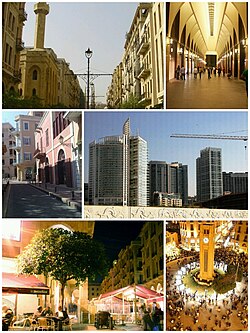
Second Premiership (2000–2004)
Hariri returned to office in October 2000. His second term was increasingly defined by the tension between Lebanese sovereignty and Syrian influence. In September 2004, he defended UN Security Council Resolution 1559, which demanded the withdrawal of all remaining foreign forces from Lebanon. This stance placed him in direct opposition to the Syrian administration.
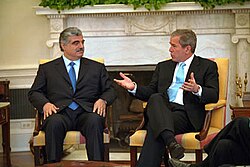
His diplomatic efforts were global in scope, involving meetings with key international figures to navigate Lebanon's precarious position.
The Assassination and Aftermath
On February 14, 2005, a suicide truck bomb containing approximately 1,800 kilograms of TNT detonated as Hariri's motorcade passed the St. George Hotel in Beirut. The explosion killed 23 people, including Hariri, several bodyguards, and former Minister of the Economy Bassel Fleihan.
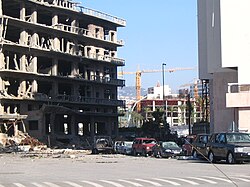
The assassination acted as a catalyst for the Cedar Revolution, a series of massive protests that demanded the withdrawal of Syrian troops and security forces from Lebanon. This period of civic action led to a fundamental shift in the Lebanese government.
The Special Tribunal for Lebanon
The investigation into the bombing was handled by the Special Tribunal for Lebanon (STL). The tribunal eventually indicted four members of Hezbollah's Unit 121. Salim Ayyash, the unit's leader, was convicted for his role in the attack. While the STL convicted three Hezbollah members before closing in 2023, it noted that there was no evidence the bombing was directed by the group's senior leadership.
Summary of Rafic Hariri's Political Tenure
| Term | Period | Key Focus/Outcome | Successor |
|---|---|---|---|
| First Term | 1992–1998 | Economic reconstruction; rapid initial growth; rising national debt. | Selim Hoss |
| Second Term | 2000–2004 | Diplomatic efforts; support for UNSC Resolution 1559; opposition to Syrian presence. | Omar Karami |
Frequently Asked Questions
Who was Rafic Hariri?
Rafic Hariri was a Lebanese businessman and politician who served twice as the Prime Minister of Lebanon (1992–1998 and 2000–2004) and was instrumental in the post-war reconstruction of Beirut.
What caused the Cedar Revolution?
The Cedar Revolution was triggered by the assassination of Rafic Hariri on February 14, 2005. The resulting public outrage led to massive protests that forced the withdrawal of Syrian troops from Lebanon.
Who was convicted of the assassination?
The Special Tribunal for Lebanon convicted Salim Ayyash, the leader of Hezbollah's Unit 121, and two other Hezbollah members. The tribunal found no evidence that the group's senior leadership ordered the attack.
What were the economic results of Hariri's first term?
Initially, his policies were successful, with a 6% increase in real national income and a doubling of the commercial banks' capital base. However, by 1998, GDP growth dropped to 1% and national debt rose to $18 billion.
What was UN Security Council Resolution 1559?
Resolution 1559 was a UN mandate that Hariri defended in 2004, which called for all remaining foreign forces to withdraw from Lebanese territory.