Radio Caroline and the MV Ross Revenge (1983–1991)
The story of Radio Caroline during the 1980s is inextricably linked to the MV Ross Revenge, a vessel that became a symbol of offshore broadcasting defiance. From its humble beginnings in a breakers' yard to its role as a floating radio station, the Ross Revenge navigated not only the treacherous waters of the North Sea but also the complex legal landscapes of international maritime law.
The journey began at the Cairnryan breakers' yard, where the Ross Revenge was identified as a suitable vessel for the Radio Caroline project. Ernst Kunz, a director of the Liechtenstein-based Simor Establishment, purchased the ship for £28,500. Under the heavy influence of Ronan O'Rahilly, the ship was registered in Panama to Grothan Steemship Lines, Inc., SA Panama.
In April 1981, the vessel was towed to Solares, where conversion work began in the autumn. The most striking addition was its transmitter mast, which reached 300 ft (91 m) above sea level—the tallest mast ever fitted to a ship.
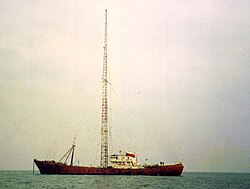
The Path to Broadcasting
The early 1980s were marked by financial and legal hurdles. In 1982, new investors joined the project, including James Ryan, who was later arrested for fraud. By May 1983, Caroline Communications acquired full legal ownership of the vessel. After a period of drydocking for a protective coating and resolving insurance issues regarding the lifeboats, the ship was finally ready for sea.
On 4 August 1983, under the command of Captain Martin Eve, the MV Ross Revenge set sail. Despite initial engine problems that required a tow by the Spanish tug MV Aznar Jose Luis, the ship dropped anchor in the Kentish Knock on 8 August. Following a test transmission on 963 kHz, the vessel shifted its anchorage to the Knock John Deep.
Challenges at Sea
Operating a radio station from a ship presented constant physical risks. In January 1984, the Ross Revenge lost its anchor and drifted into British waters, forcing a temporary halt in broadcasts. Later that March, a force twelve storm required the use of an emergency anchor, leading to the installation of a more robust anchor system.
Political shifts also forced the ship to move. On 10 June 1987, the station closed briefly for "maintenance" to relocate near South Falls Head. This move was a strategic response to the Territorial Sea Act, which extended British territorial waters from 3 miles (4.8 km) to 12 miles (19 km).
Nature struck again in November 1987. Rough weather caused the ship to list to 25°, and a subsequent force eight storm caused the antenna mast to collapse into the sea. While the ship suffered little other damage, transmissions ceased abruptly. A makeshift aerial was used until a new mast was completed by 27 January.
Logistics and Technical Infrastructure
Maintaining a floating station required a sophisticated supply chain. Small vessels from the English coast delivered crew, DJs, records, and newspapers. Fuel logistics evolved over time: diesel was initially brought from Nieuwpoort via the Zeemeeuw (hired in 1984), then via the Poolster during the 1985 "Eurosiege" (where the Dutch naval minesweeper HNLMS Makkum anchored nearby), and finally via the Bellatrix operating from Dunkirk starting in December 1986.
Technical Specifications
The Ross Revenge was a powerhouse of broadcasting technology, utilizing three transmitters:
- Main Transmitter: A 50 kW RCA BTA-50H.
- Secondary Transmitter: A 10 kW BTA-10H, used for a second service.
- Shortwave Transmitter: A 5 kW unit, originally for spare parts, later converted for a third service.
The electrical system transitioned from a purely DC-based setup—powered by two Deutz 6-cylinder generators (120 kW each), an MWM harbour generator (35 kW), and a shaft generator—to include AC power. Two identical 250 KVA generators were installed, allowing for easy maintenance through part-swapping. Later, a 500 KVA generator and a new main switchboard were added to support plans for another 50 kW transmitter.
| Feature | Detail |
|---|---|
| Purchase Price | £28,500 |
| Max Mast Height | 300 ft (91 m) |
| Primary Transmitter | 50 kW RCA BTA-50H |
| AC Power Generation | 2 x 250 KVA generators |
| Registration | Panama (9625-POXT) |
The Armed Raid and Evacuation
On 19 August 1989, the station faced a severe crisis when the Dutch Government launched an armed raid. Approximately 30 armed men from the Dutch Water Police tug Volans, including officials from the UK, France, and Belgium, boarded the ship. They dismantled the aerial array, removed studio equipment, and used sledgehammers to destroy transmitter components.
Despite the devastation, the crew remained resilient. Using hidden parts and a makeshift transmitter, they returned to the air on 1 October, gradually increasing power as technical issues were resolved.
The end of this era came in late 1990. A series of power failures left the ship unlit, violating maritime regulations. Following a force nine storm on 10 December that washed petrol supplies overboard and disabled the backup generator, the crew was evacuated by helicopter at 23:45.
The ship was declared abandoned by the Dover Coast Guard. However, on 14 December, main engineer Peter Chicago and Tony Collis successfully boarded and regained control of the vessel to prevent it from being claimed by foreign salvage tugs.
Key Facts
- Record-Breaking Mast: The Ross Revenge featured the tallest mast ever fitted to a ship at 300 ft.
- Strategic Relocation: The ship moved in 1987 to avoid the extension of British territorial waters to 12 miles.
- Resilience: The station resumed broadcasting shortly after a violent 1989 raid by Dutch and international officials.
- Technical Versatility: The ship operated three different transmitters to provide multiple services.
Frequently Asked Questions
Why did the Ross Revenge move its anchorage in 1987?
The ship moved to a position near South Falls Head to stay outside the new 12-mile limit established by the Territorial Sea Act, as the previous 3-mile limit had been extended.
What happened during the 1989 raid?
Armed Dutch Water Police and international officials boarded the ship, destroyed transmitter components with sledgehammers, and removed studio equipment and records.
How did the ship handle power generation for its transmitters?
The ship used a combination of DC generators and two identical 250 KVA AC generators, which allowed the crew to swap parts easily for maintenance.
Why was the ship evacuated in December 1990?
A combination of fuel shortages, generator failure, and a force nine storm left the ship unlit and powerless, prompting an emergency evacuation by helicopter.
Who regained control of the ship after it was abandoned?
Main engineer Peter Chicago and Tony Collis boarded the ship on 14 December 1990 to prevent foreign salvage tugs from claiming the vessel.