Pulsatilla pratensis: The Small Pasque Flower
The Pulsatilla pratensis, commonly known as the small pasque flower, is a delicate and captivating herbaceous perennial. A member of the Ranunculaceae family, this species is a hallmark of the European landscape, bringing color to meadows and open plains during the early spring months.
Named with the Latin specific epithet pratensis—which translates to "from the meadow"—this plant is perfectly suited to its namesake habitat. From the coastal lowlands of Scandinavia to the high-altitude regions of Southern Europe, this resilient wildflower plays a vital role in its native ecosystems.
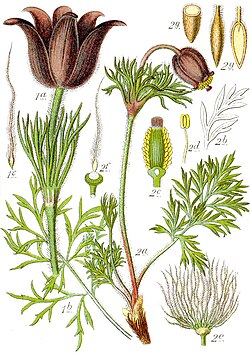
Anemone pratensis from the Deutschlands Flora in Abbildungen, 1796
Botanical Characteristics and Appearance
The small pasque flower is a compact plant, typically reaching heights between 8 and 30 cm (3–12 in). One of its most striking features is its foliage; the leaves are finely divided and thread-like, characterized by a dense covering of silvery hairs that give the plant a soft, textured appearance.
During the early to mid-spring, the plant produces pendulous, bell-like flowers that measure approximately 2–3 cm (0.8–1.2 in) in length. These hermaphrodite flowers (containing both male and female reproductive organs) feature tepals with reflexed tips. While the flower color is often a vibrant purple in the northern parts of its range, it transitions to a greenish-violet hue in southern regions. These blooms are primarily pollinated by bees.
Key Facts
- Scientific Name: Pulsatilla pratensis (L.) Mill.
- Family: Ranunculaceae
- Native Range: Central and Eastern Europe (from Norway and Denmark to Bulgaria).
- Habitat: Meadows and open sand-plains; can grow from sea level up to 2,100 m.
- Flowering Season: Early to mid-spring.
- Toxicity: The plant is toxic, though toxicity can be dissipated through drying or heat.
Classification and Subspecies
Taxonomically, Pulsatilla pratensis belongs to the order Ranunculales. Because of its wide distribution and varying environmental adaptations, several subspecies have been identified:
- Pulsatilla pratensis subsp. pratensis
- Pulsatilla pratensis subsp. bohemica Skalický
- Pulsatilla pratensis subsp. hungarica (Soó) Soó
- Pulsatilla pratensis subsp. nigricans (Störck) Zämelis
- Pulsatilla pratensis subsp. ucrainica (Ugr.) ined.
- Pulsatilla pratensis nothosubsp. zichyi (Schur) Zämelis & Paegle
The Conservation Status of Subsp. hungarica
The subspecies P. pratensis subsp. hungarica is of particular conservation interest. Found in Eastern Slovakia, Northwest Romania, and Northeast Hungary, it prefers open sand-plains and avoids limestone environments. In Slovakia and Romania, it is categorized as critically endangered (CR), while in Hungary, it is protected by law and found specifically in the Nyírség and Bodrogköz regions.
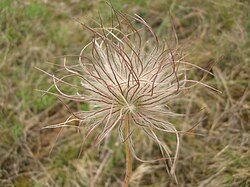
Seedhead of subsp. hungarica
Scientific Classification Summary
| Rank | Classification |
|---|---|
| Kingdom | Plantae |
| Clade | Embryophytes, Tracheophytes, Angiosperms, Eudicots |
| Order | Ranunculales |
| Family | Ranunculaceae |
| Genus | Pulsatilla |
| Species | P. pratensis |
Frequently Asked Questions
What does the name Pulsatilla pratensis mean?
The specific epithet pratensis means "from the meadow," which describes the plant's typical natural habitat.
Is the small pasque flower safe to touch or consume?
No, the plant is toxic. However, it is noted that its toxicity can be dissipated through the application of heat or by drying the plant.
When does this plant typically bloom?
The flowering period for Pulsatilla pratensis occurs during the early to mid-spring season.
What colors can the flowers be?
Flower colors vary depending on the geographic location, ranging from purple in northern ranges to greenish-violet in southern ranges.
How tall can the plant grow?
This herbaceous perennial typically grows to a height of between 8 and 30 cm.