Pueblo Peoples: A History of Culture, Architecture, and Resistance
The history of the Pueblo peoples is a narrative of adaptation, architectural brilliance, and enduring resilience. Long before European contact, the Southwest United States was home to sophisticated societies that mastered the harsh desert environment through innovative farming and urban planning. These cultures laid the foundation for the modern Pueblo communities, blending diverse traditions into a rich cultural tapestry.
Origins of the Pueblo Cultures
Pueblo societies emerged from the convergence of three primary ancestral cultures that dominated the region: the Mogollon, the Hohokam, and the Ancestral Puebloans.
The Mogollon Culture
Located near the Gila Wilderness, the Mogollon people began as foragers who gradually integrated farming into their lives. By the first millennium CE, agriculture became their primary food source. Between the 10th and 12th centuries CE, the Mimbres branch of this culture developed advanced water control features. Their housing evolved from small hamlets of pithouses—dwellings excavated into the ground with stick and thatch roofs—to larger villages with ground-level rock and earth walls by the 11th century. By the 13th and 14th centuries, cliff-dwellings became a common feature of their settlements.
The Hohokam Culture
The Hohokam, a term from the O'odham language, were masters of irrigation. As early as the 9th century CE, they utilized complex canal systems to water crops, allowing them to become the largest population in the Southwest by 1300. Evidence from the Tucson Basin suggests their ancestors may have occupied southern Arizona as early as 2000 BCE, practicing sedentary village life and corn cultivation. The Hohokam served as a central trade hub, linking the Patayan of the Lower Colorado River and southern California, the Trincheras of Sonora, the Mogollon, and the Ancestral Puebloans.
The Ancestral Puebloans
The Ancestral Puebloans are most famous for their stunning stone and earth dwellings built into cliff walls between 900 and 1350 CE. These multi-storied complexes often surrounded open plazas and were linked by extensive transportation roadways that supported outlying regions. While they eventually built the iconic cliff dwellings accessible only by rope or climbing, their earliest homes were pithouses from the Basketmaker periods. Their architectural designs show influences from as far away as present-day Mexico.
Development of Architecture and City-States
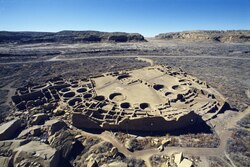
Between 700 and 900 CE, a significant architectural shift occurred as Pueblo people transitioned from cliff-dug pithouses to connected rectangular rooms made of adobe (a natural building material made from earth and organic materials). By 1050, they had developed planned villages featuring large terraced buildings.
These villages were often strategically placed on defensive sites, such as steep-sided mesas or flat summits, to protect residents from raiding parties like the Navajo and Comanche. The pinnacle of this urban development was Pueblo Bonito in Chaco Canyon, New Mexico, which featured approximately 700 rooms across five stories and could house up to 1,000 people.
Spanish Contact and Colonization
Spanish presence in Pueblo lands remained limited until 1598, when Juan de Oñate led a colonization effort as part of an apostolic mission to convert the Native population to Catholicism. The Pueblo people were governed by the cacique, a theocratic leader responsible for both spiritual and material matters. The Spanish attempts to forcibly replace the Pueblo religion with Catholicism led to increasing aggression and subsequent resistance from the Native populations.
The Pueblo Revolt of 1680
The Pueblo Revolt stands as the first successful Native American uprising to expel European colonists from North America for a significant period. This organized resistance was the result of decades of abuse and environmental hardship, including a severe drought in the 1670s that caused famine and increased Apache raids.
The tension peaked in 1675 when Governor Juan Francisco Treviño arrested 47 Pueblo medicine men on charges of sorcery. Three were hanged, and others were whipped and imprisoned. Among those released after a show of force by Pueblo leaders was Popé, an Ohkay Owingeh Tewa man. Popé spent five years coordinating a massive alliance among 46 Pueblo villages, including the Northern Tiwa, Tewa, Towa, Tano, and Keres-speaking groups, as well as the Zuni and Hopi.
On August 10, 1680, the signal for the uprising was sent via knotted ropes carried by runners; each knot represented a day to wait. On August 21, 2,500 Pueblo warriors captured Santa Fe and expelled the remaining Spanish colonists.
Modern Legacy and Recognition
The legacy of Pueblo resistance and leadership continues into the 21st century. In 2005, a statue of Popé, created by Jemez Pueblo sculptor Cliff Fragua, was unveiled in the U.S. Capitol Rotunda. It is the only statue in the National Statuary Hall Collection created by a Native American.
Political representation has also evolved, with Deb Haaland becoming the first Pueblo woman elected to the U.S. House of Representatives in 2018, and later serving as the first Native American Secretary of the Interior from 2021 to 2025.
Key Facts
- Three Core Cultures: The Pueblo peoples originated from the Mogollon, Hohokam, and Ancestral Puebloan cultures.
- Architectural Evolution: Housing progressed from underground pithouses to massive multi-story adobe complexes like Pueblo Bonito.
- Irrigation Mastery: The Hohokam developed sophisticated canal systems as early as the 9th century CE to support large populations.
- The 1680 Revolt: Led by Popé, this uprising successfully expelled Spanish colonists from New Mexico.
- Historic Firsts: Deb Haaland is the first Pueblo woman in the U.S. House and the first Native American Secretary of the Interior.
| Culture | Primary Region | Key Characteristic | Notable Housing |
|---|---|---|---|
| Mogollon | Gila Wilderness | Early farming and water control | Pithouses to cliff-dwellings |
| Hohokam | Southern Arizona | Advanced irrigation canals | Sedentary villages |
| Ancestral Puebloan | Four Corners Area | Large-scale urban planning | Multi-story stone/adobe complexes |
Frequently Asked Questions
What is a pithouse?
A pithouse is an early form of dwelling excavated into the ground surface, featuring a roof made of sticks and thatch supported by posts and beams, and an exterior faced with earth.
Who was Popé?
Popé was an Ohkay Owingeh Tewa man and leader who coordinated the Pueblo Revolt of 1680, successfully uniting various Pueblo villages to expel Spanish colonizers from the region.
What was the significance of Pueblo Bonito?
Pueblo Bonito, located in Chaco Canyon, was one of the largest ancestral villages, containing roughly 700 rooms across five stories and housing up to 1,000 people.
How did the Hohokam manage to sustain a large population?
The Hohokam utilized sophisticated irrigation canal systems to water their crops, which allowed them to expand and become the largest population in the Southwest by 1300.
What role did the cacique play in Pueblo society?
The cacique served as a theocratic leader, managing both the material and spiritual affairs of the community.