Province of West Jersey
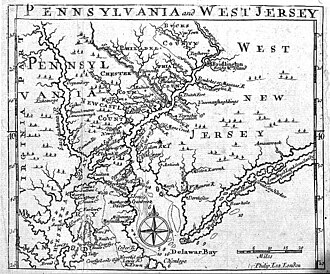
Between 1674 and 1702, the region now known as New Jersey was split into two distinct political entities: West Jersey and East Jersey. The Province of West Jersey operated as a proprietary colony of England, characterized by its unique settlement patterns and a long-standing struggle to define its physical borders. With its capital in Burlington, this colony played a pivotal role in the early European colonization of the Delaware Valley.
Key Facts
- Duration: Existed for 28 years, from 1674 to 1702.
- Capital: Burlington.
- Government Type: Proprietary colony.
- Key Figures: Lords Proprietor Edward Byllynge and John Fenwick.
- Currency: Pound sterling.
- Preceded by: Dominion of New England.
- Succeeded by: Province of New Jersey.
Early Settlement and the Delaware Valley
Long before European arrival, the Delaware Valley was inhabited by the Lenape (also known as the Delaware) Indians. European exploration began around 1609, involving the Dutch, Swedish, and English. While the Dutch West India Company initially established settlements along the Delaware River, they shifted their focus to Manhattan, making it the center of New Netherland by the late 1620s.
In 1638, the colony of New Sweden began developing the lower Delaware Valley, primarily on the west side of the river. To counter English efforts to re-establish Fort Nassau, the Swedes built Fort Nya Elfsborg in what is now Salem County, situated between present-day Salem and Alloway Creek. This era saw the creation of two primary settlements: Sveaborg (now Swedesboro) and Nya Stockholm (now Bridgeport). Trinity Church in Swedesboro served as the regional center for the Church of Sweden.
The Dutch eventually defeated New Sweden in 1655, and European settlement remained sparse until the English conquest in 1664. By the late 1670s, the region saw a surge of Quaker settlers, who first established themselves in Salem County before moving to Burlington, which subsequently became the capital of West Jersey.
Administration and Boundary Disputes
The governance of West Jersey was managed by Lords Proprietor, including Edward Byllynge and John Fenwick. Byllynge served as the first governor from 1680 to 1687, while Andrew Hamilton served as the final governor from 1699 to 1702.
One of the most enduring challenges for the colony was the demarcation of its borders. Before 1674, land surveyors viewed New Jersey as a "hundred" and divided it into tenths. West Jersey comprised five of these tenths. However, the actual physical boundaries remained disputed for years, as demarcation depended on settlement, the payment of quit-rents (land taxes paid to a proprietor), and the funding of professional surveys.
At least three separate surveys were conducted to resolve these disputes. Richard Tindall served as the surveyor-general for Fenwick's Colony, which represented the fifth tenth. On May 17, 1694, Burlington County was officially formed by combining the first and second tenths.
| Category | Details |
|---|---|
| Time Period | 1674–1702 |
| Status | English Proprietary Colony |
| Capital | Burlington |
| Primary Language | English |
| Key Settlements | Burlington, Swedesboro, Bridgeport |
| Successor State | Province of New Jersey |
Frequently Asked Questions
How long did the division between West and East Jersey last?
The political division between West Jersey and East Jersey lasted for 28 years, from 1674 until 1702.
Who were the primary European groups that settled the area before the English?
Before the English conquest in 1664, the region was settled by the Dutch and the Swedes, with the Swedes establishing New Sweden in the lower Delaware Valley.
What was the role of the Quakers in West Jersey?
Quakers settled in great numbers starting in the late 1670s, first in Salem County and later in Burlington, which became the colony's capital.
Why were the boundaries of West Jersey so difficult to determine?
Boundary determination was delayed because it required actual settlement, the payment of quit-rents to fund surveying, and multiple conflicting surveys to resolve disputes over the "tenths" of the land.
Who were the first and last governors of West Jersey?
The first governor was Edward Byllynge (1680–1687) and the last governor was Andrew Hamilton (1699–1702).