Progressive Party Platform and the Vision of New Nationalism
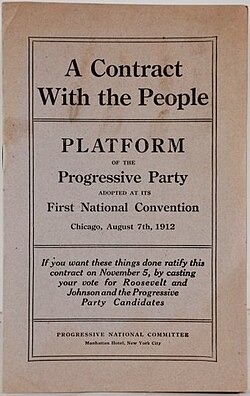
At the heart of the Progressive Party's emergence was its platform, a comprehensive blueprint for social and political reform designed to appeal to a broad spectrum of voters. Drafted in part by Charles McCarthy, the platform sought to dismantle the influence of corporate interests over the American government and establish a more equitable society.
The central theme of the platform was the eradication of the "invisible Government"—the perceived unholy alliance between corrupt business interests and political leaders. The party argued that both the Republican and Democratic parties had fallen under the domination of business interests, and that the primary task of modern statesmanship was to dissolve this connection.
Key Facts
- Core Objective: To end the domination of politics by business interests and corporate monopolies.
- Political Strategy: Implementation of "direct democracy" tools like the recall, referendum, and initiative.
- Social Vision: Establishment of a National Health Service and social insurance for the elderly, disabled, and unemployed.
- Economic Philosophy: Based on Roosevelt's "New Nationalism," favoring strong federal regulation of industry.
- Key Conflict: A deep party split occurred over whether to "bust" trusts or simply regulate them.
Political and Governmental Reforms
To combat corruption and increase transparency, the Progressive Party proposed strict limits and disclosure requirements for political campaign contributions. They further advocated for the mandatory registration of lobbyists and the public recording and publication of all congressional committee proceedings.
Expanding Democratic Participation
The platform championed several measures to shift power from political machines to the people, including:
- Women's suffrage: Granting women the right to vote.
- Direct election of senators: Removing the appointment process by state legislatures.
- Primary elections: Using primaries for both state and federal nominations.
Mechanisms of Direct Democracy
The party urged states to adopt four specific tools of direct democracy to empower citizens:
- Recall election: Allowing citizens to remove an elected official before their term expires.
- Referendum: Allowing citizens to decide on a law via popular vote.
- Initiative: Allowing citizens to propose a law by petition and enact it through a popular vote.
- Judicial referendum: Allowing citizens to override a court's ruling that a law is unconstitutional.
Social and Economic Initiatives
The platform's social agenda was ambitious, aiming to provide a safety net for the vulnerable and protect the rights of workers. This included the creation of a National Health Service that would consolidate all existing government medical agencies, as well as social insurance for the unemployed, disabled, and elderly.
Labor and economic protections were also central, with calls for a minimum wage law for women, an eight-hour workday, and workers' compensation for injuries sustained on the job. To fund these initiatives and manage the economy, the platform proposed an inheritance tax, a federal securities commission, farm relief, and a constitutional amendment to permit a federal income tax.
| Category | Proposed Measures |
|---|---|
| Political Reform | Women's suffrage, direct election of senators, primary elections, lobbyist registration. |
| Direct Democracy | Recall, referendum, initiative, and judicial referendum. |
| Social Welfare | National Health Service, social insurance, minimum wage for women, 8-hour workday. |
| Economic/Fiscal | Federal income tax, inheritance tax, federal securities commission, farm relief. |
| Foreign/Trade | Tariff reductions, naval armament limits, inland waterway improvements. |
New Nationalism and Internal Conflict
The platform was a reflection of Theodore Roosevelt's New Nationalism, a paternalistic philosophy that envisioned a strong federal government capable of regulating industry, protecting the working and middle classes, and executing large-scale national projects. This stood in direct contrast to the individualistic "New Freedom" philosophy championed by Woodrow Wilson.
However, this vision led to significant internal strife. The most contentious issue was the treatment of trusts and monopolies, such as Standard Oil. While the convention initially approved a strong "trust-busting" plank (the active breaking up of monopolies), Roosevelt replaced it with language favoring "strong National regulation" and "permanent active [Federal] supervision." This shift, attributed by some reformers like Pinchot to the influence of U.S. Steel director Perkins, created a permanent split within the party.
Roosevelt's approach to foreign policy was similarly vigorous. While the platform mentioned limiting naval armaments through international agreements, Roosevelt simultaneously recommended building two new battleships per year, a position that distressed pacifists such as Jane Addams.
Frequently Asked Questions
What was the primary goal of the Progressive Party platform?
The primary goal was to reverse the domination of American politics by business interests and dissolve the alliance between corrupt business and corrupt politics.
How did "New Nationalism" differ from "New Freedom"?
New Nationalism, advocated by Roosevelt, believed in a strong, paternalistic government to regulate industry and protect citizens, whereas New Freedom was an individualistic philosophy.
What are the four tools of direct democracy mentioned in the platform?
The four tools were the recall (removing officials), the referendum (voting on laws), the initiative (proposing laws by petition), and the judicial referendum (overriding court rulings on constitutionality).
Why did a split occur within the Progressive Party?
The split was caused by a disagreement over trusts; reformers wanted to "bust" monopolies, but Roosevelt opted for federal regulation and supervision instead.
What social protections did the platform propose for workers?
The platform called for an eight-hour workday, a minimum wage for women, and workers' compensation for work-related injuries.