Prince Mired: Championing Disability Rights and Global Mine Ban Efforts
Prince Mired has dedicated his career to the intersection of humanitarian aid, military rehabilitation, and the protection of human rights. Through a series of high-level appointments and international diplomatic missions, he has become a leading voice in the global effort to eliminate anti-personnel mines and ensure that persons with disabilities have the support and legal protections they deserve.
Key Facts
- Special Envoy for the Universalization of the Anti-Personnel Mine Ban Convention.
- Head of the Higher Council for the Rights of Persons with Disabilities in Jordan.
- Chairman of the National Commission for Demining and Rehabilitation of Jordan.
- Chair of the Jordanian Paralympic Committee.
- Presided over the Eighth Meeting of the States Parties to the Ottawa Treaty in 2008.
Leadership in Disability Rights and Rehabilitation
In April 2014, a Royal Decree appointed Prince Mired as the Head of the Higher Council for the Rights of Persons with Disabilities, succeeding Prince Ra'ad bin Zaid. In this capacity, he has been a primary advocate for Jordan's adherence to the Convention on the Rights of Persons with Disabilities, an international treaty designed to protect the rights and dignity of people with disabilities.
His commitment to rehabilitation extends to those who have served in the armed forces. As the head of the Hashemite Commission for Injured Military Personnel and former Vice President of the Supreme Council for the Affairs of Disabled Persons, he provides critical support to Jordanian military veterans injured in the line of duty.
Beyond policy and healthcare, Prince Mired promotes inclusivity through athletics. As the chair of the Jordanian Paralympic Committee, he works to expand sports opportunities and visibility for disabled athletes.
Global Advocacy for a Mine-Free World
Prince Mired has played a pivotal role in the implementation of the Ottawa Treaty (the Convention on the Prohibition of the Use, Stockpiling, Production and Transfer of Anti-Personnel Mines and on Their Destruction). In 2008, he presided over the treaty's Eighth Meeting of the States Parties held at the Dead Sea.
Following this mandate, he was appointed as a Special Envoy to promote the universalization of the mine ban. This role has involved extensive diplomatic travel to encourage non-member states to join the convention and to support victims of landmines worldwide.
His diplomatic efforts have spanned several continents and decades:
- Europe: Early missions to Finland (meeting Foreign Minister Alexander Stubb) and Poland to promote treaty norms.
- Asia: High-level meetings in China with Vice Minister of Foreign Affairs Li Baodong, and in Mongolia with Prime Minister S. Batbold.
- Oceania: Visits to Tonga (meeting Lord Tu'ivakano) and Tuvalu (meeting Prime Minister Willy Telavi and Minister Apisai Lelemia).
- North America: A 2010 mission to the United States to meet with Samantha Powers.
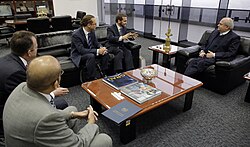
Recent Diplomatic Missions
In 2018, Prince Mired conducted an extensive tour of Asia. In Sri Lanka, he met with President Maithripala Sirisena, Prime Minister Ranil Wickremesinghe, and other key officials including Minister of Prison Reform Deva Manoharan Swaminathan. He also visited Myanmar, meeting with Minister of International Cooperation U Kyaw Tin and Minister of Defence Lt. Gen. Sein Win.
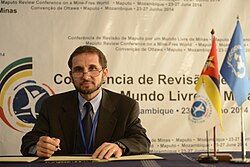
His efforts continued in Laos, where he engaged with Prime Minister Thongloun Sisoulith and various ministers of foreign affairs, defence, and social welfare. In February 2016, he further solidified these efforts by signing the Maputo Declaration for a Mine-Free World in Mozambique.
In 2019, Prince Mired joined Princess Astrid of Belgium and Crown Prince Haakon of Norway in Oslo to launch a global meeting on landmines, marking twenty years since the adoption of the original treaty.
Summary of Leadership Roles
| Organization/Role | Primary Focus | Key Objective |
|---|---|---|
| Higher Council for the Rights of Persons with Disabilities | Human Rights | Upholding the Convention on the Rights of Persons with Disabilities |
| National Commission for Demining and Rehabilitation | Mine Action | Landmine clearance and community support |
| Jordanian Paralympic Committee | Sports | Promoting opportunities for disabled athletes |
| Special Envoy for the Mine Ban Convention | International Diplomacy | Universalization of the Ottawa Treaty |
| Hashemite Commission for Injured Military Personnel | Veteran Affairs | Support for injured military veterans |
Frequently Asked Questions
What is the Ottawa Treaty?
The Ottawa Treaty, formally known as the Convention on the Prohibition of the Use, Stockpiling, Production and Transfer of Anti-Personnel Mines and on Their Destruction, is an international agreement that bans the use of anti-personnel landmines.
What is Prince Mired's role regarding disability rights in Jordan?
He serves as the Head of the Higher Council for the Rights of Persons with Disabilities, where he ensures Jordan meets its international obligations under the Convention on the Rights of Persons with Disabilities.
Which countries has Prince Mired visited as a Special Envoy?
His missions have included visits to the United States, Mongolia, South Korea, Tonga, Tuvalu, China, Sri Lanka, Myanmar, Laos, Finland, and Poland.
How does Prince Mired support military veterans?
He leads the Hashemite Commission for Injured Military Personnel, providing dedicated support to Jordanian veterans who suffered injuries during their service.
What was the significance of the 2019 Oslo meeting?
Prince Mired, alongside royalty from Belgium and Norway, helped kick off a global meeting in Oslo to mark the 20th anniversary of the adoption of the landmine treaty.