Primary Election Reform: Regional and Lottery-Based Proposals
The structure of primary elections significantly influences how candidates campaign and how voters engage with the democratic process. To address current inefficiencies and strategic imbalances, several structural reforms have been proposed to reorganize the timing and geography of primary contests.
The Lottery System Proposal
Larry Sabato, Director of the University of Virginia Center for Politics, suggests a lottery system in his book A More Perfect Constitution. Under this model, the country would be divided into specific regions, but the sequence in which these regions hold their primaries would not be fixed.
Instead, the order would be randomly selected approximately six months before the first primary. The primary goal of this randomization is to prevent candidates from "camping out"—spending disproportionate time and resources—in states that traditionally vote early.
To ensure fairness over multiple election cycles, the lottery could be adjusted with specific rules, such as preventing a single region from being selected twice in a row or barring a region from going first if it held that position in the previous two cycles.
Politically Balanced Regions
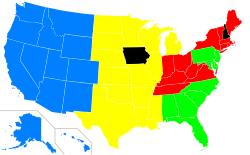
A common critique of standard regional systems is the inherent political imbalance; for instance, the East is often viewed as liberal while the South is seen as conservative. To counter this, some propose creating politically balanced regions based on historical voting stability.
In this model, regions are grouped by political leaning rather than strict geography. For example, instead of grouping Pennsylvania, Maryland, and New Jersey with New York and New England, a balanced region might instead include Ohio, Indiana, and Kentucky. While this approach sacrifices contiguity (the physical touching of borders) and regional identity, it ensures that each primary block represents a more diverse political spectrum.
Streamlining the Primary Schedule
To increase efficiency, another proposal suggests a combination of the final two regions. In this scenario, after the first and second regions have completed their primaries, the remaining two regions would merge to hold one final primary.
This modification would shorten the overall primary schedule and eliminate the likelihood of a fourth primary occurring after the party nominees have already been effectively selected.
Key Facts
- Larry Sabato proposed a lottery system to stop candidates from focusing exclusively on early primary states.
- The lottery selection would occur roughly six months before the first primary.
- Politically balanced regions prioritize voting patterns over geographic contiguity.
- Combining the final two regions aims to prevent primaries from continuing after nominees are chosen.
| Proposal | Primary Goal | Trade-off |
|---|---|---|
| Lottery System | Prevent candidate "camping" | Less predictability for campaigns |
| Balanced Regions | Political neutrality | Loss of geographic contiguity |
| Combined Final Regions | Shorter schedule | Fewer distinct primary windows |
Frequently Asked Questions
Who proposed the lottery system for primaries?
The lottery system was proposed by Larry Sabato, the Director of the University of Virginia Center for Politics, in his book A More Perfect Constitution.
How does the lottery system prevent candidates from "camping out"?
By selecting the order of the primaries randomly only six months before they begin, candidates cannot predict which states will vote first, discouraging them from focusing their resources on a few specific early states.
What is the main disadvantage of politically balanced regions?
The primary disadvantage is the loss of regional identity and geographic contiguity, as states that are not physically adjacent may be grouped together to achieve political balance.
Why would the final two regions be combined?
Combining the final two regions shortens the primary calendar and ensures that the process does not continue unnecessarily after the nominees have already been selected.
Can the lottery system be modified for fairness?
Yes, it can be adjusted to prevent a region from being picked twice in a row or to ensure a region that went first in the last two cycles does not go first again.