Pretoria–Maputo Railway
The Pretoria–Maputo railway, historically known as the Delagoa Bay railway, the Iron railway, or the Eastern railway, serves as a vital transportation artery connecting Pretoria, South Africa, to the Port of Maputo in Mozambique. Spanning 567 kilometers, this line facilitates critical trade and logistics between the interior of South Africa and the Indian Ocean.
The railway utilizes a Cape gauge (1,067 mm), a standard track width common across much of Southern Africa. Operationally, the line is split between two national entities: the Mozambican section from Maputo to Ressano Garcia is managed by the state-owned Mozambique Ports and Railways (CFM), where it is known as the Ressano Garcia Line. The South African section, stretching from Komatipoort to Pretoria, is administered by Transnet Freight Rail (TFR).
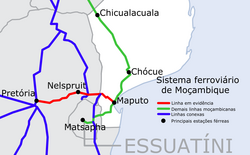
Key Facts
- Total Length: 567 km (352 mi).
- Track Gauge: 1,067 mm (3 ft 6 in).
- Primary Termini: Port of Maputo (Mozambique) and Pretoria (South Africa).
- Operators: CFM (Mozambique) and Transnet Freight Rail (South Africa).
- Opening Date: Fully opened to traffic on November 2, 1894.
- Primary Hub: The Port of Maputo serves as the main maritime logistics facility.
Historical Development
The journey to connect the Republic of Transvaal with the port of Lourenço Marques (now Maputo) in Portuguese East Africa was marked by significant planning hurdles. While a private company won a concession in 1870, a lack of initial capital forced the government to take control of construction in 1876. Between 1881 and 1882, Portuguese engineer Joaquim José Machado surveyed the land to ensure the route provided easy access to gold fields located on both sides of the Crocodile River.
The Mozambican portion of the line, reaching the border station at Ressano Garcia, opened first on March 1, 1890. However, the South African side faced geographic challenges, including deep valleys and steep mountains near Komatipoort. These terrain difficulties, combined with the loss of a half-million-pound financing contract in Amsterdam during the 1880s, delayed progress.
Construction finally began on June 2, 1887, and concluded on October 20, 1894. The line officially opened on July 8, 1895, in a ceremony attended by Transvaal President Paul Kruger and Mozambican colonial administrator António Enes.
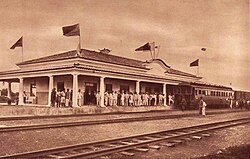
Evolution of Ownership
Initially, the Netherlands–South African Railway Company (NZASM) operated the South African section. Following the Second Boer War, ownership shifted to the private Central South African Railways, and eventually to the state-owned Railways of South Africa in 1910.
In 1983, under the government of P. W. Botha, South Africa sought greater economic self-sufficiency to counter the isolation caused by apartheid. This led to the construction of the Komatipoort railway through Eswatini, which eventually connected to the Goba railway and the Port of Richards Bay, ensuring a politically secure export route for Eastern South Africa.
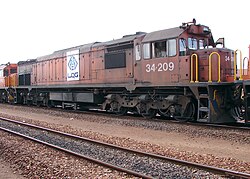
Railway Infrastructure and Network
The Pretoria–Maputo line is supported by several specialized branches and strategic connections that integrate it into the broader regional economy.
Important Branches
- Kaapmuiden–Barberton: Connects Kaapmuiden to Barberton.
- Burgersfort: Links Belfast to the Tubatse Ferrochrome mines.
- Middelburg: Connects Middelburg to the Mapochs Magnetite Iron mines in Roossenekal.
- Cullinan: Links Rayton to the Cullinan Diamond Mine.
- Tshwane: Connects the city of Tshwane to Ekangala.
- Koedoespoort: A dedicated branch for maneuvering and repairs in Pretoria.
Strategic Connections
The line intersects with various other routes to maximize efficiency:
- Maputo: Connects with the Limpopo and Goba railways.
- Komatipoort: Connects with the Komatipoort railway.
- Matsulu / Kaapmuiden: Connects with the Morebeng–Matsulu railway.
- Machadodorp: Connects with the Machadodorp–Ermelo railway.
- Wonderfontein: Connects with the Koornfontein railway.
- Witbank: Connects with the Witbank-Klipspruit railway.
- Pretoria: Connects with the Sentrarand railway and the Cape to Cairo Railway (Metrorail Gauteng).
Technical Summary
| Feature | Detail |
|---|---|
| Total Length | 567 km (352 mi) |
| Track Gauge | 1,067 mm (Cape gauge) |
| Mozambican Operator | CFM (Mozambique Ports and Railways) |
| South African Operator | Transnet Freight Rail (TFR) |
| Key Termini | Port of Maputo & Pretoria |
Frequently Asked Questions
What is the total length of the Pretoria–Maputo railway?
The railway spans a total distance of 567 kilometers (352 miles).
Who operates the different sections of the line?
The section between Maputo and Ressano Garcia is operated by CFM (Mozambique Ports and Railways), while the section between Komatipoort and Pretoria is managed by Transnet Freight Rail.
When was the railway officially opened?
The entire route was opened to traffic on November 2, 1894, with an official ceremony held on July 8, 1895.
What is the significance of the Cape gauge used on this line?
The Cape gauge is a track width of 1,067 mm (3 ft 6 in), which is the standard gauge used for most railways in Southern Africa to ensure compatibility across the region.
Which major mines are served by the railway's branches?
The railway serves several industrial sites, including the Tubatse Ferrochrome mines via the Burgersfort branch, the Mapochs Magnetite Iron mines via the Middelburg branch, and the Cullinan Diamond Mine via the Cullinan branch.