Preston Football Club: The Rise and Fall of the Bullants
The story of the Preston Football Club is a sweeping saga of Australian Rules Football, spanning over 140 years of triumph, resilience, and eventual decline. From its humble beginnings in the late 19th century to its era of dominance in the VFA and its final years as a standalone VFL entity, the club—famously known as the "Bullants"—remains a significant part of Victorian sporting history.
Foundations and Early Success (1882–1911)
Formed in 1882, the club's early years were modest. After the Shire of Jika Jika was renamed Preston in September 1885, the club merged with local side Gowerville to compete in the Victorian Junior Football Association (VJFA). By 1887, after negotiations with the local council, the club secured Preston Park as its home ground, a site it would occupy for most of its existence.
The 1890s were a period of survival; Preston was the only one of 28 teams in the 1890 VJFA first-rate division to survive the decade despite frequent last-place finishes. However, as the district grew, so did the club's strength. This culminated in a golden era of junior football with three consecutive premierships from 1900 to 1902.
In 1903, the club joined the senior Victorian Football Association (VFA), adopting a maroon jumper with navy blue knicks. While the transition was difficult—marked by a 27-game losing streak starting in 1904—the club saw a brief resurgence in 1909 under the leadership of former Collingwood star Charlie Pannam.
The Junior Transition and VFA Return (1912–1930s)
Pressure to merge with neighboring Northcote led to a complex transition in 1912. While the senior VFA entity became the Northcote and Preston Football Club, the original club's assets were diverted to the junior Preston Districts Football Club. This move allowed the club to rebuild its foundations in the VJFA, winning premierships in 1921 and 1923 under coach William "Bull" Adams.
Preston rejoined the VFA in 1926. The 1930s brought a surge of excitement, particularly during the 1931 season led by the legendary Roy Cazaly. It was during this era, around 1938, that the club adopted the nickname "Bullants," a nod to their tenacity and "sting" on the field.
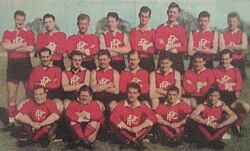
Key Players of the Era
The club became a breeding ground for talent, producing players like Bert Deacon, who would later become Carlton's first Brownlow Medallist. In 1941, ruckman Jack Lynch transitioned to full-forward, kicking a remarkable 133 goals before tragically losing his life during World War II.
Post-War Era and the Golden Years (1945–1989)
Following World War II, the club adopted a plain red uniform with a "PFC" monogram. While finals success was initially elusive, the club excelled in individual accolades, winning the Liston Trophy (the VFA's best and fairest award) in 1949 and 1953.
The 1960s marked a turning point. After a period in the Second Division, Preston secured a premiership in 1963, earning promotion to Division 1. Under the guidance of coaches like Alan Joyce, the club achieved back-to-back premierships in 1968 and 1969, coinciding with a period where Preston players dominated the Liston Trophy.
The 1980s represented the club's absolute zenith. Between 1981 and 1984, the Bullants reached four consecutive Grand Finals. In a historic feat of depth, the club won the Senior, Seconds, and Thirds premierships in the same year in both 1983 and 1984.
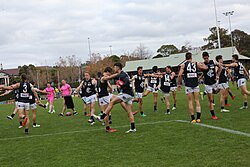
The Modern Era: Affiliation and Decline (1990–2025)
The 1990s brought hardship as the demographic of the Preston area shifted and the AFL's dominance grew. This led to a period of affiliation with the Carlton Football Club, during which the team was known as the Northern Blues. This partnership provided financial stability and high-quality recycled AFL talent, leading to Grand Final appearances in 2009 and 2010.
The COVID-19 pandemic in 2020 severed the tie with Carlton, forcing the club to return as a standalone entity under the name Northern Bullants. However, this return was fraught with difficulty. The club struggled on the field, recording three wooden spoons between 2022 and 2025 and suffering some of the heaviest defeats in VFL history.
In August 2025, the club reverted to its original name, the Preston Football Club. However, plagued by financial instability and uncompetitive results, the VFL revoked the club's licence in October 2025. By December 2025, the club entered voluntary liquidation.
Key Facts
- Founded: 1882.
- Nickname: The Bullants (adopted circa 1938).
- Historic Achievement: First club to win Senior, Seconds, and Thirds premierships in one year (1983 and 1984).
- Home Ground: Preston Park.
- Major Honors: Multiple VFA premierships and several Liston Trophy winners.
- Final Status: Entered voluntary liquidation in December 2025.
| Era | Primary Name | Key Competition | Defining Characteristic |
|---|---|---|---|
| 1882–1911 | Preston | VJFA / VFA | Early growth and junior dominance |
| 1926–1990s | Preston (Bullants) | VFA | Peak success and 1980s dominance |
| 2003–2020 | Northern Blues | VFL | Affiliation with Carlton FC |
| 2021–2025 | Northern Bullants / Preston | VFL | Standalone struggle and liquidation |
Frequently Asked Questions
Why was the club called the "Bullants"?
The nickname was first mentioned in 1938, with reports stating the club was known as the Bullants because "they can sting." Radio commentator Wallace "Jumbo" Sharland also compared the team's energy and bright uniforms to a swarm of busy bullants.
What was the club's greatest achievement in the 1980s?
Preston achieved an unprecedented feat in 1983 and 1984 by winning the Senior, Seconds, and Thirds premierships in the same year in Division 1.
What was the relationship between the Northern Blues and Carlton?
The Northern Blues served as an affiliated reserves team for the Carlton Football Club. This partnership provided the Bullants with financial backing and access to AFL-listed players until the affiliation ended in 2020 due to the COVID-19 pandemic.
Why did the Preston Football Club eventually fold?
The club suffered from years of uncompetitive on-field performances, financial struggles regarding player and staff payments, and the loss of league subsidies. This led the VFL to revoke its licence in October 2025, resulting in voluntary liquidation.