Pollen: The Microscopic Engine of Plant Reproduction
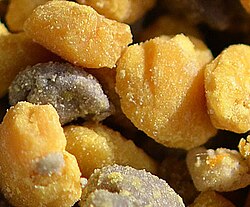
At the heart of most seed plants lies a tiny, powdery substance essential for life: pollen. While often viewed simply as a seasonal nuisance, pollen is actually a complex biological vehicle designed for one primary purpose—sexual reproduction. It carries the male genetic material necessary to ensure the next generation of flora can thrive.
Pollen consists of pollen grains, which are highly reduced microgametophytes. These microscopic structures are responsible for producing male gametes, or sperm cells, which fertilize the female components of a plant.
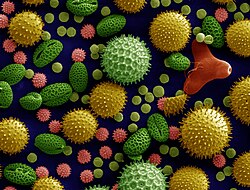
The Biology of a Pollen Grain
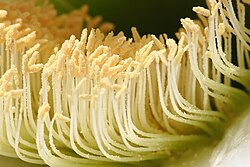
To survive the journey from a male reproductive organ to a female one, pollen grains require significant protection. They are encased in a remarkably tough outer coat made of sporopollenin. This durable substance shields the delicate gametophytes during transport, whether they are moving from the stamens to the pistil in flowering plants or between cones in gymnosperms.
Once a compatible pollen grain lands on a receptive pistil or female cone, the process of germination begins. The grain produces a pollen tube, a specialized structure that grows toward the ovule to deliver the sperm to the female gametophyte, completing the cycle of fertilization.

Because of their minute size, the intricate details of pollen grains can only be observed through magnification. This has given rise to palynology, the scientific study of pollen. This field provides invaluable data across several disciplines, including paleoecology, paleontology, archaeology, and forensics.
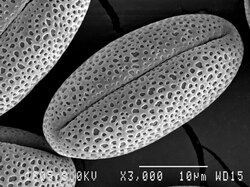
Diversity in Shape and Size
Pollen is far from uniform. Each species possesses unique characteristics in shape, size, and surface markings that can act as a biological fingerprint. For instance, pollen from conifers like pines, firs, and spruces often features "wings" to assist in wind dispersal.
The scale of these grains varies dramatically across the plant kingdom:
- Smallest: The forget-me-not (*Myosotis spp.*) produces grains only 2.5–5 μm in diameter.
- Medium: Most grasses produce pollen around 20–25 μm.
- Largest: Corn pollen grains are significantly larger, measuring approximately 90–100 μm.
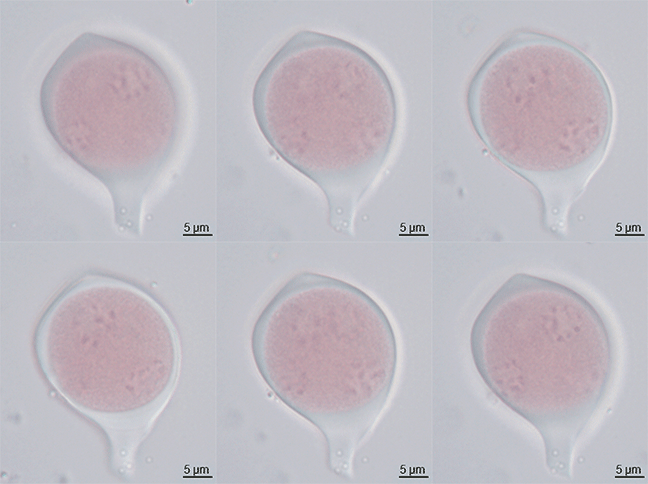
Some pollen grains even exhibit complex geometric structures, such as those based on geodesic polyhedra, resembling the pattern of a soccer ball.
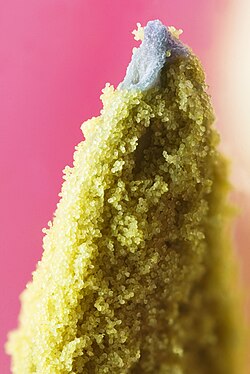
Pollen in the Ecosystem: More Than Just Bees
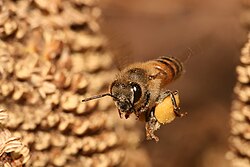
While honey bees are the most famous pollen consumers, they are far from the only organisms that rely on this nutrient source. A wide variety of predatory and parasitic arthropods incorporate pollen into their diets.
Arthropod Consumers
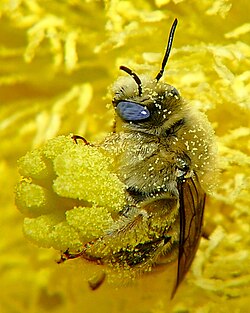
Many species of Hymenoptera (the order containing bees, wasps, and ants) consume pollen as adults. Interestingly, while most spiders are carnivores, some spiderlings utilize pollen caught in their webs as a food source. Even certain predatory mites, such as Euseius tularensis, can subsist almost entirely on pollen from dozens of different plant species.
Beetles also play a significant role. While many beetle families are predatory, specific lineages within the families Mordellidae and Melyridae feed almost exclusively on pollen. Similarly, many ladybird beetles include pollen in their diet alongside insects.
Other Biological Consumers
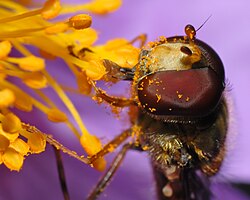
In the world of insects, many adult flies, particularly those in the Syrphidae family (hoverflies), feed on pollen. Because of their mouthpart structure, they typically consume the pollen contents dissolved in a fluid. Beyond insects, certain fungi, such as Fomes fomentarius, can break down pollen grains to access high levels of nitrogen.
Summary of Pollen Characteristics and Roles
| Feature | Description |
|---|---|
| Primary Component | Microgametophytes (male gametes) |
| Protective Layer | Sporopollenin (Exine) |
| Scientific Study | Palynology |
| Dispersal Methods | Wind (Anemophily) and Animals (Zoophily) |
| Key Nutrient | High in nitrogen for certain fungi and detritivores |
Key Facts
- Sporopollenin is the incredibly durable substance that forms the pollen grain's protective coat.
- Palynology is the study of pollen, used in fields ranging from archaeology to forensics.
- Pollen sizes range from 2.5 μm (forget-me-not) to 100 μm (corn).
- Pollen tubes are essential for transferring sperm to the ovule during fertilization.
- Many non-bee arthropods, including spiders and certain beetles, consume pollen.

Frequently Asked Questions
What is the purpose of the pollen tube?
The pollen tube is a structure produced by a germinating pollen grain. Its role is to create a physical pathway that allows sperm cells to travel from the pollen grain to the ovule, where fertilization occurs.
How does pollen travel from one plant to another?
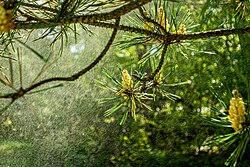
Pollen can be dispersed through various methods, most notably by wind (as seen in pine trees) or by animals such as insects (bees, flies, and beetles) that visit flowers for food.
Why is pollen important to scientists in forensics?
Because pollen grains have unique shapes and surface markings specific to certain plant species, they can be used in forensic palynology to link individuals or objects to specific geographic locations.
Do all insects eat pollen?
No. While many insects like bees, hoverflies, and certain beetles consume pollen, many others are strictly predatory or herbivorous. However, pollen remains a vital supplemental nutrient for various arthropods.
What is the smallest known pollen grain?
The smallest pollen grains belong to the forget-me-not (*Myosotis spp.*), measuring between 2.5 and 5 micrometers in diameter.