Pneumatic Tube Systems: From Victorian Mail to Modern Industry
Pneumatic tube systems use pressurized air or vacuum suction to move capsules through a network of pipes. While often associated with the nostalgic imagery of old-fashioned post offices, this technology has evolved from 19th-century experiments into critical infrastructure for modern hospitals, banks, and industrial plants.
Key Facts
- Invention: Created by Scottish engineer William Murdoch in the 19th century.
- Postal Peak: Paris operated a massive network of 467 kilometers until 1984.
- Industrial Use: ThyssenKrupp uses tubes to transport steel samples at 900°C.
- Transport Evolution: Early atmospheric railways paved the way for modern concepts like the Hyperloop.
- Medical Efficiency: 6-inch tubes are more effective than 4-inch tubes for transporting heavy IV bags.
Pneumatic Post and Communication
Pneumatic post, or pneumatic mail, was designed to accelerate the delivery of letters and documents across urban centers. These systems typically connected vital hubs such as banks, stock exchanges, ministries, and post offices.
The technology saw widespread adoption in the second half of the 19th century. In Berlin, the Rohrpost system reached a peak length of 400 kilometers by 1940. Paris maintained one of the most extensive networks, which remained operational until 1984 before being replaced by fax machines and computers. In the United States, the first system was established in Philadelphia in 1893 by Postmaster General John Wanamaker, eventually expanding to cities like New York, Chicago, and Boston before closing in 1953.

Interestingly, Italy was the only nation to issue specific postage stamps for pneumatic mail (1913–1966), while Germany, France, and Austria provided specialized postal stationery.
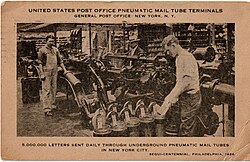
Historical Timeline of Postal Tubes
| Year | City/Location | Key Detail |
|---|---|---|
| 1853 | London | Linked Stock Exchange to main telegraph station (220 yards). |
| 1865 | Berlin | The Rohrpost system; operated until 1976. |
| 1866 | Paris | Network reached 467 km by 1934; closed in 1984. |
| 1887 | Prague | 60 km network; closed in 2002 due to flooding. |
| 1893 | Philadelphia | First North American system; expanded to rail stations and businesses. |
Public Transportation and the Vactrain
Beyond mail, engineers attempted to use pneumatic pressure to move people. The atmospheric railway—a precursor to modern tube transit—featured a tube laid between rails with a piston suspended from the train. Early examples operated in Ireland (Dalkey Atmospheric Railway) and England (London and Croydon Railway) during the 1840s.
In 1865, the London Pneumatic Despatch Company demonstrated that its parcel tubes were large enough to transport humans, blowing the Duke of Buckingham and other directors from Holborn to Euston in five minutes.
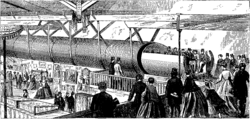
In the United States, Alfred Ely Beach demonstrated a pneumatic subway under Broadway in 1869. Although it proved the concept, political opposition from Boss Tweed prevented its expansion. By the 1960s, Lockheed and MIT studied vactrains (trains in evacuated tubes), calculating that a trip between Philadelphia and New York could average 626 km/h (388 mph). This research continues today through projects like the Hyperloop.
Modern Commercial and Industrial Applications
Pneumatic tubes remain vital in several specialized sectors due to their speed and reliability.
Medicine and Healthcare
Hospitals use these systems to transport X-rays, drugs, patient documents, and laboratory samples. To prevent haemolysis (the rupture of red blood cells caused by acceleration forces), transport duration and weight are carefully managed. Research indicates that 6-inch (152 mm) tubes are superior to 4-inch (102 mm) systems for moving heavy IV bags, as they experience significantly fewer jams.
Finance and Retail
Banks frequently use pneumatic tubes in drive-through windows for secure money transfer. Historically, large department stores like Sears and Myer used them to send sales slips and cash from the floor to centralized accounting offices.
Industrial Production and Waste
In manufacturing, tubes convey tools, spare parts, and samples. ThyssenKrupp, for instance, transports steel samples at 900°C (1,650°F) at speeds of 22 meters per second. Additionally, pneumatic waste disposal is utilized in high-density or specialized areas, including Disney World, Roosevelt Island, and the Masjid al-Haram in Mecca.
Pneumatic Elevators
A pneumatic elevator uses a transparent cylindrical shaft and capsule. It operates via differential air pressure: a vacuum pump at the top creates low pressure to lift the capsule, while normal atmospheric pressure enters from below. To descend, electronically controlled valves regulate air entry. If the system fails, a mechanical valve allows trapped air to escape slowly, acting as a cushion to return the capsule safely to the ground.
Frequently Asked Questions
What is a pneumatic tube system?
It is a system that uses pressurized air or a vacuum to move cylindrical capsules through a network of tubes for the transport of documents, samples, or objects.
Why did cities stop using pneumatic post?
Most systems were abandoned as technology evolved; for example, Paris closed its network in 1984 in favor of computers and fax machines.
How does a pneumatic elevator work?
It uses a vacuum pump to create low pressure above the capsule for ascent and controlled air valves to regulate the descent, requiring no pit or loft.
Are pneumatic tubes still used in hospitals?
Yes, they are widely used to quickly send blood samples, medications, and patient records to laboratories and pharmacies.
What is the connection between pneumatic tubes and the Hyperloop?
The Hyperloop is a modern evolution of the vactrain concept, which involves moving vehicles through partially evacuated tubes to achieve extremely high speeds by reducing air resistance.