Pluto Water: The Early 20th Century Natural Laxative
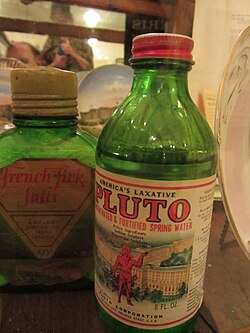
In the early 1900s, the American market saw the rise of Pluto Water, a potent natural laxative derived from mineral springs. Marketed as a fast-acting solution for digestive issues, it became a household name through aggressive advertising and a distinct brand identity. Sourced from the earth's depths, this mineral water promised relief when other methods failed.
The product was bottled at the French Lick Springs in French Lick, Indiana. This region was renowned for its natural mineral springs, which also served as the source for a competing product known as Sprudel Water.
Key Facts
- Active Ingredients: Sodium sulfate and magnesium sulfate.
- Origin: Bottled at French Lick Springs, Indiana.
- Effectiveness: Typically worked within one hour (advertised range: 30 minutes to 2 hours).
- Scale of Production: In 1919, output required 450 railroad cars for transport.
- Discontinuation: Sales stopped in 1971 due to the regulation of lithium.
The Science of the Springs
Pluto Water owed its efficacy to a high native content of mineral salts. The primary active ingredients were sodium sulfate and magnesium sulfate, both of which are recognized as natural laxatives. These salts stimulated the digestive system, allowing the product to work quickly.
Beyond the primary laxatives, the water contained various other minerals, most notably lithium salts. While these contributed to the water's unique chemical profile, they eventually led to the product's demise. In 1971, when lithium became a controlled substance, the sale of Pluto Water was officially halted.
Marketing and Brand Identity
Known as "America's Laxative," the product utilized the memorable slogan, "When Nature Won't, PLUTO Will." To emphasize the underground origin of the mineral springs, the company used the image of Pluto, the Roman god of the underworld, on its bottles and in its promotional materials.
The company's marketing focused heavily on speed. Promotional literature emphasized that the water was generally effective within one hour of ingestion, with advertisements specifying a window of effectiveness between 30 minutes and two hours.
Pluto Water in Popular Culture
Due to its ubiquity in the early 20th century, Pluto Water appeared frequently in literature and film:
- Cinema: The 1924 film Greed by Erich von Stroheim features several advertisements for the product. It was also mentioned by Charles Butterworth in the 1931 movie Illicit.
- Television: The sitcom Sanford and Son referenced the water in multiple episodes, including mentions by the characters Grady and Fred.
- Literature: Kurt Vonnegut included the drink in his novel Player Piano, describing it as a fashionable beverage mixed with benedictine and mint in a dystopian tavern. It is also the central subject of Michael Koryta's 2010 novel, So Cold the River.
- Autobiography: Jazz legend Louis Armstrong recalled in Satchmo, My Life in New Orleans that his mother administered Pluto Water to help treat his lockjaw.
| Feature | Details |
|---|---|
| Primary Use | Laxative / Physic |
| Source Location | French Lick, Indiana |
| Key Minerals | Sodium sulfate, Magnesium sulfate, Lithium salts |
| Slogan | "When Nature Won't, PLUTO Will" |
| End of Sale | 1971 |
Frequently Asked Questions
What made Pluto Water an effective laxative?
Its effectiveness came from a high natural concentration of mineral salts, specifically sodium sulfate and magnesium sulfate, which act as natural laxatives.
How quickly did Pluto Water work?
The company advertised that the product was effective between 30 minutes and two hours after ingestion, though it generally worked within one hour.
Why was Pluto Water taken off the market?
The sale of the water was halted in 1971 because it contained lithium salts, and lithium became a controlled substance.
Where was Pluto Water produced?
It was bottled at the French Lick Springs in French Lick, Indiana, a location famous for its mineral-rich waters.
Who was the figure on the Pluto Water bottle?
The bottle featured Pluto, the Roman god of the underworld, which served as a metaphor for the water's origin from deep underground springs.