Discovering Plumbago: The Fascinating World of Leadwort
From the tropical landscapes of Asia to the warm temperate regions of the Mediterranean, the genus Plumbago brings a striking splash of color to the natural world. Known commonly as plumbago or leadwort, these flowering plants are celebrated for their elegant tubular blooms and resilient nature. Belonging to the family Plumbaginaceae, this genus comprises 23 distinct species that have adapted to a wide variety of environments across the globe.
Key Facts
- Genus: Plumbago (containing 23 species).
- Common Names: Plumbago and leadwort.
- Distribution: Native to warm temperate and tropical regions worldwide.
- Plant Type: Ranges from herbaceous plants to shrubs.
- Flower Colors: White, blue, purple, red, or pink.
- Distinctive Feature: Sticky glandular hairs on the flower calyx.
Botanical Description
Plants within the Plumbago genus typically grow as herbaceous plants or shrubs, reaching heights between 0.5 and 2 meters (1.6 to 6.6 feet). Their leaves are simple and entire, measuring between 0.5 and 12 centimeters in length. These leaves are spirally arranged and often feature a tapered base and hairy margins.
The most striking feature of the genus is the flowers. They are produced in racemes (clusters of flowers arranged along a central axis) and feature a tubular corolla that opens into five petal-like lobes. Depending on the species, these blooms can appear in shades of white, blue, purple, red, or pink.
Unique Biological Adaptations
Plumbago species possess several intriguing biological characteristics that distinguish them from other garden shrubs.
Sticky Trichomes and Protocarnivory
The flower calyx is equipped with glandular trichomes—specialized hairs that secrete a sticky mucilage. This substance is capable of trapping and killing insects. While the exact evolutionary purpose of these hairs is still debated, scientists suggest they may serve as a defense mechanism against "crawlers" (insects like ants that do not effectively transfer pollen) or may even be a form of protocarnivory, where the plant derives some benefit from trapped insects.
The "Chalk" Gland Mystery
Gardeners often notice a whitish residue on the undersides of mature plumbago leaves. While this can be mistaken for chemical deposits or powdery mildew, it is actually a natural occurrence. This residue is an exudate produced by "chalk" glands, a natural characteristic of the genus.
Etymology and Nomenclature
The name Plumbago is derived from the Latin word plumbāgō, meaning "leadwort," which stems from plumbum (lead). This naming convention was first used by Pliny the Elder between 23 and 79 AD. There are several theories as to why the plant is associated with lead: the lead-blue color of the flowers, the ability of the plant's sap to leave lead-colored stains on the skin, or Pliny's historical belief that the plant could cure lead poisoning.
Species and Global Distribution
With 23 accepted species, Plumbago is found across several continents. Some species, such as Plumbago indica, are prevalent across the Indian subcontinent, Indochina, and parts of China and the Philippines.
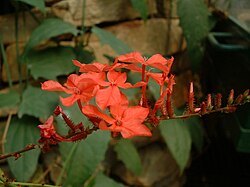
Other species have more restricted ranges, such as Plumbago hunsbergensis and Plumbago pearsonii, which are native to Namibia. In contrast, Plumbago zeylanica is one of the most widespread species, found in the Americas, sub-Saharan Africa, Madagascar, Asia, and Australia.
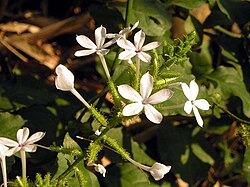
| Species Name | Primary Distribution |
|---|---|
| Plumbago auriculata | Mozambique and South Africa |
| Plumbago indica | Indian subcontinent, Indochina, China, Philippines, Indonesia |
| Plumbago zeylanica | Americas, Africa, Madagascar, Asia, Australia |
| Plumbago europaea | Mediterranean, Iraq, Iran, Caucasus, Turkmenistan |
| Plumbago caerulea | Venezuela, Colombia, Peru, Bolivia, Chile, Argentina |
| Plumbago arabica | Eastern Arabian Peninsula, Western and Central India |
Frequently Asked Questions
What is the difference between Plumbago and leadwort?
There is no difference in terms of the genus Plumbago; "leadwort" is simply a common name used to describe plants in this genus, though the name is also shared by the genus Ceratostigma.
Why do Plumbago leaves have a white powder on the bottom?
The white residue is not a disease or a chemical spray; it is a natural exudate produced by specialized "chalk" glands found on the leaves of Plumbago species.
Are Plumbago plants carnivorous?
While they are not fully carnivorous, they exhibit protocarnivory. Their flower calyxes have sticky glandular hairs (trichomes) that can trap and kill insects.
Where does the name "Plumbago" come from?
The name comes from the Latin word for lead (plumbum), likely referring to the blue color of the flowers, the staining properties of the sap, or ancient beliefs regarding its medicinal use for lead poisoning.
How tall do Plumbago plants grow?
Depending on the species, these plants can grow as herbaceous plants or shrubs, typically reaching heights between 0.5 and 2 meters.