Plumage and the Science of Bird Feathers
Plumage, derived from the Latin word pluma meaning "feather," refers to the entire layer of feathers covering a bird, including their specific patterns, colors, and arrangements. Far from being random, feathers grow in organized, overlapping rows and groups known as feather tracts. The study of these feathers is formally known as plumology.
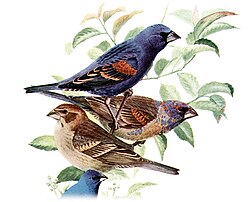
Plumage varies significantly across species and subspecies, and often changes based on the bird's sex, age, and the time of year. Some species even exhibit different color morphs within a single population.
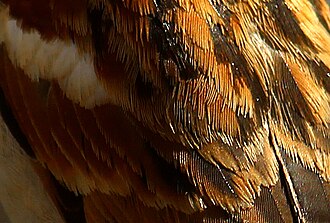
The Process of Molting
Molting is the process of shedding old feathers to make room for new ones. Most birds undergo this process twice a year, creating a distinction between breeding and non-breeding plumage.
- Complete Moult: Usually occurring after the breeding season, this replaces all feathers on the bird.
- Partial Moult: Often occurring before the breeding season, this replaces small body feathers but leaves larger flight feathers in the wings and tail intact.
Different species have evolved unique molting strategies. Large birds like eagles replace flight feathers slowly and continuously to maintain flight efficiency. Many passerines (perching birds) moult only once a year, with their appearance changing as the colored tips of their feathers naturally wear away. Young birds start with juvenile plumage, which is replaced by first-winter plumage, and in slow-maturing birds like gulls, a series of immature plumages may follow over several years.
Eclipse Plumage and Sexual Dimorphism
Sexual dimorphism occurs when males and females of the same species look markedly different. In the family Anatidae (ducks), males often possess vibrant breeding plumage but transition into a dull, female-like appearance called eclipse plumage after the mid-summer breeding season.
During this eclipse phase, some ducks shed all flight feathers simultaneously, rendering them temporarily flightless for one to three months. While common in ducks, eclipse plumage is also found in red junglefowl, some sunbirds, and most fairywrens. In contrast, hummingbirds and lek-mating birds, such as birds of paradise, maintain their bright colors year-round.

Plumage Polymorphism
Polymorphism occurs when two or more distinct color variants exist within a single population across most seasons. Common examples include true owls, nightjars, skuas, and cuckoos, which often have brown (phaeomelanin) and grey (eumelanin) morphs. In cuckoos, the brown variant is specifically called the "hepatic form." Other examples include the varied face colors of the Gouldian finch and the diverse courtship types of male ruffs.
The Humphrey–Parkes (H–P) System
To standardize the naming of these changes, some ornithologists use the Humphrey–Parkes terminology. This system uses specific technical terms:
- Pre-basic moult: The annual moult after breeding.
- Basic plumage: The feathers resulting from the pre-basic moult.
- Pre-alternate moult: The moult occurring before the breeding season.
- Alternate (or nuptial) plumage: The resulting breeding plumage, which is often brighter for display or more cryptic for nesting protection.
Abnormal and Aberrant Plumages
Rare genetic mutations or environmental factors can lead to abnormal plumage. These are categorized by the type of pigment affected:
- Melanism: An excess of black or dark pigments.
- Erythromelanism (Erythrism): Excessive reddish-brown deposition in feathers that usually lack melanin.
- Schizochroisms: Imbalances in color mixtures, such as xanthochromism (too much yellow) or axanthism (lack of yellow).
- Carotenism: Abnormal distribution of carotenoid pigments.
- Dilution: A lower intensity of color caused by decreased pigment deposition. This only affects pigment-based colors, not structural colors (e.g., there is no "dilute blue").
Albinism and Leucism
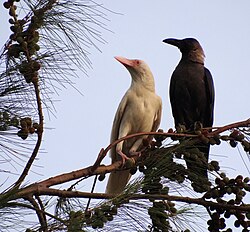
Albinism is a rare genetic mutation (occurring in roughly 1 in 1,800 individuals) caused by the absence of tyrosinase, an enzyme needed for melanin synthesis. This results in a total loss of color in feathers, skin, bills, and the iris of the eyes (which appear pink or red). Complete albinos often struggle in the wild due to poor eyesight and high visibility to predators.
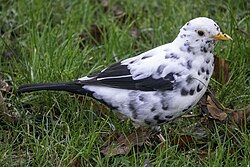
Leucism differs from albinism in that it is a partial loss of pigments in feathers, but does not necessarily affect the eyes or skin. It is important to note that naturally white birds, such as swans or egrets, are not albinos.
Hen Feathering in Cocks
In domestic fowl, a specific genetic condition called "hen feathering" allows males to develop female-type plumage. This is controlled by an autosomal dominant gene that increases the activity of enzymes responsible for estrogen synthesis in the skin, though the birds remain virile males.
Key Facts
- Plumology is the scientific study of bird feathers.
- Eclipse plumage is a temporary, drab plumage adopted by some male ducks to blend in after breeding.
- Albinism involves a total lack of melanin and affects the eyes, whereas leucism primarily affects feather pigmentation.
- Structural coloration cannot be "diluted" because it relies on light refraction rather than pigment deposition.
- The H-P system distinguishes between "basic" (non-breeding) and "alternate" (breeding) plumages.
| Condition | Description | Key Characteristic |
|---|---|---|
| Albinism | Total loss of melanin | Pink/red eyes, white feathers |
| Leucism | Partial loss of pigment | White patches, normal eye color |
| Melanism | Excess dark pigment | Unusually dark or black plumage |
| Xanthochromism | Excess yellow pigment | Unusually yellow coloration |
| Axanthism | Lack of yellow pigment | Absence of yellow tones |
Frequently Asked Questions
What is the difference between an albino bird and a naturally white bird?
An albino bird has a genetic mutation that prevents the production of melanin, affecting the eyes, skin, and feathers. A naturally white bird, such as a swan or egret, has evolved white plumage as a standard trait and does not lack the necessary enzymes for pigment production in other parts of its body.
Why do some ducks become flightless during their eclipse plumage?
Many male ducks in the Anatidae family shed all of their flight feathers simultaneously during the transition to eclipse plumage, which leaves them unable to fly for a short period.
What is the "hepatic form" in cuckoos?
The hepatic form is a specific color morph in cuckoos characterized by brown (phaeomelanin) plumage, as opposed to the grey (eumelanin) morph.
How does structural coloration differ from pigment-based coloration?
Pigment-based colors come from chemicals like melanin or carotenoids and can be "diluted" by reducing pigment deposition. Structural colors are created by the physical refraction of light; therefore, they cannot be diluted, only shifted in wavelength.
What causes "hen feathering" in male chickens?
Hen feathering is caused by an autosomal dominant gene that increases the production of estrogen in the skin via the aromatase enzyme complex, resulting in female-like plumage despite the bird being a male.