Pistachios: Cultivation, Nutrition, and Global Production
The pistachio, scientifically known as Pistacia vera, is a prized culinary nut produced by a hardy deciduous tree. Native to the desert regions of the Middle East, specifically Iran, this plant has evolved to thrive in harsh, arid environments. Today, it is a global commodity valued for its distinct flavor and dense nutritional profile.
Key Facts
- Global Production: Approximately 1.4 million tonnes were produced in 2024.
- Top Producers: The United States, Iran, and Turkey account for 87% of the world's supply.
- Tree Lifespan: Pistachio trees can live for up to 300 years.
- Growth Cycle: Trees typically take 7 to 10 years to reach significant production and peak around 20 years.
- Nutritional Powerhouse: Rich in protein, dietary fiber, and B vitamins, particularly thiamin and vitamin B6.
Botanical Description and Biology
The pistachio tree can grow up to 10 metres (33 feet) tall. It features pinnate leaves—leaves arranged on either side of the stem—that measure between 10 and 20 centimetres in length.
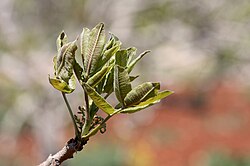
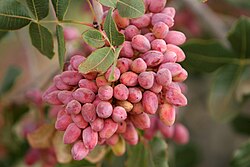
A defining characteristic of the species is that it is dioecious, meaning individual trees are either male or female. Male trees provide the necessary pollen for the female trees, which bear the drupes (the fruit containing the seed). Typically, one male tree can pollinate between 8 and 12 female trees. The flowers are unisexual and apetalous, meaning they lack petals, and are borne in clusters called panicles.
On average, a mature tree produces about 50 kilograms (110 pounds), or roughly 50,000 seeds, every two years.
Habitat and Cultivation
Pistachios are highly specialized desert plants. They are remarkably tolerant of saline soil and can thrive even when irrigated with water containing 3,000–4,000 ppm of soluble salts. They are hardy enough to survive extreme temperature swings, from winter lows of −10 °C (14 °F) to summer highs of 48 °C (118 °F).
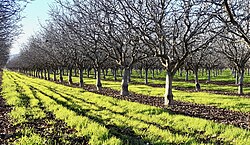
For successful growth, the trees require full sun and well-drained soil. They are sensitive to high humidity and are prone to root rot in winter if the soil remains too wet. Furthermore, long, hot summers are essential for the fruit to ripen properly.
Cultivation is characterized by biennial bearing, a process where the harvest is significantly heavier in alternate years. In modern commercial orchards, such as those in the United States and Greece, mechanical shakers are used to remove the drupes from the trees. After the nuts are hulled and dried, they are sorted by shell opening (open-mouth vs. closed-mouth) before being roasted or processed into kernels.
Global Production and Commercial Trends
The global pistachio market is dominated by a few key players. In 2024, world production reached 1.4 million tonnes. The United States, Turkey, and Iran are the primary contributors to this total.
| Country | Production (Tonnes) |
|---|---|
| United States | 498,950 |
| Turkey | 383,000 |
| Iran | 316,142 |
| Syria | 83,796 |
| China | 78,986 |
| World Total | 1,380,321 |
In the United States, California is the epicenter of production, accounting for 99% of the domestic crop. However, this success comes with environmental challenges; a single acre of California pistachio orchard can require over 1,000,000 US gallons of water annually, placing significant stress on regions already facing high water scarcity.
Diseases and Environmental Threats
Pistachio orchards are susceptible to various pests and pathogens. In North America, the Leptoglossus clypealis insect is a known threat. Fungal infections are also common, such as Botryosphaeria, which causes panicle and shoot blight, leading to the death of young shoots and flowers.
Environmental factors also play a critical role. For example, anthracnose fungus caused a 50% loss in the Australian harvest in 2011, while severe droughts in Iran between 2008 and 2015 led to significant production declines.
Nutritional Value and Health Effects
Pistachios are nutrient-dense seeds. A 100-gram serving provides 562 kcal and is composed of approximately 45% fat, 28% carbohydrates, and 20% protein.
Vitamins and Minerals
They are an exceptional source of B vitamins, providing 100% of the Daily Value (DV) for vitamin B6 and 73% for thiamin (B1). They also provide significant amounts of manganese (52% DV), phosphorus (39% DV), and potassium (34% DV).
Fat Profile and Heart Health
The fat content is primarily composed of healthy unsaturated fats. Oleic acid (a monounsaturated fat) makes up 52% of the total fat, while linoleic acid (a polyunsaturated fat) accounts for 30%. Only a small fraction consists of saturated fats.
The US FDA has noted that eating 1.5 ounces (42.5 g) of nuts like pistachios daily as part of a low-saturated-fat diet may reduce the risk of heart disease. Additionally, a 2021 review indicated that consuming pistachios for three months or less can significantly reduce triglyceride levels.
Frequently Asked Questions
Why do pistachio trees produce more nuts in some years than others?
This is due to a phenomenon called biennial bearing, where the tree's production cycle naturally fluctuates, resulting in a heavier harvest every other year.
How long does it take for a pistachio tree to start producing fruit?
Pistachio trees typically take between 7 and 10 years to reach significant production levels, with peak production usually occurring around the 20-year mark.
Are pistachios high in calories?
While they are energy-dense, providing 562 kcal per 100 grams, research suggests that consuming them in normal amounts is not associated with weight gain or obesity.
What are the main environmental requirements for growing pistachios?
They require a sunny position, well-drained soil, and long, hot summers for the fruit to ripen. They are highly tolerant of saline soil but perform poorly in high-humidity environments.
Which countries are the largest producers of pistachios?
The United States, Iran, and Turkey are the leading producers, collectively accounting for 87% of the total global production.