Picathartes: The Rare Rockfowl of Tropical Africa
Deep within the rainforests of tropical West and Central Africa live the Picathartes, more commonly known as rockfowl or bald crows. These enigmatic birds are the sole members of the family Picathartidae. Characterized by their striking unfeathered heads and specialized dependence on rocky jungle habitats, these non-migratory birds are as biologically fascinating as they are rare.
Because of their highly specific environmental needs and limited distribution, both recognized species of rockfowl are currently listed as vulnerable to extinction on the IUCN Red List.
Key Facts
- Species: Two recognized species: the White-necked rockfowl and the Grey-necked rockfowl.
- Habitat: Lowland rainforests up to 800 meters in rocky, hilly terrain.
- Diet: Generalist insectivores feeding on invertebrates, frogs, and lizards.
- Nesting: Unique mud nests attached to cave roofs or overhanging cliffs.
- Conservation Status: Both species are classified as vulnerable.
Taxonomy and Systematics
The scientific classification of the Picathartes genus has historically been a subject of debate. For years, researchers grouped them with various other birds, including starlings, flycatchers, and babblers. Early theories suggested links to the Asian genus Eupetes or the Timaliidae family based on protein similarity determined by electrophoresis (a laboratory technique used to separate macromolecules).
Modern molecular sequence studies have provided more clarity, suggesting that rockfowl are closely related to crows. They appear to be a sister group to the rockjumpers (Chaetops) and sit at the boundary between the Passerida and Corvida clades. Interestingly, the name Picathartes is a linguistic blend of the Latin words pica (magpie) and cathartes (vulture).
Physical Description
Rockfowl are large passerines, measuring between 33 and 38 cm in length and weighing between 200 and 250 g. They possess crow-like black bills, long necks, and sturdy legs adapted for terrestrial movement. Rather than flying long distances, these birds move through the forest floor using long, bounding leaps.
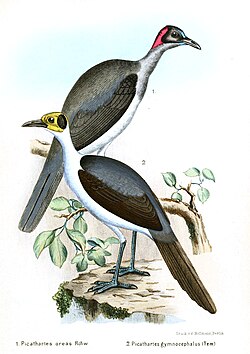
Their plumage is largely similar across the genus, featuring white breasts and bellies contrasted by darker grey or grey-black wings, backs, and tails. The primary distinction lies in the color of their necks—which gives the two species their names—and their bald heads, which feature brightly colored and patterned skin.
Behavior and Ecology
Diet and Foraging
As generalized feeders, rockfowl consume a wide variety of invertebrates. Their diet primarily consists of beetles, termites, ants, millipedes, centipedes, gastropods, and earthworms. They are also known to forage in shallow flowing water for crabs. While they primarily eat insects, they provide frogs and lizards to their chicks.
Their foraging technique involves hopping and bounding across the ground, using their long bills to flip over leaves to find prey. They are also opportunistic, often following swarms of army ants (Dorylinae) to catch insects fleeing the ant colony.
Breeding and Nesting
Rockfowl breed during the wet season, sometimes twice a year if the region experiences two wet seasons. While once thought to be cooperative breeders, they are now believed to be exclusively monogamous. They often nest in colonies of up to seven pairs, though smaller groups or solitary pairs are more common.
Their nesting habits are highly specialized: they construct cup-like nests made of dried leaves, twigs, and plant fibers, which are then set into dried mud and attached to the roof of a cave or an overhanging cliff. The female lays two eggs, spaced 24 to 48 hours apart. Both parents share incubation duties in 12-hour shifts. After about 20 days, the altricial (born helpless and nearly naked) chicks hatch and take approximately 25 days to fledge.
Distribution and Habitat
The distribution of the genus is split across West and Central Africa. The White-necked rockfowl (P. gymnocephalus) is found in Guinea, Sierra Leone, Liberia, Ivory Coast, and Ghana. The Grey-necked rockfowl (P. oreas) inhabits Nigeria, Cameroon, Equatorial Guinea, Gabon, the Republic of the Congo, and the Central African Republic.
These birds are restricted to lowland rainforests up to 800 meters in elevation. Their survival depends on a specific combination of forest litter for foraging, the presence of army-ant swarms, and the availability of cliffs or caves for nesting.
| Feature | White-necked Rockfowl (P. gymnocephalus) | Grey-necked Rockfowl (P. oreas) |
|---|---|---|
| Distribution | West Africa (e.g., Ghana, Liberia) | Central Africa (e.g., Gabon, Cameroon) |
| Neck Color | White | Grey |
| Habitat | Lowland rainforest / Rocky terrain | Lowland rainforest / Rocky terrain |
| Conservation Status | Vulnerable | Vulnerable |
Frequently Asked Questions
Are there more than two species of rockfowl?
While only two species are officially recognized, there is a possibility that a third species exists in Uganda, specifically near the Kazinga Channel between Lake Edward and Lake George.
Why are they called "bald crows"?
They are referred to as bald crows because of their unfeathered heads with brightly colored skin and their physical resemblance to crows, including their black bills.
How do rockfowl build their nests?
They use mud to attach a nest to the ceiling of a cave or an overhanging rock. The interior of the nest is a cup made from plant fibers, twigs, and dried leaves.
What is the primary threat to their survival?
Their vulnerability stems from their extreme specialization; they require a very specific combination of lowland rainforest, rocky nesting sites, and specific prey sources like army ants.
Do rockfowl migrate?
No, both species of rockfowl are totally non-migratory and remain within their specialized rocky jungle habitats year-round.