Photographic Film: The Science, History, and Mechanics of Analog Imaging
Photographic film is a sophisticated medium consisting of a transparent base coated with a gelatin emulsion. This emulsion contains microscopically small, light-sensitive silver halide crystals. When light strikes these crystals, it triggers a chemical reaction that allows a photographer to capture a moment in time. The specific characteristics of these crystals—such as their size and distribution—directly dictate the film's sensitivity, contrast, and resolution.
While the emulsion will darken if left exposed to light over a long period, cameras use a lens to provide a very brief, controlled exposure. This creates a latent image—an invisible chemical change proportional to the light absorbed—which is later made visible through a chemical development process.
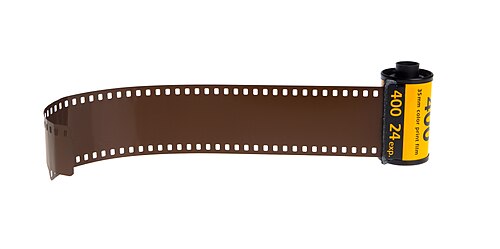
Key Facts
- Composition: A transparent base coated in silver halide crystals suspended in gelatin.
- Sensitivity: Measured by ISO; lower numbers are "slow" (fine grain), higher numbers are "fast" (better for low light).
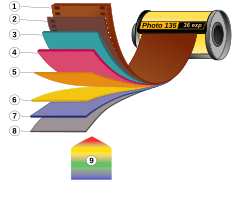
- Color Process: Uses multiple layers of sensitizing dyes and color couplers to render full-spectrum images.
- Dynamic Range: Offers a logarithmic response to light, often providing a wider dynamic range than many digital sensors.
- Resolution: Capable of extreme spatial resolution, with some holographic films exceeding 4,000 lines/mm.
How Film Works: From Light to Image
Spectral Sensitivity
Naturally, silver halide crystals only respond to blue light. To capture a full range of colors, scientists developed sensitizing dyes. This led to the creation of orthochromatic film (sensitive to blue and green) and eventually panchromatic film, which is sensitive to all visible colors and renders them as shades of gray based on their subjective brightness. Some specialized films are even engineered to detect infrared (IR) light, X-rays, or gamma rays.
Black-and-White vs. Color Film
Black-and-white film typically utilizes a single layer of silver halide. During development, exposed grains are converted into metallic silver, which blocks light and forms the dark areas of a negative.
Color film is more complex, featuring at least three sensitive layers. A blue-sensitive layer sits on top, followed by a yellow filter to block blue light from reaching the lower layers. Below this are green-and-blue and red-and-blue sensitive layers. During development, color couplers combine with reaction by-products to form dye clouds. The silver is then removed via a bleach and fixing process (using ammonium thiosulfate or sodium thiosulfate), leaving only the colored dyes behind.
The H&D Curve
The relationship between exposure and image density is represented by the H&D curve (or characteristic S-curve). This plot helps determine a film's sensitivity. The curve features a non-linear "toe" at the far left and a "shoulder" at the far right, indicating how the film responds to extreme under- or over-exposure.
![Plot of image density (D) vs. log exposure (H), yields a characteristic S-curve (H&D curve) for each type of film to determine its sensitivity. Changing the emulsion properties or the processing parameters will move the curve to the left or right. Changing the exposure will move along the curve, helping to determine what exposure is needed for a given film. Note the non-linear response at the far left ("toe") and right ("shoulder") of the curve.[11]](/images/ab/72/ab72166654b48babbba718eddaa76ff8542ab65ba5161bf00f74bc6454b25699.webp)
Film Characteristics and Speed
Understanding ISO (Film Speed)
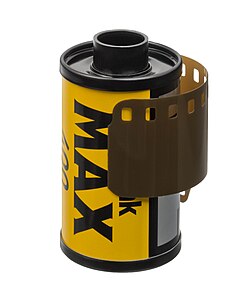
Film speed, measured in ISO, indicates how much light is needed to produce a usable image. Common speeds range from ISO 25 to ISO 3200.
- Slow Film (e.g., ISO 25, 100): Requires more light but typically offers finer grain and superior color rendition. These are preferred for landscapes and portraits using a tripod.
- Fast Film (e.g., ISO 800, 3200): Requires less light, making it ideal for action shots or low-light environments.
Scientific Advantages and Limitations
Compared to digital detectors, film is harder to calibrate, non-reusable, and requires strict temperature and humidity control. However, it excels in spatial resolution and dynamic range. For instance, Agfa 10E56 holographic film can achieve a pixel-equivalent size of 0.125 micrometers, far surpassing typical scientific CCDs.
Metadata and Encoding
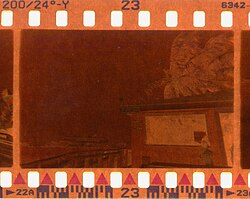
DX Encoding
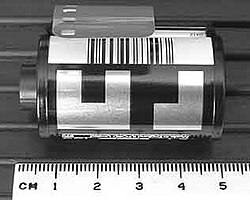
Introduced by Kodak in the 1980s, DX Encoding allows cameras to automatically detect film properties. This system consists of three parts:
- Cassette Barcode: Identifies the manufacturer and processing method for photofinishing labs.
- Film Edge Barcode: Indicates frame numbers and synchronizes frame position.
- DX CAS Code: A series of 12 metal contacts that tell the camera the ISO, number of exposures, and film type.
Common Film Formats
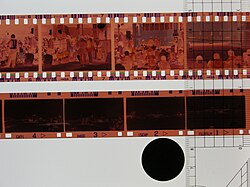
Film comes in various widths and formats depending on the intended use, from compact consumer cartridges to large-format sheets.
| Designation | Film Width (mm) | Image Size (mm) | Typical Exposures | Key Characteristics |
|---|---|---|---|---|
| 110 | 16 | 13 × 17 | 12/20/24 | Cartridge loaded, single perforations |
| 135 (35mm) | 35 | 24 × 36 | 12–36 | Cassette loaded, double perforations |
| 120 | 62 | 45 × 60 (varies) | 8–16 | Unperforated, medium format |
| 220 | 62 | 45 × 60 (varies) | 16–32 | Unperforated, medium format |
| Sheet Film | Varies | Varies | 1 | Large format, notched corners |
Evolution and Modern Revival
From Glass Plates to Safety Film
Early photography relied on the daguerreotype (silver-plated copper) and calotypes (paper). By the 1850s, glass plates became the standard due to their optical quality. In 1908, Kodak introduced cellulose acetate, known as "safety film," to replace hazardous nitrate film. Nitrate film remained the standard for 35mm theatrical movies until 1951.
The Digital Shift and Analog Comeback
The rise of digital cameras (such as the Sony Mavica in 1981 and Fuji DS-X in 1989) and software like Adobe Photoshop led to a decline in film use by the early 21st century. However, interest has renewed recently. Kodak reformulated Ektachrome in 2017, and new innovations have emerged, such as Sami Vuori's 2023 invention of a reusable film using synthetic hackmanite, which reacts to UV radiation.


Frequently Asked Questions
What is the difference between slow and fast film?
Slow film (low ISO) requires more light for exposure but produces finer grain and better color. Fast film (high ISO) is more sensitive to light, making it suitable for low-light or high-speed action photography, though it often has more noticeable grain.
How does color film create a colored image?
Color film uses multiple layers of silver halide crystals sensitized to different colors. During development, these layers react with color couplers to create dye clouds. The silver is then bleached and fixed away, leaving only the dyes to form the final image.
What is DX encoding?
DX encoding is a system of barcodes and metal contacts on a film cassette that allows a camera to automatically identify the film's ISO, the number of exposures, and the manufacturer.
Is there such a thing as reusable film?
Yes, a recent innovation by chemist Sami Vuori uses synthetic hackmanite. This medium colors purple under UV light and bleaches white under visible light to create a positive image, which can then be reset with UV radiation.
Why would a professional choose film over digital?
Professionals may choose film for its superior spatial resolution in certain formats and its logarithmic response to light, which can provide a wider dynamic range than some digital sensors.