Phillip Forman: A Legacy of Federal Judicial Service
Phillip Forman was a distinguished American jurist who dedicated decades of his life to the United States federal judiciary. From his early days in private practice to his tenure as a senior judge on the United States Court of Appeals, Forman's career was marked by a steady ascent through the legal ranks and a commitment to the rule of law in New Jersey and the broader Third Circuit.
Early Life and Legal Foundations
Born in New York City on November 30, 1895, Phillip Forman spent much of his formative life in Trenton, New Jersey. His path to the bench began with a period of military service in the United States Navy from 1917 to 1919 during the World War I era. Following his service, he pursued his legal education at the Temple University Beasley School of Law, earning his Bachelor of Laws in 1919.
Forman entered private practice in Trenton in 1919, balancing his work with public service. Between 1923 and 1928, he served as an Assistant United States Attorney for the District of New Jersey. His leadership capabilities were soon recognized when President Calvin Coolidge appointed him as the United States Attorney for the District of New Jersey, a role he held from 1928 to 1932.
Federal Judicial Career
The transition to the federal bench occurred in 1932 when President Herbert Hoover nominated Forman to the United States District Court for the District of New Jersey. He was confirmed by the Senate on June 23, 1932, filling a seat vacated by Judge William Nelson Runyon.
During his tenure on the District Court, Forman rose to become the Chief Judge from 1951 to 1959. He also contributed to the broader administration of the judiciary as a member of the Judicial Conference of the United States—the policy-making body for the federal courts—from 1957 to 1959.
Elevation to the Third Circuit
In 1959, President Dwight D. Eisenhower nominated Forman to the United States Court of Appeals for the Third Circuit, replacing Judge Albert Branson Maris. After his Senate confirmation on September 9, 1959, he began his service on the appellate court. He eventually assumed senior status—a form of semi-retirement for federal judges that allows them to continue hearing a reduced caseload—on March 31, 1961, serving in this capacity until 1978.
Key Facts
- Born: November 30, 1895, in New York City.
- Education: Bachelor of Laws from Temple University Beasley School of Law (1919).
- District Court Service: Judge for the District of New Jersey (1932–1959).
- Appellate Court Service: Judge for the Third Circuit (1959–1978).
- Presidential Appointments: Appointed by Calvin Coolidge, Herbert Hoover, and Dwight D. Eisenhower.
- Notable Actions: Administered the citizenship oaths for Albert Einstein and Kurt Gödel.
Notable Grants of Citizenship
Beyond his judicial rulings, Judge Forman is remembered for his role in welcoming some of the 20th century's greatest minds to the United States. In 1940, he presided over the proceedings that granted United States citizenship to the world-renowned German physicist Albert Einstein.
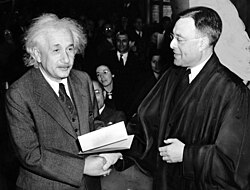
In addition to Einstein, Judge Forman performed the same official role for the influential mathematician and logician Kurt Gödel.
Career Summary Table
| Role | Jurisdiction/Organization | Tenure | Appointing Authority |
|---|---|---|---|
| United States Attorney | District of New Jersey | 1928–1932 | Calvin Coolidge |
| District Judge | District of New Jersey | 1932–1959 | Herbert Hoover |
| Chief Judge | District of New Jersey | 1951–1959 | N/A |
| Circuit Judge | Court of Appeals for the Third Circuit | 1959–1978 | Dwight D. Eisenhower |
Personal Life and Passing
Phillip Forman was married to Pearl Karlberg. He remained connected to his roots in New Jersey throughout his life and career. He passed away on August 17, 1978, at a hospital in Trenton, New Jersey, at the age of 82.
Frequently Asked Questions
Which presidents appointed Phillip Forman to federal office?
Phillip Forman was appointed by three different U.S. Presidents: Calvin Coolidge (as U.S. Attorney), Herbert Hoover (as District Judge), and Dwight D. Eisenhower (as Circuit Judge).
What was Phillip Forman's role in Albert Einstein's life?
Judge Forman presided over the legal process and granted United States citizenship to Albert Einstein on October 1, 1940.
How long did Phillip Forman serve on the federal bench?
He served as a federal judge from June 25, 1932, until his death in 1978, spanning over 46 years of judicial service.
What is the difference between his District Court and Circuit Court roles?
As a District Judge, he presided over trial-level federal cases in New Jersey. As a Circuit Judge for the Third Circuit, he served on an appellate court, which reviews decisions made by lower district courts.
Who else besides Albert Einstein received citizenship through Judge Forman?
Judge Forman also served the same role in granting United States citizenship to the mathematician Kurt Gödel.