Philips Hue: The Evolution of Smart LED Lighting
Philips Hue represents a pioneering line of smart LED lamps and accessories designed for wireless control. As the first commercially available smart bulbs on the market, they set the standard for modern home automation. These products are developed and manufactured by Signify N.V., the company formerly known as the Philips Lighting division of Royal Philips N.V.
Key Facts
- Manufacturer: Signify N.V.
- Launch Date: October 2012 via the Apple Store.
- Connectivity: Supports Zigbee 3.0, Bluetooth, and Matter (on newer hardware).
- Brightness: Initial bulbs offered 600 lumens, with later models reaching 1600 lumens.
- Control Options: Smartphone apps, voice interfaces, and the Hue Bridge.
System Operation and Connectivity
The Hue ecosystem has evolved significantly since its debut as an iOS-controlled lighting appliance. Early products relied on the Zigbee Light Link protocol. However, devices released after 2019 utilize Zigbee 3.0 or Bluetooth for communication. Accessories such as motion detectors and smart switches, which originally used Zigbee Home Automation, have also transitioned to support Zigbee 3.0.
Users typically control their lighting via smartphone apps over Wi-Fi or cellular networks, or through voice command interfaces. These commands are sent to a central bridge via a wired Ethernet connection, which then distributes the instructions to the lamps through a Zigbee mesh network.
The Role of the Hue Bridge
The Hue Bridge serves as the central controller, enabling communication between the bulbs, the app, and various smart home platforms. The system has seen three major iterations of this hardware:
- First Generation (2012): A round bridge supporting Google Home and Amazon Alexa. Support for this model ended in April 2020.
- Second Generation (2016): A square-shaped bridge with a faster processor, increased memory, support for up to 63 devices, and Apple HomeKit integration.
- Hue Bridge Pro (2025): The latest iteration featuring a faster processor, expanded memory, support for up to 150 lights and 50 accessories, built-in Wi-Fi, and Matter support (a universal smart home connectivity standard).
Product Range and Color Options
Philips Hue offers three distinct color ranges, all of which are dimmable to suit different moods and needs:
- White: Produces a fixed warm white light at 2700 K.
- White Ambiance: Adjustable white light ranging from 2200 K (warm soft white) to 6500 K (daylight).
- White and Color Ambiance: Offers adjustable white light from 2000 K to 6500 K, in addition to a full spectrum of colored light.
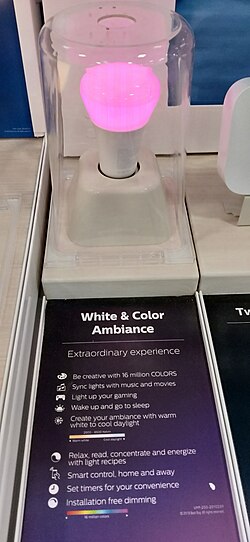
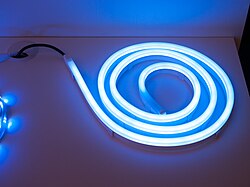
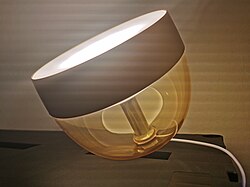
Beyond standard bulbs, the product line expanded in 2018 to include outdoor lighting and entertainment-focused free-standing fittings. By January 2019, the suite grew to include outdoor sensors.
Bluetooth Integration
Since June 2019, all Hue bulbs have included Bluetooth support. This allows users to control up to ten bulbs within a range of 30 feet (9.1 m) using the Philips Hue Bluetooth app without needing a Bridge. However, the Bridge remains necessary for advanced features such as away-from-home control, timers, schedules, and synchronization with entertainment devices.
Technical Specifications Summary
| Range | Color Temperature | Colored Light | Dimmable |
|---|---|---|---|
| White | 2700 K | No | Yes |
| White Ambiance | 2200 K - 6500 K | No | Yes |
| White and Color Ambiance | 2000 K - 6500 K | Yes | Yes |
Security and Reception
In 2016, a security vulnerability was identified where researchers could remotely control bulbs from up to 70 meters (230 ft) away by tricking them into installing malicious firmware. This flaw was subsequently resolved by the manufacturer.
The system has been widely praised by critics. Forbes named Philips Hue the "best product of 2012," and PC Magazine designated the white variation as an "editors' choice," citing its brightness, affordability, and feature set.
Frequently Asked Questions
Do I need a Hue Bridge to use the lights?
Not for basic operation. Since June 2019, bulbs support Bluetooth, allowing control of up to ten lights via the app. However, a Bridge is required for advanced features like scheduling, voice control, and managing more than ten devices.
What is the difference between White Ambiance and Color Ambiance?
White Ambiance allows you to adjust the shade of white light from warm to daylight (2200 K to 6500 K). White and Color Ambiance provides a similar range of white light (2000 K to 6500 K) but also adds the ability to produce millions of different colors.
How many lights can the Hue Bridge Pro support?
The Hue Bridge Pro, released in 2025, can support up to 150 lights and 50 accessories.
What happened to the first-generation Hue Bridge?
The first-generation round bridge received its final software update in April 2020. Because it relied on Philips servers for certain functions like scene scheduling, users were required to upgrade to a second-generation bridge to maintain full functionality.
What is the maximum brightness of Hue bulbs?
While the initial system launched with bulbs producing up to 600 lumens, later models increased this limit to 1600 lumens.