Permanent Joint Headquarters: The Nerve Center of UK Overseas Operations
The Permanent Joint Headquarters (PJHQ) serves as the central hub for the United Kingdom's tri-service military operations. As a joint command—meaning it integrates the Royal Navy, British Army, and Royal Air Force—PJHQ is the primary location where all overseas military operations are planned, coordinated, and controlled. Based at the Northwood Headquarters in Hertfordshire, England, it ensures that the UK's strategic military objectives are met with precision and cohesion across different branches of service.
Currently part of the Cyber & Specialist Operations Command, PJHQ is led by the Chief of Joint Operations (CJO), a three-star ranked officer. The current commander is Air Marshal Allan Marshall.
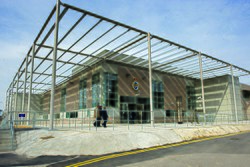
Key Facts
- Established: April 1, 1996.
- Location: Northwood Headquarters, Hertfordshire, England.
- Role: Planning and controlling all UK overseas military operations.
- Composition: Tri-service (Royal Navy, British Army, Royal Air Force).
- Personnel: 567 military and civil service personnel (as of November 2022).
- Command: Led by the Chief of Joint Operations (CJO).
History and Evolution
The journey toward a unified joint command began in 1994, led by Major General Christopher Wallace. Establishing the PJHQ required significant advocacy, as senior leadership within the Army and RAF were initially hesitant to embrace the initiative. The headquarters officially launched on April 1, 1996, to improve the efficiency of UK-led joint and multi-national operations, as well as to manage UK forces assigned to operations led by other nations.
By August 1, 1996, PJHQ became fully operational, assuming responsibility for military operations worldwide. The site at Northwood, spanning 35 hectares, has been under RAF ownership since 1938. In 2010, the organization reached a milestone when its 600 staff officers and enlisted personnel moved into a contemporary building, allowing the entire team to work under one roof for the first time.
The Joint Force Headquarters (JFHQ)
In mid-1998, the Joint Force Headquarters (JFHQ) was created as an extension of the PJHQ's J3 Operations staff. Commanded by a Brigadier-equivalent officer, the JFHQ was designed to be a short-notice deployable headquarters capable of entering the field rapidly. Its first commander, Brigadier David Richards, expanded the staff from 24 to 55 personnel to better meet the needs of the Joint Rapid Reaction Forces (JRRFs)—a pool of high-readiness force elements maintained to handle urgent contingencies.
Mission and Operational Scope
The primary mission of the CJO is to exercise operational command over UK forces assigned to overseas joint and combined operations. Additionally, the PJHQ provides politically aware military advice to the Ministry of Defence (MOD) to ensure strategic objectives are achieved.
Modern warfare requires digital integration; consequently, PJHQ manages cyber operations in coordination with the Government Communications Headquarters (GCHQ) in Cheltenham.
Operational Boundaries
While PJHQ manages most overseas activities, certain critical areas fall under different jurisdictions:
- Strategic Nuclear Deterrent: Managed by the Royal Navy Commander Operations.
- UK Home Base Defence: (Including territorial waters and airspace) Managed by the Standing Joint Command.
- Northern Ireland: Managed by Army HQ Northern Ireland.
- UK Counter-terrorism: Managed by the Home Office.
- NATO Article V (General War): Managed by the NATO Military Command Structure.
Notable Operations
PJHQ has supervised numerous high-profile missions, including:
- Operation Veritas: Afghanistan (2001).
- Operation Telic: The 2003 invasion of Iraq.
- Operation Herrick: UK operations in Helmand Province, Afghanistan (from 2006).
- Operation Pitting: The 2021 evacuation of UK nationals and at-risk Afghans from Kabul.
Summary of PJHQ Administration
| Attribute | Details |
|---|---|
| Parent Command | Cyber & Specialist Operations Command |
| Headquarters Site | Northwood, London/Hertfordshire |
| Budget (2007-2008) | Estimated £475 million |
| Staffing (2022) | 567 military and civil service personnel |
| Commanding Officer | Chief of Joint Operations (CJO) |
Commanders of PJHQ
The leadership of PJHQ has been shared across the three branches of the British Armed Forces, reflecting its joint nature.
- Sir Christopher Wallace (Army) - April 1996
- Sir Ian Garnett (Royal Navy) - February 1999
- Sir John Reith (Army) - August 2001
- Sir Glenn Torpy (RAF) - July 2004
- Sir Nicholas Houghton (Army) - March 2006
- Sir Stuart Peach (RAF) - March 2009
- Sir David Capewell (Royal Marines) - December 2011
- Sir John Lorimer (Army) - January 2015
- Tim Fraser (Royal Navy) - June 2017
- Sir Ben Key (Royal Navy) - April 2019
- Sir Charles Stickland (Royal Marines) - November 2021
- Nick Perry (Army) - November 2024
- Allan Marshall (RAF) - July 2026
Frequently Asked Questions
What is the primary purpose of the Permanent Joint Headquarters?
The PJHQ is the tri-service headquarters responsible for planning and controlling all of the United Kingdom's overseas military operations.
Who is in charge of the PJHQ?
The headquarters is commanded by the Chief of Joint Operations (CJO), a three-star officer. The current commander is Air Marshal Allan Marshall.
Does PJHQ handle all UK military matters?
No. It does not handle the Strategic Nuclear Deterrent, the defence of the UK home base, operations in Northern Ireland, domestic counter-terrorism, or NATO Article V (General War) scenarios.
Where is the PJHQ located?
It is located at the Northwood Headquarters in Northwood, London (Hertfordshire), on a 35-hectare site that has belonged to the RAF since 1938.
What is the difference between PJHQ and JFHQ?
While PJHQ is the permanent command center, the Joint Force Headquarters (JFHQ) was established as a smaller, highly mobile unit capable of deploying into the field at very short notice.