Père Lachaise Cemetery: Paris's Most Iconic Garden Necropolis
Located in the 20th arrondissement of Paris, the Père Lachaise Cemetery (originally known as the Cimetière de l'Est) is the largest cemetery in the French capital. Spanning 44 hectares (110 acres), it holds the distinction of being the first municipal and garden cemetery in Paris. More than just a place of rest, it is a sprawling open-air museum of art, history, and botany, housing over one million interments.
Visitors can access the grounds via the Boulevard de Ménilmontant, with convenient access through the Philippe Auguste station (Line 2) or the Père Lachaise station (Lines 2 and 3).
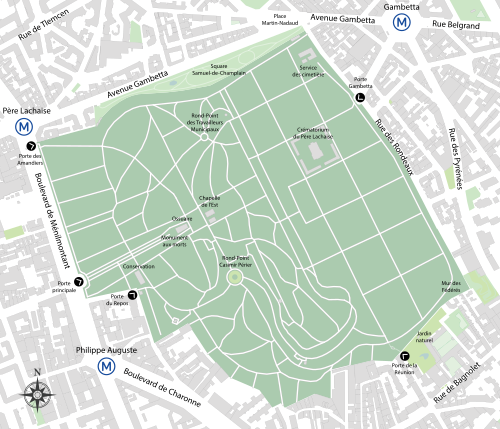
Key Facts
- Established: 1804 by Napoleon Bonaparte.
- Size: 44 hectares (110 acres).
- Interments: Over 1 million people.
- Type: Public, non-denominational garden cemetery.
- Notable Feature: Home to the first crematorium built in France.
The History and Evolution of the Grounds
Origins and Design
The cemetery takes its name from Père François de la Chaise (1624–1709), a confessor to Louis XIV who lived in a Jesuit house on the site. In 1804, the city purchased the property, and Napoleon—who had recently been proclaimed Emperor—established the cemetery under the principle that every citizen has the right to be buried regardless of race or religion.
The layout was designed by neoclassical architect Alexandre-Théodore Brongniart. Drawing inspiration from English-style gardens, Brongniart created a landscape of uneven paths, diverse flora, and carved graves, moving away from the crowded city graveyards like the Holy Innocents' Cemetery.
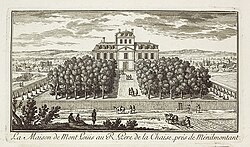
A Strategic Rise to Fame
Initially, the cemetery struggled to attract burials; in 1804, it contained only 13 graves. To increase its prestige, administrators implemented a marketing strategy in 1817, organizing the high-profile transfer of the remains of Molière and Jean de La Fontaine. They also moved the purported remains of the famous lovers Pierre Abélard and Héloïse d'Argenteuil.
This spectacle worked. The public began clamoring to be buried alongside these luminaries, and by 1830, the cemetery grew to over 33,000 graves. To accommodate this growth, the site was expanded five times between 1824 and 1850.
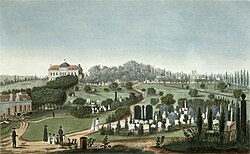
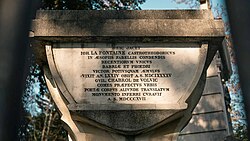
Architectural and Religious Landmarks
The Crematorium and Columbarium
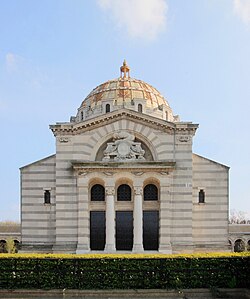
In 1894, Jean-Camille Formigé designed a Byzantine Revival building housing both a crematorium and a columbarium (a wall for funeral urns). The structure features a large brick and sandstone dome, later decorated with stained glass by Carl Maumejean in the 1920s. The columbarium consists of four levels capable of holding over 40,800 cases.
The crematorium was a pioneer in France, performing its first cremation on January 30, 1889. While initially uncommon, cremation grew in popularity after the Catholic Church lifted its ban in 1963, eventually representing 45% of Parisian funerals by 2012.
Diverse Religious Enclosures
Reflecting Napoleon's vision of inclusivity, the cemetery established dedicated areas for different faiths:
- Jewish Enclosure: Opened in 1810 in the 7th division. Following the 1881 law revoking segregation in cemeteries, the walls were removed, and burials moved to the 96th division.
- Muslim Enclosure: Opened in 1857 in the 85th division, it was the first Muslim cemetery in France. It included a mosque and a lavatorium for purification. The mosque was unfortunately destroyed in 1914 during World War I.
The Chapel and Ossuary
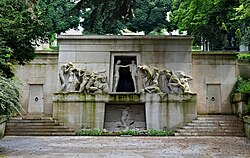
While Brongniart originally envisioned a pyramid for all Christian denominations, architect Étienne-Hippolyte Godde instead built a chapel in 1820, which was sanctified in 1834. Additionally, the site contains an ossuary (a site for skeletal remains) located behind the Monument aux morts.
Notable Interments and Cultural Impact
Père Lachaise is world-renowned for the figures resting within its walls. From the arts, it houses Oscar Wilde, Jim Morrison, Édith Piaf, and Marcel Proust. In the realms of science and philosophy, it is the final resting place of Auguste Comte, Joseph Fourier, and Jean-François Champollion.
Influence on Popular Culture
The cemetery's atmospheric beauty has made it a frequent setting for cinema and literature. It appears in films such as Amélie, Fantastic Beasts: The Crimes of Grindelwald, and The Walking Dead: Daryl Dixon. In literature, it is mentioned in the works of Victor Hugo (Les Misérables) and Alexandre Dumas (The Count of Monte Cristo).
| Feature | Detail |
|---|---|
| Total Area | 44 hectares (110 acres) |
| Total Interments | Over 1 million (as of 2012) |
| Founder | Napoleon Bonaparte |
| Architect | Alexandre-Théodore Brongniart |
| Key Facilities | Crematorium, Columbarium, Chapel |
Frequently Asked Questions
Who is the cemetery named after?
It is named after Père François de la Chaise, a 17th-century confessor to King Louis XIV who lived on the site in a Jesuit house.
Why is it called a "garden cemetery"?
Unlike traditional cramped city graveyards, it was designed with English-style gardens, featuring winding paths, diverse trees, and lush plants to create a park-like atmosphere.
Is the cemetery open to all religions?
Yes. Established under Napoleon's decree, it was designed to be non-denominational, providing burial rights to all citizens regardless of their faith.
What is a columbarium?
A columbarium is a structure containing niches where funeral urns containing cremated remains are placed. The one at Père Lachaise is part of a Byzantine Revival building.
Which famous musicians are buried here?
Notable musical figures include Frédéric Chopin, Georges Bizet, and the legendary rock star Jim Morrison.