Pep Guardiola: The Evolution of a Football Icon
Few figures have left as indelible a mark on the modern game as Josep Guardiola Sala. From his days as a cerebral defensive midfielder to his tenure as one of the most decorated managers in football history, Guardiola has consistently redefined how the sport is played and perceived. Born on January 18, 1971, in Santpedor, Catalonia, Spain, his journey is a testament to the power of tactical intelligence and an unwavering pursuit of excellence.
Key Facts
- Full Name: Josep Guardiola Sala.
- Playing Position: Defensive midfielder.
- Managerial Record: Over 1,000 matches managed with a win percentage of 71.3%.
- Major Honors: Multiple league titles across Spain, Germany, and England, including the UEFA Champions League.
- Olympic Success: Gold medal winner with Spain at the 1992 Barcelona Games.
The Playing Years: A Midfield Maestro
Guardiola's professional journey began in the youth ranks of Gimnàstic Manresa before he joined the prestigious FC Barcelona academy in 1984. He rose through the ranks, playing for Barcelona C and Barcelona B before establishing himself as a cornerstone of the first team from 1990 to 2001.
As a defensive midfielder—a role focused on breaking up opposition play and initiating attacks—Guardiola became the heartbeat of the Barcelona squad. During his tenure, he secured six La Liga titles and the 1991–92 European Cup. His international career was equally distinguished, earning 47 caps for Spain and playing a pivotal role in the 1992 Olympic gold medal victory.
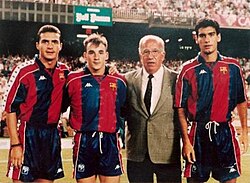
Following his long stint in Catalonia, Guardiola spent the twilight of his playing career in Italy with Brescia and Roma, and later in Qatar with Al-Ahli and Mexico with Dorados, before retiring in 2006.
Transition to Management: The Barcelona Revolution
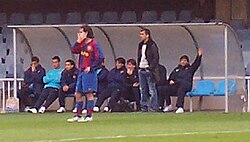
Guardiola's transition to coaching began in 2007 with Barcelona B, where he led the team to the Tercera División title. This success paved the way for his appointment as the first-team manager in 2008, sparking one of the most dominant eras in football history.
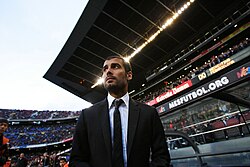
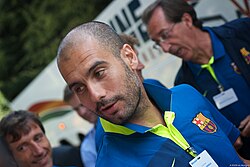
In his first season (2008–09), Guardiola achieved a historic treble, winning La Liga, the Copa del Rey, and the UEFA Champions League. He followed this by winning six trophies in a single calendar year in 2009 and securing a second Champions League title in 2011. By the time he departed in 2012, he had established a legacy of possession-based football that changed the global game.
Global Dominance: Bayern Munich and Manchester City
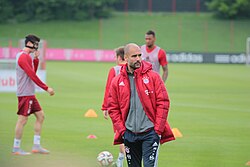
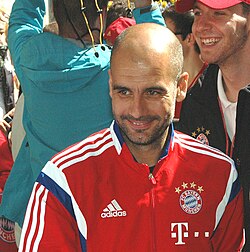
After a brief sabbatical, Guardiola took the helm at Bayern Munich in 2013. He dominated the Bundesliga, winning three consecutive titles and achieving two domestic doubles before leaving in 2016.
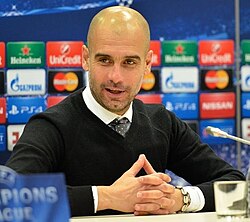
In 2016, Guardiola moved to England to manage Manchester City. His arrival signaled a shift in the Premier League, culminating in the 2017–18 "Centurions" season, where City became the first team to reach 100 points in a single campaign. His tenure at City has been marked by unprecedented domestic success, including a historic "four-peat" of Premier League titles between 2020 and 2024.
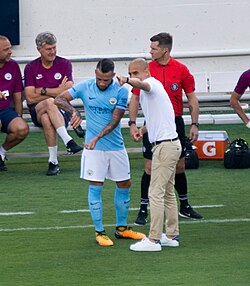
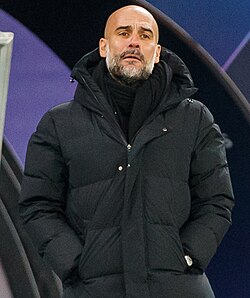
The pinnacle of his time in England came with the 2022–23 continental treble, which included the long-coveted UEFA Champions League trophy, cementing his status as a master tactician across multiple leagues.
Career Summary and Statistics
Guardiola's career is defined by a staggering volume of silverware and a consistently high win rate across three of Europe's top leagues.
| Role | Primary Teams | Key Achievements | Total Apps/Matches |
|---|---|---|---|
| Player | Barcelona, Spain, Brescia, Al-Ahli | 6x La Liga, Olympic Gold, European Cup | 398 Club Apps / 47 Int'l Caps |
| Manager | Barcelona, Bayern Munich, Man City | Multiple UCL, PL, Bundesliga, La Liga titles | 1,043 Matches Managed |
Frequently Asked Questions
What is a "treble" in football?
A treble occurs when a club wins its domestic league, its primary domestic cup, and the continental championship (such as the UEFA Champions League) all in a single season.
Which teams has Pep Guardiola managed?
Guardiola has managed Barcelona B, FC Barcelona, Bayern Munich, and Manchester City.
How many Premier League titles has he won with Manchester City?
He has won six Premier League titles with Manchester City, including a sequence of four consecutive titles from 2020 to 2024.
What was Guardiola's role as a player?
He played as a defensive midfielder, primarily for FC Barcelona, where he was known for his tactical discipline and ability to distribute the ball.
Has Guardiola won the UEFA Champions League as a manager?
Yes, he has won the UEFA Champions League with both FC Barcelona (2009, 2011) and Manchester City (2023).