PBA History: The Evolution of Professional Bowling
Before the formalization of professional bowling, the sport thrived through team-based competition and prestigious national events. Tournaments like the BPAA All-Star, which debuted in 1942, and the ABC Masters, starting in 1951, served as the primary stages for the era's elite bowlers. While television coverage was sporadic in the early 1950s—beginning with NBC's Championship Bowling and later weekly shows like Jackpot Bowling—the foundation was being laid for a structured professional circuit.
The Founding of the PBA
The drive to establish a professional division in the United States was led by Eddie Elias, an Akron, Ohio-based lawyer and sports agent. During the 1958 American Bowling Congress (ABC) tournament in Syracuse, New York, Elias presented his vision to sixty men. Among those present were legends such as Don Carter, Carmen Salvino, and Buzz Fazio. Thirty-three of these men contributed $50 each, raising a total of $1,650 to incorporate the Professional Bowlers Association (PBA) in 1958.
These initial investors became charter members, granting them lifetime membership in the organization. While Bill Bunetta was originally tapped by Elias to serve as the first commissioner, Bunetta declined the role to focus on his active bowling and teaching career.
Early Growth and the Golden Age of Television
Competition officially launched in 1959 with three tournaments. Lou Campi won the inaugural Empire State Open, while Dick Weber claimed victory in both the Paramus Eastern Open and the Dayton Open. Weber quickly became the face of the sport, winning 10 of the first 23 events, including seven in 1961 alone.
The tour's growth was exponential: from seven tournaments in 1960 to 13 in 1961, and a massive leap to 30 stops by 1962. This expansion coincided with a strategic push for television visibility. After a brief run with Make That Spare on ABC Sports (1960–1964), the PBA secured a dedicated series called the Professional Bowlers Tour, which aired on ABC from 1962 to 1997.
Supported by major sponsors like Ford Motor Company, Coca-Cola, True Value Hardware, and Firestone Tire, prize funds soared. By 1963, top bowlers earned salaries competitive with major league baseball and football stars. For example, Sports Illustrated noted that Harry Smith's potential earnings in 1963 rivaled the combined incomes of MLB's Sandy Koufax and NFL's Y. A. Tittle.
Milestones in Prize Money and Expansion
The 1965 Firestone Tournament of Champions marked a milestone as the first event to offer a $100,000 prize fund. By 1987, the U.S. Open, sponsored by Seagram distillery, offered a $500,000 fund and the first $100,000 first-place prize in PBA history.
The organization also expanded its reach by launching the PBA Senior Tour in 1981 (renamed the PBA50 Tour in 2013), with Bill Beach winning the first championship. High-stakes incentives also became common; True Value once offered $100,000 (later $200,000) for a perfect game on national television, and the Miller Brewing Company offered $1 million for winning three specific sponsored tournaments in one season.
Challenges and Transitions
The PBA faced significant hurdles in the late 20th century. Between 1986 and 1991, the organization was embroiled in an antitrust lawsuit with the Touring Pro Bowlers (TPB), a group of dissatisfied professionals. Although settled out of court, the legal battle caused substantial financial strain.
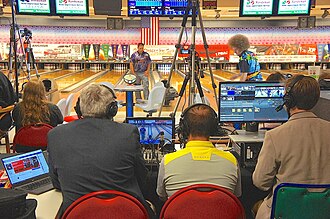
By the late 1990s, the rise of cable television and the popularity of Saturday afternoon college football led to a decline in viewership. The Professional Bowlers Tour ended its 36-year run on ABC in June 1997. Following brief stints on CBS and Fox Sports Net, ESPN gained exclusive rights in 2001.
The 21st Century: Modernization and Inclusion
In March 2000, former Microsoft executives Chris Peters, Rob Glaser, and Mike Slade purchased the PBA, moving headquarters to Seattle, Washington. Alongside CEO Steve Miller, they are credited with saving the organization from potential collapse.
The 2000s brought a shift toward inclusivity. After the Professional Women's Bowling Association (PWBA) folded in 2003, the PBA began admitting female members in 2004. Missy Bellinder (Parkin) was the first female member, while Liz Johnson became the first woman to cash in a PBA Tour event and appear on a telecast. In 2010, Kelly Kulick made history as the first woman to win a PBA Tour event open to men, winning the Tournament of Champions.
Financial pressures during the 2009 economic downturn led to a restructured schedule. The PBA introduced the World Series of Bowling, consolidating multiple tournaments into a single event to optimize broadcasting and costs. While some standard tournament prizes dropped as low as $15,000 for winners, the 2011 Tournament of Champions reached a record $1 million prize fund with a $250,000 top prize.
Current Ownership and Future Outlook
In September 2019, the Bowlero Corporation purchased the PBA. Under this new ownership, television coverage transitioned from ESPN to Fox Sports, with a partnership extended through the 2025 season. Looking ahead, the PBA has secured a multi-year agreement with The CW network to air ten events on Sunday afternoons starting in 2026, with additional telecasts on CBS networks.
In January 2026, Peter Murray was appointed as the CEO and Head of Media, filling a vacancy that had existed since 2022.
| Era/Year | Key Milestone | Significant Figure/Entity |
|---|---|---|
| 1958 | PBA Incorporated | Eddie Elias |
| 1962 | Launch of Professional Bowlers Tour on ABC | ABC Sports |
| 1981 | Inauguration of Senior Tour (now PBA50) | Bill Beach |
| 2000 | Acquisition and relocation to Seattle | Chris Peters, Rob Glaser, Mike Slade |
| 2010 | First woman to win an open PBA event | Kelly Kulick |
| 2019 | Acquisition by Bowlero Corporation | Bowlero Corporation |
Key Facts
- Founding Capital: The PBA was started with $1,650, donated by 33 charter members.
- Membership: Over 10,000 bowlers have held PBA membership since 1958.
- Title Winners: As of September 2017, 345 different bowlers have won a PBA Tour title.
- Success Rate: Approximately 15.6% of title winners have earned 10 or more titles.
- Broadcasting: The PBA has moved from ABC to ESPN, Fox Sports, and will expand to The CW in 2026.
Frequently Asked Questions
Who founded the Professional Bowlers Association?
The PBA was founded in 1958 through an effort led by Eddie Elias, a lawyer and sports agent from Akron, Ohio, with the financial support of 33 charter members.
Who was the first woman to win a PBA Tour event open to men?
Kelly Kulick became the first woman to win a PBA Tour event open to men when she won the 2010 Tournament of Champions.
How did the PBA's television coverage change over time?
The PBA had a long-standing relationship with ABC (1962–1997), followed by periods with CBS and Fox Sports Net, an exclusive era with ESPN starting in 2001, a move to Fox Sports in 2019, and a future agreement with The CW beginning in 2026.
What is the World Series of Bowling?
Introduced in 2009 due to financial difficulties and economic conditions, the World Series of Bowling consolidates multiple standard tournaments and qualifying events into a single location to streamline the schedule and broadcasting.
Who currently owns the PBA?
The PBA is owned by the Bowlero Corporation, which purchased the organization in September 2019.