Parque de la Independencia: Rosario's Premier Urban Oasis
Located in the heart of Rosario, Santa Fe, the Parque de la Independencia (Independence Park) serves as a vital green lung for the city. Spanning 1.26 square kilometers, this expansive public space is strategically positioned near the geographical center of the city, bordered by Moreno Street and three major thoroughfares: Pellegrini Avenue, Ovidio Lagos Avenue, and 27 de Febrero Boulevard.
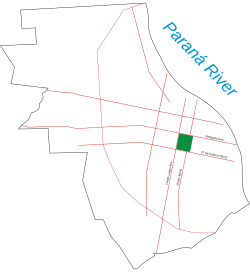
Key Facts
- Location: Rosario, Santa Fe, Argentina.
- Total Area: 1.26 km² (0.49 sq mi).
- Designer: Renowned landscape architect Carlos Thays.
- Inauguration Date: January 1, 1902.
- Key Features: Three museums, multiple themed gardens, and several major sports venues.
The History and Design of the Park
The Parque de la Independencia holds the distinction of being the first park in Rosario. Its origins trace back to four public squares situated at the intersection of two newly opened boulevards, then known as Santafesino and Argentino (now Oroño Boulevard and Pellegrini Avenue). This four-part plaza was originally named Independencia.
In 1900, under the leadership of Mayor Luis Lamas, the provincial government authorized the municipality to expropriate the necessary land. The park's layout was designed by Carlos Thays, a celebrated landscape architect also known for his work on the Buenos Aires Botanical Garden. By 1901, the city had constructed internal roads, an artificial lake, and a small artificial hill created from the lake's excavation, which remains known today as La Montañita (the Little Mountain).
The park officially opened on January 1, 1902, following the First Festival of the Tree, during which students planted 6,000 trees to establish the park's lush canopy.
Cultural and Botanical Attractions
The park is a blend of nature, art, and tradition. One of its most unique features is the Calendar, where gardeners have rearranged flowers every evening since 1946 to display the current date on the ground. Additionally, a dedicated area is reserved for fairs, which historically hosted agricultural, industrial, and commercial expositions.
Themed Gardens
- The Rosedal (Rose Garden): Completed in 1915, this garden features various rose species, fountains, and sculptures.
- The French Garden: Established in 1942, it is characterized by intricate flower arrangements and a large marble fountain.
- The Children's Garden: A 35,000 m² area dedicated to educational and amusement facilities.
Museums and Art
The park serves as a cultural hub, housing three significant institutions:
- Museum of the City: Opened in 1902, it originally served as the School of Gardener Apprentices.
- Juan B. Castagnino Fine Arts Museum: A premier art venue opened in 1937.
- Dr. Julio Marc Provincial Historical Museum: An institution dedicated to regional history, opened in 1939.
Sports and Recreation
Beyond its gardens and galleries, the park is a center for athletic excellence. The Jorge Newbery Municipal Stadium, started in 1925, was the first state-funded public sports venue in Argentina and hosted the 2005 South American Junior Championships in Athletics.
Other notable facilities include the Patinódromo Municipal "Roberto Tagliabué" (Municipal Skating Rink), which opened for the 1982 Southern Cross Games and hosted the 2014 Inline Speed Skating World Championship. The park also contains the former Rosario Jockey Club horsetrack and is home to three sports clubs: Club Gimnasia y Esgrima, Club Atlético Provincial, and Club Atlético Newell's Old Boys, one of the city's primary football teams.
Park Summary Table
| Category | Feature | Year Established/Opened |
|---|---|---|
| Gardens | Rosedal | 1915 |
| Gardens | French Garden | 1942 |
| Museums | Museum of the City | 1902 |
| Museums | Juan B. Castagnino Fine Arts Museum | 1937 |
| Sports | Jorge Newbery Municipal Stadium | 1925 |
| Sports | Patinódromo Municipal "Roberto Tagliabué" | 1982 |
Frequently Asked Questions
Who designed the Parque de la Independencia?
The park was designed by the famous landscape architect Carlos Thays, who is also well-known for his work on the Buenos Aires Botanical Garden.
What is "La Montañita"?
La Montañita (the Little Mountain) is a small artificial hill created in 1901 using the earth removed during the construction of the park's artificial lake.
Which sports teams are located in the park?
The park hosts three sports clubs: Club Gimnasia y Esgrima, Club Atlético Provincial, and Club Atlético Newell's Old Boys.
What is unique about the park's flower calendar?
Since 1946, gardeners have rearranged flowers every single evening to write the current date on the ground.
When was the park officially inaugurated?
The Parque de la Independencia was officially inaugurated on January 1, 1902.