Parasitic Worms: Biology, Life Cycles, and Public Health Impact
Parasitic worms, scientifically known as helminths, are a diverse group of large macroparasites. Unlike microscopic pathogens, adult helminths are generally visible to the naked eye. These organisms are classified as endoparasites, meaning they live and feed inside their hosts, where they receive nourishment and protection. While some parasitic worms, such as leeches, are ectoparasites (living on the outside of the host), true helminths operate internally, often disrupting the host's ability to absorb essential nutrients.
This biological relationship can lead to significant weakness and disease, creating substantial global health and economic challenges. To survive, helminths have evolved the ability to manipulate the host's immune response by secreting immunomodulatory products, allowing them to persist within a mammalian host for many years.
Key Facts
- Diversity: There are up to 300,000 parasite species affecting vertebrates, with approximately 300 affecting humans.
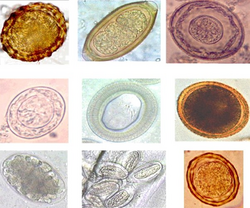
- Resilience: Helminth eggs possess strong shells that allow them to survive in soil, water, and sewage for months or even years.
- Life Cycle: Helminths cannot complete their reproduction entirely within a host; they require external stages to mature.
- Transmission: Many are soil-transmitted, infecting the gastrointestinal tract, while others, like schistosomes, reside in blood vessels.
- Inactivation: Eggs are highly resistant but can be inactivated by temperatures above 40°C or moisture levels below 5%.
Taxonomy and Classification
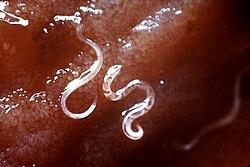
Helminths are broadly categorized into three primary groups based on their morphology and reproductive strategies: Cestodes (tapeworms), Trematodes (flukes), and Nematodes (roundworms).
Cestodes (Tapeworms)
Cestodes are characterized by a segmented, flat body and lack a digestive tube. They are hermaphroditic and use suckers or hooks (rostellum) to attach to the host.
Trematodes (Flukes)
Trematodes are unsegmented and flat. While most are hermaphroditic, schistosomes are dioecious (having separate male and female individuals). They typically utilize oral and ventral suckers for attachment.
Nematodes (Roundworms)
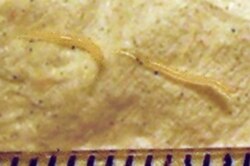
Nematodes possess a cylindrical body with a complete digestive tube ending in an anus. They are dioecious and use lips, teeth, or dentary plates to maintain their position within the host.
Reproduction and the Life Cycle
The reproduction of helminths is characterized by the production of massive quantities of eggs through a process called oviposition. Depending on the species, a female may deposit between 3,000 and 700,000 eggs per event. For some Taenia species, this occurs up to six times daily.
The eggs are engineered for survival. Their structure consists of outer layers of mucopolysaccharides and proteins, with a middle layer of chitinous material that provides mechanical resistance. This allows eggs to remain viable for 1–2 months in crops and several years in feces or sewage sludge.
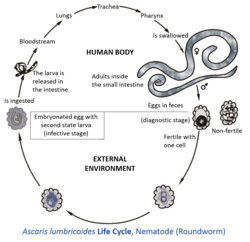
While nematodes and cestodes typically produce one larva per egg, trematodes exhibit a different strategy. A single egg develops into a miracidia, which then produces thousands of cercariae (swimming larvae), meaning one egg can potentially result in thousands of adult worms.
Comparison of Helminth Groups
| Feature | Cestodes (Tapeworms) | Trematodes (Flukes) | Nematodes (Roundworms) |
|---|---|---|---|
| Shape | Segmented flat | Unsegmented flat | Cylindrical |
| Digestive Tube | None | Ends in cecum | Ends in anus |
| Sex | Hermaphroditic | Mostly Hermaphroditic | Dioecious |
| Body Covering | Tegument | Tegument | Cuticle |
| Human-Infecting Species | ~40 | ~16 | >12,000 |
Sanitation and Environmental Impact
Because helminth eggs are so resilient, they pose a significant challenge for wastewater management. Eggs typically range from 20 to 90 μm in size with a relative density of 1.06–1.23. In many regions, Ascaris lumbricoides (the giant roundworm) is used as an indicator organism to test the efficiency of sludge treatment because its eggs are among the most resistant.
To ensure safety in agricultural reuse of wastewater, treatment processes must effectively inactivate these eggs. Common methods include:
- Thermal Treatment: Increasing temperatures above 40°C.
- Dehydration: Reducing moisture to less than 5%.
- Chemical/Biological Processes: Alkaline-post stabilization, acid treatment, and anaerobic digestion.
- Long-term Storage: Storing feces for 1–2 years with high solids content (>50-60%) at temperatures above 30°C.
Successful treatment is often measured by reducing the concentration of viable eggs to ≤1 per liter.
Frequently Asked Questions
What is the difference between a helminth and other parasitic worms?
Helminths are specifically endoparasites (living inside the host). Other parasitic worms, such as leeches and monogeneans, are ectoparasites (living outside the host) and are therefore not classified as helminths.
Why are helminth eggs so difficult to destroy?
Their difficulty stems from a strong protective shell composed of mucopolysaccharides, proteins, and a chitinous middle layer, which protects them from harsh environmental conditions for months or years.
How does Ascaris lumbricoides react to temperature?
The eggs of Ascaris lumbricoides develop best at around 25°C. However, larval development stops below 15.5°C, and the eggs cannot survive temperatures significantly above 38°C.
Can helminths complete their entire life cycle inside a human?
No. All helminths have a life cycle that requires at least some stages to take place outside the host's body before they can reinfect another host.
What is an indicator organism in sanitation?
An indicator organism is a specific species, such as Ascaris lumbricoides, used to assess the overall efficiency of a treatment process. If the most resistant eggs are removed or inactivated, it is assumed other, less resistant helminth eggs have also been eliminated.