Para-alpine Skiing: Disciplines, Rules, and Technical Specifications
Para-alpine skiing is a high-speed, exhilarating sport that adapts traditional alpine racing for athletes with disabilities. Governed by rules based on the International Ski Federation (FIS), these disciplines challenge athletes to balance raw speed with technical precision. In the most demanding events, skiers can reach breathtaking speeds of up to 100 kilometres (62 mi) per hour.
The sport is divided into several distinct disciplines, ranging from the sheer velocity of the downhill to the intricate agility required for the slalom. Each event has specific equipment requirements and course layouts designed to test different athletic capabilities.
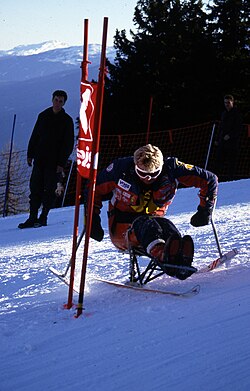
Key Facts
- Top Speeds: Athletes can reach 100 km/h (62 mph) in speed-based events.
- Governing Rules: Based on International Ski Federation (FIS) standards with adaptations for disabilities.
- Technical Range: Disciplines vary from the high-speed Downhill to the highly technical Slalom.
- Equipment: Specific ski lengths and radii are mandated based on the discipline and gender.
- Paralympic Status: Downhill, Super-G, Giant Slalom, and Slalom are all included in the current Paralympic programme.
Speed Disciplines: Downhill and Super-G
Downhill
The downhill is a timed event focused on maximum speed. Competitors navigate a steep course with a vertical drop between 450 metres (1,480 ft) and 800 metres (2,600 ft). This discipline features the fewest gates of all para-alpine events; missing a gate results in immediate disqualification. The winner is determined by a single run.
Equipment is strictly regulated: women must use skis at least 200 cm (79 in) long, while men require a minimum length of 205 cm (81 in). Both genders must use skis with a minimum radius of 45 metres (148 ft) and a profile radius of 67 millimetres (2.6 in). Athletes use curved ski poles and must wear a helmet for all runs, including the mandatory practice run.
Super-G
Developed in the 1980s, the Super-G (Super Giant Slalom) is less technical than the slalom events but faster than the giant slalom. The course is mid-length, with a vertical drop ranging from 400 metres (1,300 ft) to 600 metres (2,000 ft). Skiers navigate alternating red and blue gates spaced 25 metres (82 ft) apart—men must clear 35 gates, while women clear 30.
Similar to the downhill, ski lengths are 200 cm for women and 205 cm for men. However, the minimum radius is shorter at 33 metres (108 ft), and the profile radius is 65 millimetres (2.6 in). Curved ski poles are also used in this discipline.
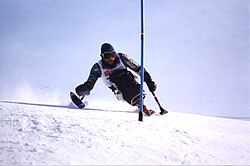
Technical Disciplines: Giant Slalom and Slalom
Giant Slalom
The giant slalom is a technical event with a vertical drop of 300 metres (980 ft) to 400 metres (1,300 ft). Unlike speed events, the winner is determined by the combined time of two separate runs. To increase competition, judges may eliminate the bottom 20% of finishers after the first run.
The starting order for the second run is inverted for the top 15 skiers (the fastest first-run skier goes 15th), while remaining skiers follow in their original finishing order. In some competitions, this top group is expanded to 30 skiers. Athletes use straight ski poles for this event.
Slalom
Derived from a Norwegian word meaning "sloping path," the slalom is the most technical discipline. It takes place on an intentionally iced course with the shortest vertical drop, between 140 metres (460 ft) and 220 metres (720 ft). Like the giant slalom, it consists of two runs on different courses, with the combined time determining the winner.
The course is densely packed with gates—roughly 55–75 for men and 40–60 for women. Missing a gate leads to disqualification. Due to the technical nature and proximity to gates, skiers often wear protective pads and use straight ski poles.
Combined and Alternative Events
Super Combined
The Super Combined merges speed and technique. It typically pairs a speed event (either downhill or Super-G) with the slalom. Athletes complete the downhill course once and the slalom course twice, with the fastest total combined time winning.
Snowboard
Para-snowboarding is open exclusively to standing competitors. The courses range from 400 metres (1,300 ft) to 900 metres (3,000 ft) in length, featuring alternating gates and vertical drops between 100 metres (330 ft) and 240 metres (790 ft).
Comparison of Para-alpine Disciplines
| Discipline | Vertical Drop | Run Format | Pole Type | Primary Focus |
|---|---|---|---|---|
| Downhill | 450m – 800m | Single Run | Curved | Speed |
| Super-G | 400m – 600m | Single Run | Curved | Speed/Technical |
| Giant Slalom | 300m – 400m | Two Runs | Straight | Technical |
| Slalom | 140m – 220m | Two Runs | Straight | High Technical |
| Snowboard | 100m – 240m | Single Run | N/A | Technical |
Frequently Asked Questions
How is the winner determined in the Giant Slalom and Slalom?
In both the Giant Slalom and Slalom, the winner is decided by the combined time of two separate runs down the course.
What happens if a skier misses a gate in the Downhill or Slalom?
If a skier misses a gate in either the Downhill or Slalom disciplines, they are disqualified from the race.
What are the ski length requirements for the Downhill and Super-G?
For both disciplines, women's skis must be at least 200 cm (79 in) and men's skis must be at least 205 cm (81 in), with a tolerance of 1 cm (0.39 in).
Who is eligible to compete in Para-snowboarding?
The snowboard discipline is only open to standing competitors.
How does the starting order work for the second run in technical events?
The starting order for the second run typically begins with the slowest of the top 15 skiers from the first run, with the fastest skier going 15th. Those outside the top 15 ski in the order of their first-run times.