Exploring the Genus Pandorea: Elegant Climbers of the Bignoniaceae Family
The genus Pandorea comprises a group of nine species of flowering plants known for their graceful growth habits and striking blooms. Belonging to the Bignoniaceae family, these plants are primarily native to Australia, New Guinea, New Caledonia, and Malesia. Most species in this genus are woody climbers, making them a fascinating subject for both botanists and gardening enthusiasts interested in tropical and subtropical flora.
Key Facts
- Genus: Pandorea
- Family: Bignoniaceae
- Species Count: 9 accepted species
- Primary Habit: Woody, evergreen climbers (rarely shrubs)
- Native Range: Australia, Malesia, New Guinea, and New Caledonia
- Distinctive Feature: Tube-shaped flowers and winged seeds
Botanical Description
Plants within the Pandorea genus are characterized as woody, evergreen climbers, though they occasionally appear as shrubs. A defining feature of their foliage is the imparipinnate leaves—meaning the leaflets are arranged on either side of a central stem and end with a single terminal leaflet. These leaves are arranged in opposite pairs and notably lack tendrils, which are the specialized climbing organs found in many other vine species.
The flowering structure of Pandorea is equally distinct. Flowers typically emerge at the ends of stems or within the upper leaf axils. They often form racemes, which are flower clusters where individual blossoms are attached by short stalks, known as pedicels, along a central axis. Each flower features five sepals fused at the base to form a cup- or bell-shaped tube. The five petals are also joined at the base, forming two distinct "lips," and are supported by two pairs of stamens.
Once pollination occurs, the plant produces a capsule fruit. This capsule contains numerous flat, winged seeds, a design that allows the wind to disperse the seeds across the landscape.
Taxonomy and Etymology
The taxonomic history of Pandorea began in 1838 when Stephan Endlicher first described it as a section of the genus Tecoma in his work Genera Plantarum. It was later elevated to its own genus by Édouard Spach in his monograph Histoire Naturelle des Vegetaux. Phanerogames.
The name "Pandorea" is derived from Pandora of Greek mythology, the first woman who famously opened a jar (often referred to as Pandora's box) and released the evils of the world. This mythological reference was chosen because the original species described was associated with a plague of insects on Norfolk Island.
Species Diversity and Distribution
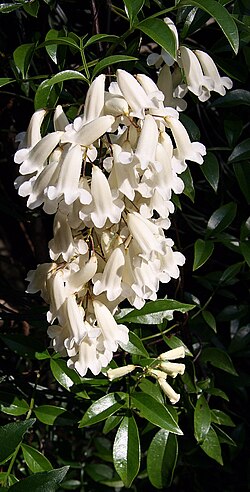
The genus consists of several species distributed across the Asia-Pacific region. Some, like Pandorea jasminoides (commonly known as the bower vine or bower of beauty), are well-known for their ornamental value in Queensland and New South Wales.
Another prominent species is Pandorea doratoxylon, found in New South Wales and Queensland.
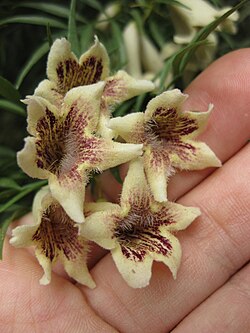
The Pandorea pandorana, or wonga wonga vine, is one of the most widely distributed species, appearing in regions ranging from the Lesser Sunda Islands and New Caledonia to various Australian states including Victoria and Tasmania.
The following table summarizes the accepted species within the genus:
| Scientific Name | Common Name | Primary Distribution |
|---|---|---|
| P. baileyana | Large-leaved wonga vine | Qld., N.S.W. |
| P. doratoxylon | — | Qld., N.S.W. |
| P. floribunda | — | Qld., N.S.W. |
| P. jasminoides | Bower vine / Bower of beauty | Qld., N.S.W. |
| P. linearis | — | Qld. |
| P. montana | — | New Guinea |
| P. nervosa | — | Qld. |
| P. pandorana | Wonga wonga vine | Australia, New Guinea, New Caledonia, Malesia, Vanuatu, Solomon Islands |
| P. stenantha | — | New Guinea |
Frequently Asked Questions
What is the primary growth habit of Pandorea plants?
Most Pandorea species are woody, evergreen climbers, although a few rare instances occur where they grow as shrubs.
Where are Pandorea plants native to?
They are native to Australia, New Guinea, New Caledonia, and Malesia.
What does the name "Pandorea" refer to?
The name refers to Pandora from Greek mythology. This was chosen because the original species was linked to an insect plague on Norfolk Island.
How are the seeds of the Pandorea genus dispersed?
The seeds are flat and winged, which allows them to be carried and dispersed by the wind from the parent plant's capsule fruit.
What are the characteristics of Pandorea leaves?
The leaves are imparipinnate (leaflets arranged on either side of a stem with one terminal leaflet), arranged in opposite pairs, and do not have tendrils.