Pacific Southwest Airlines: The Rise and Fall of California's Iconic Carrier
Pacific Southwest Airlines (PSA) was more than just a regional carrier; it was a cultural symbol of mid-century California. Known for its vibrant pink liveries, friendly service, and a bold approach to the intrastate market, PSA transformed from a small flight school offshoot into a dominant force in West Coast aviation before eventually merging into USAir.
Key Facts
- Founded: May 6, 1949, by Kenny Friedkin.
- Initial Route: San Diego to Oakland via Burbank.
- Starting Fare: $9.99 from Burbank to Oakland.
- Peak Fleet: Heavily reliant on the Boeing 727 series in the 1970s.
- Market Dominance: Once the leading carrier between the Bay Area and Los Angeles.
- Final Fate: Acquired by USAir in 1987 for $400 million.
The Early Years: From Flight School to Market Leader
PSA began as an extension of Friedkin Aeronautics, a San Diego flight school established by Kenny Friedkin to train returning World War II veterans. When the demand for GI training declined, Friedkin pivoted to commercial aviation. On May 6, 1949, he launched a weekly service from San Diego to Oakland via Burbank using a leased Douglas DC-3. In its earliest days, the airline operated with minimal overhead; reservations were famously taken in a refitted World War II surplus latrine.
The late 1940s saw a surge of intrastate carriers in California. While eight airlines launched within a 13-month window, only PSA and California Central Airlines (CCA) survived beyond a year. Although CCA initially operated larger fleets of Martin 2-0-2s, PSA's disciplined focus on the San Diego-to-Bay Area corridor allowed it to outlast its competitor.
Scaling the Operation
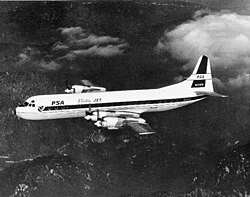
By 1958, PSA was competing directly with giants like United, Western, and TWA. While the major carriers focused on high-priced First Class seats, PSA targeted the coach market. The introduction of the 92-seat Lockheed Electra turboprop in 1959 marked a turning point, replacing the 70-seat DC-4s and allowing PSA to carry more passengers between Los Angeles and the Bay Area than any other airline by 1963.
Corporate Growth and the "Smiling" Era
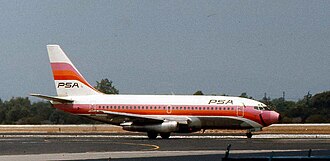
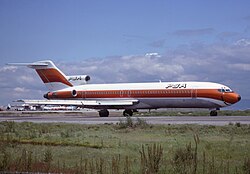
Following the death of founder Kenny Friedkin in 1962, J. Floyd Andrews took the helm. Under Andrews, PSA transitioned into a public company on February 14, 1963, and developed a high-profile brand identity. This era became legendary for its "smiling" aircraft liveries and flight attendants in hot pants, embodying the optimistic, flamboyant spirit of California in the late 1960s.
Financially, the company saw explosive growth. Operating revenue climbed from roughly $1.5 million in 1955 to over $24 million by 1965. This success was driven by a high-efficiency model characterized by rapid 20-minute aircraft turnarounds and no-frills service.
The CPUC Era and Strategic Missteps
For years, PSA operated with significant freedom, but in 1965, the California Public Utilities Commission (CPUC) gained new powers to regulate routes and service quality. While PSA initially welcomed the stability, the CPUC eventually became a restrictive bureaucracy.
One of PSA's most significant missed opportunities occurred in 1965 when it declined to serve the newly expanded Orange County Airport (now John Wayne Airport). Air California seized this opportunity, establishing a stronghold in one of the fastest-growing counties in the U.S. PSA later attempted to acquire Air California twice, but these efforts were blocked by the Department of Justice on antitrust grounds or derailed by financial scandals involving Air California's leadership.
Fleet Evolution
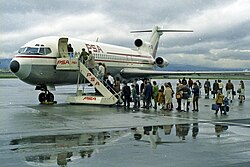
PSA's fleet was in constant flux. The airline introduced its first pure jets, the Boeing 727-100s, in 1965. By 1970, the fleet had shifted toward the larger 727-200s and Boeing 737-200s.
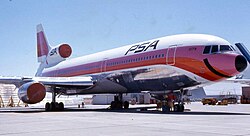
The airline also experimented with widebody aircraft, ordering Lockheed L-1011s in the early 1970s. However, the 300-seat aircraft proved ill-suited for PSA's quick-turnaround business model. The L-1011s were grounded after only eight months, leading to years of costly litigation with Lockheed.
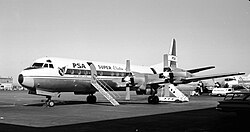
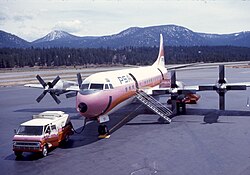
In 1975, PSA entered the South Lake Tahoe market after the collapse of Holiday Airlines, utilizing Lockheed Electras specifically for the Tahoe routes due to operational requirements.
Deregulation and Diversification
The Airline Deregulation Act of 1978 freed PSA from CPUC control, allowing it to fly outside California. However, the transition was difficult. While competitors like Southwest Airlines and Piedmont Airlines saw massive growth, PSA struggled. Management was criticized for "hanging fire," failing to modernize its fuel-inefficient 727 fleet quickly enough.
During this period, PSA also pursued an unusual diversification strategy, investing in radio stations, catamarans, and energy subsidiaries involved in oil and gas exploration. This diverted corporate attention away from the core airline business at a critical moment of industry upheaval.
The Texas Venture
In 1982, PSA attempted a low-risk expansion into Texas by partnering with the bankrupt Braniff International Airways. The deal involved Braniff flying 727s in PSA colors using Braniff's gates and takeoff/landing slots. However, this strategy failed to propel PSA to the same heights as its deregulated peers.
The Final Chapter: Merger and Tragedy
By the mid-1980s, the industry entered a wave of consolidations. In December 1987, USAir agreed to purchase PSA for $400 million. The merger was fraught with tension, particularly between the pilot unions of the two carriers.
The final days of the PSA brand were overshadowed by tragedy. On December 7, 1987, a former USAir employee used unrecovered credentials to smuggle a weapon on board PSA Flight 1771, shooting the crew and causing a fatal crash. The merger was finalized in May 1987, but the operational integration continued through the end of the year, marking the end of an era for California aviation.
| Year | Operating Revenue (USD) | Net Profit/Loss (USD) | Primary Aircraft |
|---|---|---|---|
| 1955 | 1.588 Million | 244,000 | DC-3 / DC-4 |
| 1962 | 14.205 Million | 1.369 Million | Lockheed Electra |
| 1965 | 24.015 Million | 2.035 Million | Boeing 727-100 |
| 1979 | 293.0 Million | 23.1 Million | Boeing 727-200 |
| 1986 | 694.1 Million | (3.1 Million) | Boeing 727 / BAe-146 |
Frequently Asked Questions
Why did PSA struggle after the 1978 deregulation?
PSA suffered from a lack of fleet modernization, relying on fuel-inefficient Boeing 727s while competitors adopted more efficient aircraft. Additionally, management diverted focus toward non-airline diversifications, such as radio stations and energy subsidiaries.
What was the significance of the CPUC in PSA's history?
The California Public Utilities Commission (CPUC) regulated intrastate fares and routes. While PSA initially supported this for market stability, the CPUC eventually became a restrictive bureaucracy that hindered PSA's ability to enter new markets, such as Orange County.
Why did PSA use the Lockheed L-1011 widebody aircraft?
PSA ordered the L-1011s to increase capacity, but the aircraft proved too large for their business model of quick turnarounds. The per-seat costs were not better than the Boeing 727, leading PSA to ground them after eight months.
How did PSA end its operations?
PSA was acquired by USAir in a $400 million deal announced in December 1986 and closed in May 1987. The airline was eventually merged into USAir's operations.
What was the "smiling" livery?
The "smiling" livery was a bright, pink-themed aircraft paint scheme that, along with the airline's friendly service and distinctive flight attendant uniforms, made PSA a cultural icon of California in the 1960s and 70s.