Ovenbird
The Ovenbird (Seiurus aurocapilla) is a distinctive small songbird belonging to the New World warbler family, Parulidae. Unlike many of its relatives that flit through the canopy, the ovenbird is primarily a ground-dweller. It holds a unique taxonomic position as the only species currently placed within the genus Seiurus.
This migratory species is well-known for its specific nesting habits and its presence across eastern North America during the breeding season, later migrating to Central America, the Caribbean, Florida, and northern Venezuela for the winter.
Key Facts
- Scientific Name: Seiurus aurocapilla
- Conservation Status: Least Concern (IUCN 3.1)
- Distinctive Feature: An orange crown stripe that can be raised into a small crest.
- Nesting Habit: Builds a domed, oven-like nest on the forest floor.
- Diet: Primarily terrestrial arthropods and snails.
- Range: Breeds in eastern North America; winters in Central America and the Caribbean.
Taxonomy and Classification
The ovenbird was first described in 1766 by Carl Linnaeus as Motacilla aurocapilla. The name is derived from the Latin aurum (gold) and capillus (crowned), referring to the bird's striking head markings. In 1827, English zoologist William Swainson introduced the genus Seiurus, a name derived from the Ancient Greek seiouros, meaning "wag-tail."
Modern genetic studies have revealed that the ovenbird is genetically distinct and occupies a basal position within the Parulidae family. While waterthrushes were previously included in the Seiurus genus, they have since been moved to the genus Parkesia due to a lack of close genetic relation.
There are three recognized subspecies:
- S. a. aurocapilla: Breeds in central and southeast Canada and the eastern USA; winters in northern South America.
- S. a. cinereus: Breeds in the central west USA; winters in Middle America.
- S. a. furvior: Breeds in Newfoundland; winters in the West Indies and eastern Middle America.
Physical Description
Ovenbirds are relatively large for wood warblers, often leading untrained observers to mistake them for thrushes. Adults typically measure between 11 and 16 cm in length with a wingspan of 19 to 26 cm. Their average weight is approximately 19 g, though this can fluctuate between 14 and 28.8 g, often increasing before migration.
Their plumage consists of olive-brown upperparts and white underparts with heavy black streaking. A defining characteristic is the line of orange feathers with olive-green tips running along the top of the head, bordered by blackish-brown. These orange feathers can be erected to form a small crest.
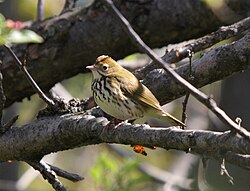
While males and females are similar in appearance, immature birds differ slightly. Their crown feathers have larger olive-green tips that often almost completely cover the orange stripe, and they possess tawny fringes on their tertiary remiges (wing feathers).
Distribution and Habitat
During the breeding season, ovenbirds inhabit mature deciduous and mixed forests across Canada and the eastern United States, preferring areas with minimal undergrowth for nesting but abundant shrubs for foraging. They are territorial year-round, living singly or as mated pairs.
Migration begins in late August, with birds arriving at wintering grounds between September and October. They return to their breeding grounds between late March and early May. While primarily found in the Americas, they are occasional vagrants in Europe and regular vagrants in California.
Wintering Altitudes
In winter, ovenbirds generally stay in lowlands, though they have been recorded at altitudes up to 1,500 meters (4,900 ft) above sea level in regions such as Costa Rica.
Behavior and Ecology
Feeding Habits
The ovenbird is a ground-forager, searching through dead leaves for terrestrial arthropods and snails. During the winter, they supplement their diet with fruit. Their foraging behavior is characterized by a distinct head-bobbing motion and a tendency to tilt or flick their tails.
Breeding and the "Oven" Nest
The species derives its name from its unique nest: a domed structure woven from vegetation and placed directly on the ground with a side entrance, resembling an old-fashioned oven. The female lays 4–5 brown or gray speckled eggs and handles all incubation for 11–14 days. Both parents feed the altricial (helpless at birth) young, who typically fledge between 8 and 11 days.
Because they nest on the ground, ovenbirds face significant predation from snakes, red squirrels, and chipmunks. To protect the nest, the female may perform a distraction display, mimicking an injured bird to lure predators away.
Vocalizations
The ovenbird's primary song is a loud, strident, bisyllabic motive repeated about eight times, increasing in volume (e.g., "chur-tee' chur-tee'... chur-TEE!"). Males also perform a complex, chattering song at twilight while diving through the air. Their standard call is a sharp, variably pitched "chik!"
Summary Table
| Feature | Details |
|---|---|
| Family | Parulidae (New World Warblers) |
| Average Length | 11–16 cm |
| Average Weight | 19 g |
| Primary Habitat | Mature deciduous/mixed forests |
| Nest Type | Domed ground nest ("oven") |
| Conservation Status | Least Concern |
Frequently Asked Questions
Why is it called an Ovenbird?
It is named after its nest, which is a domed structure built on the forest floor that resembles an oven.
Is the Ovenbird related to other ovenbirds?
No. Despite the name, it is a member of the New World warbler family (Parulidae) and is not related to the ovenbird family of birds.
What do Ovenbirds eat?
They primarily eat terrestrial arthropods and snails found in leaf litter, though they incorporate fruit into their diet during the winter months.
How do Ovenbirds protect their nests from predators?
Because their nests are on the ground, they are vulnerable to chipmunks and snakes. The female often uses a distraction display, pretending to be injured to lead predators away from the eggs or chicks.
Where does the Ovenbird migrate?
They breed in eastern North America and migrate to the southeastern United States, the Caribbean, Mexico, and northern South America (including Venezuela) for the winter.